
On 15 June 1974, an anti-fascist demonstration organised by Liberation converged on Red Lion Square in central London to counter a National Front meeting and march at Conway Hall.
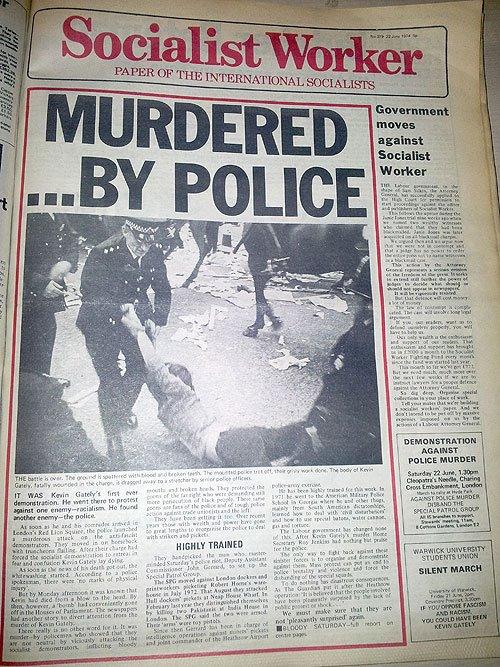
Clashes between anti-fascist demonstrators and police spilled out of the square into surrounding streets. University of Warwick student Kevin Gately, who had joined the Liberation demonstration, was hit and died from a head injury. Gately’s injuries were consistent with being hit with a blunt object, such as a truncheon.
Despite this, a public inquiry held immediately after the event blamed the disorder and – by extension – Gately’s death on the actions of left-wing protesters. This assessment was - and still is highly contested.
At least two Special Demonstration Squad undercover officers were deployed among the protesters: HN353 ‘Gary Roberts’ and HN301 ‘Bob Stubbs’.
Afterwards, the SDS claimed it had provided advance information about the demonstration’s size and the risk of disorder. In his Tranche 1 Interim Report to the Undercover Policing Inquiry, Chair Sir John Mitting accepted that SDS reporting probably contributed to police planning, but that this would have supplemented publicly available information. However, no contemporaneous reporting by SDS officers was recovered. In any case, the information received, whatever the source, and the police preparations did not prevent disorder.
The Red Lion Square protest is the first of many counter-fascist events that the Undercover Policing Inquiry chronicled.
The 1974-1975 public inquiry into that day's events concluded with the Scarman Report, published in 1975.
Archival research has revealed that Lord Scarman, the judge who chaired the public inquiry into the Red Lion Square clashes, had been privately briefed about undercover officers who had attended the protest.
The National Front and anti-fascist opposition
Far-right group the National Front (NF) was established in 1967. It opposed immigration and advocated the repatriation of non-white Commonwealth citizens. It stood candidates in elections and organised public meetings and street demonstrations and was associated with violent attacks on ethnic minorities - as well as members of left-wing organisations.
A wide range of anti-racist organisations and left-wing groups opposed the NF, mobilising protest marches and attempting to prevent the group from holding public meetings.
The NF organised its 15 June 1974 march under the slogan ‘Stop Immigration, Start Repatriation’. The NF leadership apparently had a close contact within Special Branch, with NF leader Martin Webster personally writing to Detective Sergeant Ian Bryan, who passed information about the proposed demonstration to Metropolitan Police’s public order section (A8). Liberation, formerly the Movement for Colonial Freedom, organised a counter-demonstration. A8 arranged a meeting with the counter-demonstration organisers after learning of planned protests through advertisements in left-wing publications.
Police preparations
A8’s operation order, issued on 13 June, anticipated approximately 1,500 Liberation supporters assembling on Victoria Embankment at 2.00pm and marching to Red Lion Square at 3.00pm. Around 1,000 NF supporters were expected to assemble in Tothill Street at 2.30pm and to begin their march at 2.45pm, handing in a petition at Downing Street on the way.
The order noted that both organisations had booked separate halls within Conway Hall and that attendance might exceed the rooms’ capacity. If overflow meetings were necessary, Liberation was to meet on the north side of Red Lion Square and the NF on the south side. Deputy Assistant Commissioner JH Gerrard commanded the operation.
Approximately 900 officers were allocated, including 25 mounted officers, 30 Criminal Investigation Department (CID) officers and four units of the Special Patrol Group (SPG). Most of these officers were held in reserve in or around the square.
Gerrard, the senior officer in charge of the demonstration, subsequently explained the decision to bring both marches into the same area:
the arrival in a limited area of two controlled marches [was] a far more efficient way of handling a situation than having a march being harassed along the route by the opposition.
However, it was this tactic of containment that at least contributed to the following disorder and indirectly led to Gately’s death.
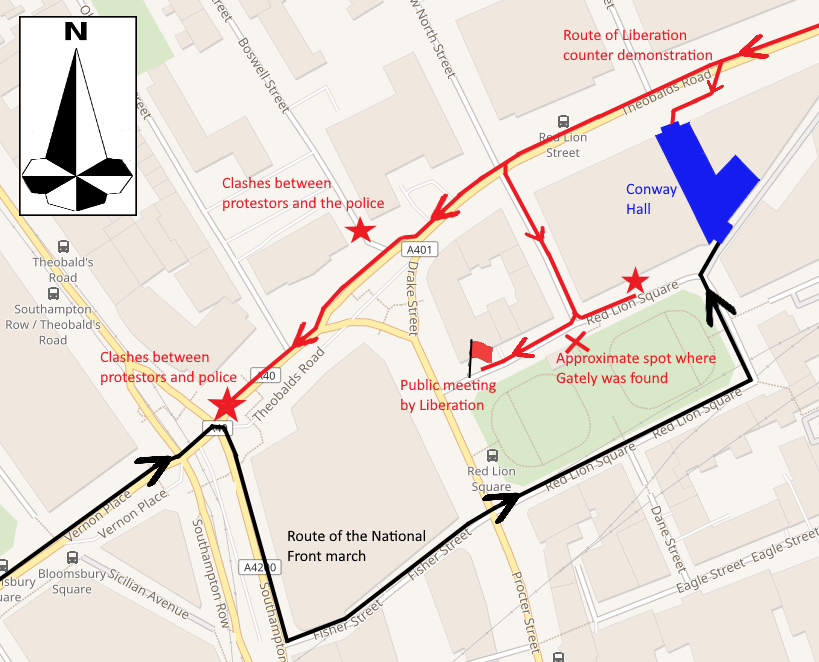

On Saturday 15 June, approximately 800 participants took part in the NF march and 1,500 in the Liberation demonstration. Members of the International Marxist Group (IMG) intended to establish a mass picket outside Conway Hall to obstruct the NF meeting. When the anti-fascist march reached the square, IMG supporters pushed against a police cordon, sparking clashes that involved both officers on horseback and the SPG.
Police decided to clear the square, a provocative move. Dispersing the protesters also disrupted Liberation’s march and drove the anti-fascist demonstrators towards the NF march, which police had stopped west of the square. Anti-fascists threw objects, including smoke bombs, towards the NF contingent.
Mounted officers and SPG officers then tried to clear demonstrators from the road. The NF eventually reached Conway Hall as disorder spread into neighbouring streets. Police reports documented 51 arrests, and 47 police officers injured; records do not show how many demonstrators were also injured.
John Cracknell , then a chief superintendent with A8, recalled commanding eight reserve serials on coaches in Bedford Square:
Eventually I gave orders for all of them to be debussed which was unusual; usually it would be done in dribs and drabs, but we needed all of them.
Cracknell remembered receiving an A8 briefing, containing information from Special Branch but could not recall its contents.
Kevin Gately’s death
Gately sustained his fatal head injury during the clashes outside Conway Hall. Two post-mortem examinations found that Gately had died from a cerebral haemorrhage following a head injury but could not determine whether the injury resulted from an object striking him or from falling onto the pavement.
Commander Roy Habershon of the Anti-Corruption unit (A10) led a police investigation. A coroner’s inquest subsequently returned a majority verdict of ‘misadventure’.
Photographs produced at the inquest showed two officers with drawn truncheons near the location of Gately’s death, despite no officer having had reported drawing their truncheon to their ‘serial’ inspector during the initial police investigation.
Despite this, Habershon’s report recommended no further action be taken against the officers. Instead, he controversially suggested Gately was at fault by:
tak[ing] part in a frenzied and violent attack upon a passive police cordon.
The Scarman Report
Home Secretary Roy Jenkins appointed Lord Justice Scarman to investigate the events at Red Lion Square and to identify lessons for policing demonstrations. Published in February 1975, Scarman’s report did not establish the specific cause of Gately’s fatal injury. Controversially, although it identified shortcomings in police reporting and crowd dispersal, it attributed the start of the disorder to the IMG ‘attack’ on the police cordon.
The report’s recommendations included better planning and training for police, considering escape routes before dispersing crowds, issuing warnings where practicable, and establishing an effective complaints procedure to build public confidence.
The 1974 SDS Annual Report
The SDS Annual Report for 1974 described Red Lion Square as ‘the most traumatic event of the year’. It attributed the confrontation to demonstrators urged on by the IMG (and Communist Party of England (Marxist-Leninist)) , and claimed:
Fortunately, the SDS gave forewarning of both the size of the demonstration and the possible disorder which might occur.
This claim seems at odds with the reality of the disorder and police violence which culminated in Gately’s death - and that it was recognised as such a major issue that a judicial inquiry was called. Despite this, the separate Special Branch Annual Report for 1974 also dubiously claimed that the SDS’ surveillance was ‘invaluable’.
The annual report also suggested that left-wing activists were desperate to find a cause to attach themselves to - and the rise of the National Front was therefore in some way welcome to them:
The most traumatic event of the year was the 'antifascist' demonstration on 15 June 1974, which culminated in the death of Kevin GATELY. Having lacked a sufficiently interesting, broad-fronted target for some time, the 'ultra-left' eventually decided to combat the re-emerging spectre of fascism, as exemplified by the National Front. The June demonstration provided the opportunity…
An alternative explanation would be that they were genuinely concerned about the threat of a revived National Front - which had won 113,843 votes in the recent General Election and an associated uptick in racist attacks.
Perhaps even more contentious was that the SDS seemed to think that the Kevin Gately killing acted as a disciplinary restraint on following anti-fascist demonstrations:
GATELY's death introduced a note of harsh reality; so that subsequent demonstrations, both in the Metropolitan Police District and at Leicester, did not achieve the aims of the militant minority.
SDS officers at Red Lion Square
There were no contemporaneous SDS intelligence reports located by the Inquiry. However, HN353 ‘Gary Roberts’ who infiltrated the IMG, recalled:
I remember in particular attending and reporting on a demonstration in which a demonstrator, Kevin Gately, died; this was in the press at the time, and there doesn’t appear to be any reports on that in my witness pack.
Roberts continued:
I didn’t however see anything which could’ve assisted into explaining the circumstances of his death, I was at the back of the crowd.
HN301 ‘Bob Stubbs’ also attended the demonstration as a member of the International Socialists. Indicative of the police tactics on the day, Stubbs recalled:
When I got punched at Red Lion Square I happened to be towards the front of the protest and so was unable to get out of the way [...]
Stubbs said the police assault was unprovoked but excused the attack, suggesting the uniformed officer who struck him was probably frightened.
SDS reporting after the demonstration
Although there was no reporting on the Red Lion Square demonstration itself, there was a report soon after dated 18 June 1974. In it, Roberts recorded International Socialists members criticising national executive member Chris Harman for failing to attend a Liberation planning meeting on 6 June or to mobilise IS members for the demonstration.
Special Branch also recorded resolutions passed by the Young Liberal’s at a conference in Birmingham on 22–23 June 1974. The report was made by HN298 ‘Michael Scott’. One resolution condemned police actions at Red Lion Square as:
the vicious and unnecessary attack on the left-wing demonstrators by the police.
The Young Liberals resolution alleged police bias in favour of the NF march and demanded an independent public inquiry into Gately’s death and police activities that day and called for the immediate disbandment of the SPG.
They also called for an independent inquiry and investigation into NF members wearing paramilitary uniforms.
Scarman briefed about the SDS
Archival research by the Undercover Research Group unearthed a confidential Home Office note by civil servant David Hilary, which discussed handling of sensitive information during the Scarman inquiry:
[How] plain clothes police officers get information about demonstrations and extremist organisations… it is essential should not be revealed.
The note stated that police files concerning Red Lion Square referred to those methods. Sir Arthur Peterson, another senior civil servant in the Home Office, instructed Hilary to raise this with Lord Scarman, and Hilary asked that the note be placed before Scarman.
Hilary also recorded a forthcoming discussion between the Metropolitan Police solicitor and the Deputy Treasury solicitor, after which he would explain the issue to Scarman in greater detail. The note did not name the SDS or specify which intelligence documents Scarman ultimately received.
Inquiry non-state participants have identified Scarman’s knowledge of the SDS as an early but missed opportunity to review whether the unit should continue.
Events at Red Lion Square later featured in an essay on how to police demonstrations, prepared by HN103 David Smith during a Bramshill inspectors’ course in 1979. The essay summarised lessons that included coming to a written agreement on routes, separating rival marches, planning access for crowd dispersal and warning protesters before clearance. It also discussed protective equipment and the use of Special Branch intelligence.
SDS reporting and public order policing
In his interim report, Mitting stated that no written report had survived to substantiate the annual report’s claim that the SDS supplied detailed advance warnings about the planned Red Lion Square protest’s size and risks. Despite this, Mitting accepted that SDS reports had probably contributed to the police assessment:
It is probable that reporting by SDS officers contributed to the assessment of left-wing numbers and the route of the march which they proposed to take. I have no reason to doubt that the statement in the annual report was accurate.
However, Mitting also identified other information available to police:
Uniformed police, however, had other readily available public information that trouble was afoot, as Lord Justice Scarman noted. SDS reporting merely supplemented it.
Following Scarman’s line, Mitting described Red Lion Square as significant because it was:
the first time that serious public disorder occurred as a result of Trotskyist attempts to obstruct NF, and later British National Party (BNP), activities – a recurring, if intermittent, theme of SDS reporting from then on.
Closing statements by Non-State participants forcefully criticised Mitting and the original Scarman Report for favouring the police narrative. Rajiv Menon KC stated:
At Red Lion Square in 1974, we say a mounted police officer was almost certainly responsible for the death of Kevin Gateley regardless of what Lord Scarman’s report may say about the matter.
Menon backed up his claim, citing evidence of police violence at the demonstration, which included use of batons.