
The ‘Battle of Southall’ principally occurred on Monday 23 April 1979, though it comprised several protests, spread over two days. The confrontations were a result of the openly racist, far-right National Front (NF) organising a pre-election meeting in Southall Town Hall in west London.
The local community, many of whom were migrants of South Asian and African-Caribbean descent, opposed the meeting, along with anti-racist groups and left-wing organisations. The Metropolitan Police facilitated the gathering of the NF, and in the subsequent violent clashes, mainly between residents and the police, a member of the Socialist Workers Party (SWP) and Anti-Nazi League (ANL), Blair Peach, was killed by Special Patrol Group (SPG) police officers.
At least two Special Demonstration Squad (SDS) undercovers reported on some of the organisations involved in the events at Southall. The undercovers were HN126 ‘Paul Gray’ and the unnamed HN41. The former had infiltrated the SWP and the Anti-Nazi League (ANL) in west London and though the details of the groups that HN41 had spied on have not been disclosed, the latter was present at the events in Southall.
At least seven SDS undercovers spied on the protests and the campaign for justice in the aftermath of the death of Blair Peach. These were HN126 ‘Paul Gray’, HN155 ‘Phil Cooper’, HN80 ‘Colin Clark’, HN106 ‘Barry Tompkins’, HN96 ‘Michael James’, HN356/HN124 ‘Bill Biggs’ and the unnamed HN21. The anonymised HN41, who had been present at the ‘Battle of Southall’, was called in for questioning over Peach’s death.
There are three connected articles on this topic:
Part 1: provides a history of the precursors and the events in Southall on 22 and 23 April 1979.
Part 2: analyses the spying by Special Branch and SDS undercovers on community organisations and political groups that were involved in the protests in Southall.
Part 3: considers the aftermath of the death of Blair Peach and the involvement of the SDS in reporting on the protests and the campaign for justice.
By the mid-1970s, the NF had achieved some electoral support over the issue of immigration, particularly the arrival of Asian refugees from African ex-colonies. The party linked their anti-migrant stance with economic and urban ‘crises’, blaming non-white residents for unemployment, poor living conditions, and rising crime.
The rise of the NF in the 1970s coincided with an increase in racist attacks on ethnic minorities, particularly those of south Asian descent. A series of racist murders in the capital, Gurdip Singh Chaggar (Southall, June 1976), Altab Ali (Whitechapel, May 1978), Kennith Singh (Newham, April 1978), and Ishaque Ali (Hackney, June 1978), shocked their respective communities and led to organised responses.
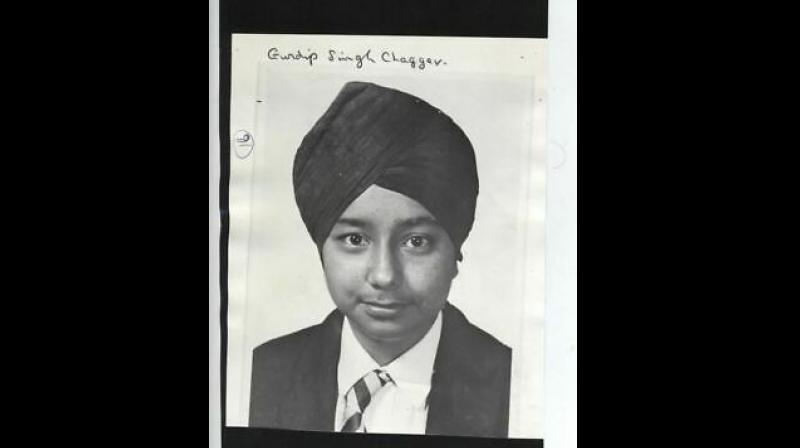
The case of Chaggar, an eighteen-year-old Sikh student who was stabbed to death outside the Dominion Cinema in Southall by a group of white youths, was a case in point. The murder led to a weekend of mass protest, which was exacerbated by the arrest of demonstrators and the refusal of local police to acknowledge the attack on Chaggar as racially motivated.
The outcome of the protests in June 1976 was the formation of the Southall Youth Movement (SYM) , an organisation of young South Asian and African-Caribbean people committed to self-defence and direct action against racism and racial violence.
From Lewisham to Southall
After the ‘Battle of Lewisham’ in August 1977, which saw violent confrontations between the National Front (NF) , the Metropolitan police who facilitated the march and anti-fascists who opposed it, the attitude of the Metropolitan Police Commissioner David McNee appeared to change. Despite calls from the multi-racial community of Lewisham, McNee had opposed banning the NF march and insisted that it traverse the town centre.
After the debacle in Lewisham, which involved injury to hundreds of police and civilians, in March 1978, McNee applied for and was granted a two-month ban on all public demonstrations (other than those of a religious, festive or ceremonial character) across the Metropolitan Police District. The ban had been prompted by the NF planning a march in support of their candidates in by-elections in Ilford and, latterly, in Lambeth.
A year later, on 28 March 1979, the Labour government lost a no-confidence vote in the House of Commons, and a general election was announced for 3 May. This provided a loophole for the NF to exploit, as the legislation covering bans on marches and demonstrations did not apply to public meetings organised under the 1949 Representation of the People Act.
Consequently, the NF leadership announced they would be requesting a series of contiguous pre-election public meetings in the capital in April, at Conway Hall in the west end (18 April), Battersea (19 April), Islington (20 April), culminating on the evening of Monday 23 April, St George’s Day, in Southall Town Hall. Southall was a particularly controversial location for an intervention by the NF, as the area had the largest south Asian population in the UK.
When it became clear that the Conservative-led Ealing Council had granted permission for the NF meeting in Southall Town Hall, there was an immediate and vociferous reaction from the local community. However, Ealing Council ignored demands that the decision be reversed, based on recent successful rejections by Brent Council and the Inner London Educational Authority of the 1949 Act.
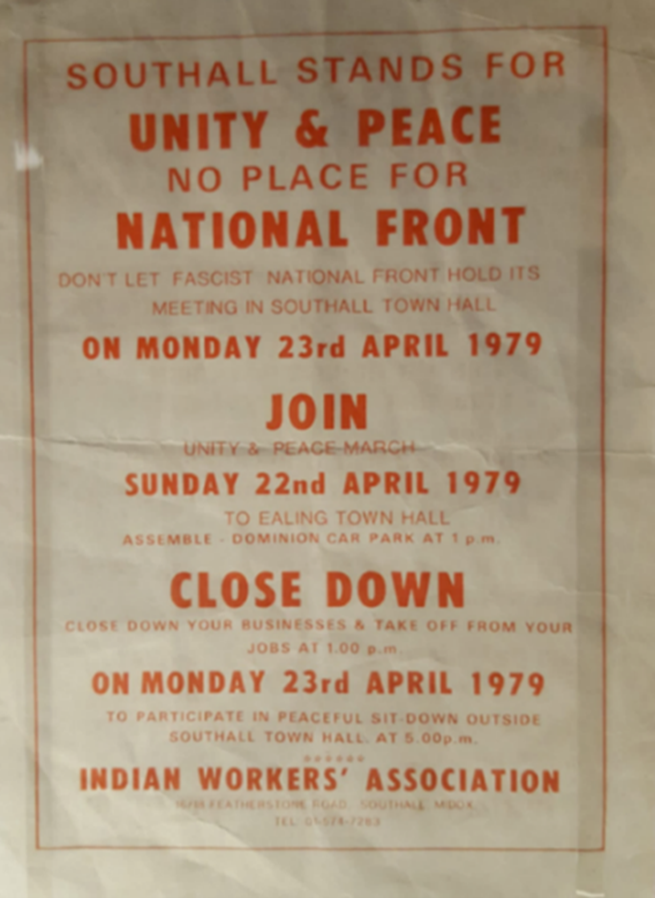
Consequently, on 11 April, the Indian Workers Association (IWA) hosted a meeting at their cultural centre, the Dominion Cinema in Southall, to determine what kind of protest should take place.
A mixture of groups attended, including Ealing Community Relations Council (ECRC), religious organisations of various faiths, local trade union branches and a delegate from the Anti-Nazi League (ANL). At the start of the meeting, the organisers asked two senior police officers present to leave.
The meeting agreed that there should be a ‘Unity and Peace’ protest march to take a petition to Ealing Town Hall, assembling at the cinema at 1.00pm on Sunday 22 April. The following day, from 1.00pm, businesses in Southall should close down and workers walk out to take part in a mass ‘sit down’ protest at 5.00pm outside the Town Hall, more than two hours before the NF meeting was planned to start.
On 17 April, the Metropolitan Police held a meeting at Southall Police Station. Representatives from a range of business, community, religious, and political organisations attended, including delegates from the IWA, SYM, and the ANL. A Special Branch officer was also present at this meeting.
The Chief Superintendent made it clear to those present that the NF meeting could not be stopped, that mass protest would lead to violence and that the main danger to public order came from ‘Indian youth’ who needed to be ‘disciplined’. The three senior officers then:
pleaded most strongly that all members should go back to their community, and endeavour to persuade them all to shut up shop, and spend the time in their houses and resume work the following day, leaving the National Front to hold their meeting and retire from the town without notice, and certainly without disturbance.
This was clearly unacceptable to many of the representatives present, who reiterated that there would be a sit-down protest on Monday afternoon. The Chief Superintendent did not forbid the protest but ominously ‘warned them of the consequences of what might happen if matters escalated’.
In the run-up to the planned protests, the IWA in Southall, along with the ECRC, formed the Coordinating Committee of Southall Organisations (CCSO) to coordinate the numerous community groups in the area. The IWA was also appealing for support to its branches across the country. Still, due to other NF pre-election meetings, particularly in the Midlands, it could only guarantee members coming from east London. Support was being offered to the IWA by some local Labour Parties, their Young Socialists and the West Middlesex District Communist Party.
Members of more radical anti-fascist and left-wing groups outside of Southall began to be aware of the NF meeting and the planned protests over the weekend prior to the events. On Friday 13 April, several weekly local newspapers in west London published accounts of the controversy with Ealing Council over the meeting in the Town Hall. The campaign in Southall was publicised by the Morning Star, and Socialist Worker, the paper of the SWP, carried an article stating that:
For the Nazis to appear in Southall is an act of blatant and criminal incitement. Our reaction needs to be overwhelming and decisive. The Nazis must not be allowed to get anywhere near Southall Town Hall.
The North West London district of the ANL encouraged its members to attend the demonstrations in Southall, as did the Socialist Unity Group, an election front for the International Marxist Group (IMG) led by Tariq Ali, who was standing as a Parliamentary candidate for Southall.
The IMG asked its members in London to attend. The difficulty for all the London-based anti-fascist organisations was that there were several NF meetings occurring in other boroughs over that week, so support for Southall was likely to be denuded by arrests and exhaustion.
Whilst the left was attempting to mobilise, the A8 division of the Metropolitan Police, tasked with organising the policing for mass protests, was planning a massive operation for both days of the protest. Despite the lack of an ‘opposition’ to the ‘Unity and Peace’ march on the Sunday, A8 aimed to commit 1,200 police officers and a police helicopter. For Monday, this was more than doubled to 2,876 officers, including a huge contingent of 96 mounted police, all six units of the SPG, and the use of the police helicopter once again. In order to marshal and provision these enormous forces, A8 requisitioned part of the 30-acre Ministry of Defence installation at Feltham, around five miles from Southall in Middlesex.
At this point, it should be noted that the (final) estimates for attendance made by Special Branch and planned for by A8 were 3-5,000 for the Sunday ‘Unity and Peace’ march and 1,000-1,200 for the Monday sit-down protest. Southall Town Hall had a capacity of only 150, so NF numbers were expected to be around 100.
The policing operation began on Friday, 19 April, with additional police patrols in Southall and a permanent deployment of officers through to Monday night at the Town Hall to prevent a possible occupation of the building.
These were the first signs of what some Southall residents later described as the actions of an ‘occupying force’ and the feeling that they had been reduced to the ‘status of living in a British Imperial Colony’.
The briefing given to police officers on Friday 19 April, concerning the policing tactics for the ‘Unity and Peace’ community march on the Sunday morning, makes interesting reading.
The commander of the operation, Deputy Assistant Commissioner (DAC) David Helm, emphasised the need for ‘firm’ action, drew reference to the policing of confrontations between the NF and anti-fascists in the capital over the previous few days and targeted left-wing groups as wanting to ‘ferment trouble’. Helm summed up the overall strategy as:
We must act firmly and actively from the start. It has only been firm policing which has prevented disorder at several recent public order events, and we want to ensure this trend continues.
One obvious issue with this statement is that, unlike the recent clashes between the NF and anti-fascist protesters, there was no formal opposition to the ‘Unity and Peace’ protest march and thus little chance of violence. This raises the question of why policing had to be ‘firm’ and proactive.
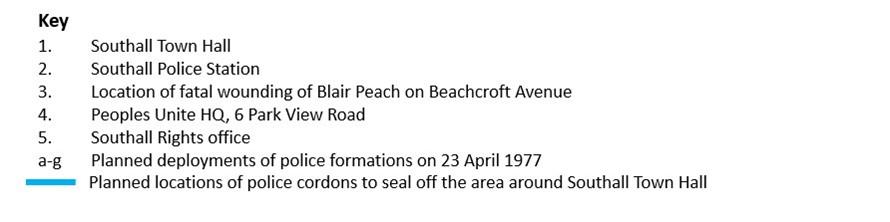
Around 1.00pm in the car park of the Dominion Cinema, crowds began to gather for a meeting before setting off. The four-mile march was planned to pass along South Road, past Southall Town Hall (Figure 1, Location 1) and then along Uxbridge Road, through Hanwell, before reaching Ealing Town Hall and terminating in nearby Haven’s Green.
![Figure 1: Southall – showing locations of planned police deployments around Southall Town Hall [Base map: OpenStreetMap]](/sites/default/files/styles/wide/public/2026-04/Southall%20Map.jpg?itok=B027AqoO)
The procession, at least 2,000-4,000 strong, was mostly men, women, and children from the Southall community, along with trade union branches, anti-fascists, and other left-wing parties. The plan was to deliver a 10,000-signature petition to Ealing Town Hall, asking Ealing Borough Council to cancel the meeting of the NF.
From the very start, the ‘Unity and Peace’ march was surrounded by hundreds of police officers on foot and led by 24 mounted officers. Other massed groups of 50-100 police officers were deployed along the route at various locations, including outside the Dominion cinema, Southall Town Hall, and Ealing Town Hall, as well as at major road intersections. Although clearly a peaceful protest, in the intimidating atmosphere, there were confrontations between police and young people.
For example, as the march passed Southall Police Station, two African-Caribbean youths, one of whom was a SYM steward, were arrested for obstruction and dragged straight into the building. The marchers immediately carried out a sit-down protest, demanding the release of the two youths before they would continue. After the two were granted bail, the march resumed. Similar sit-down protests occurred along the route as other marchers were selectively detained.
In all, 24 people were arrested, many by the use of police ‘snatch squads’. The local legal advice group Southall Rights commented that:
In our view, the heavy-handed policing of the Sunday march contributed to a raising of tensions amongst the marchers, most if not all of whom would be present on Monday [23 April].
In his report in the aftermath, DAC Helm claimed that it had been a very ‘unruly march’ and that this was down to a ‘large number of young Asians who were very difficult’. Helm also stated that the prospective parliamentary candidate, Tariq Ali, was ‘one of the prime movers of the disorder and civil disobedience’. Helm claimed in a later report that there had been ‘considerable disorder’, and switched his emphasis from Ali to lay the blame for this squarely on the SYM.
Even though the NF meeting was scheduled for 7:30 pm that evening, a significant police presence was already in place in several locations in Southall from 10:00am on Monday. These included High Street, Broadway and residential streets to the north and south, outside Sikh temples, the IWA-run Dominion Cinema and within the Town Hall. The feeling of ‘occupation’ rather than protection was palpable, and this was enhanced by shop owners boarding their premises close to the Town Hall.
The SYM had been preparing for days, purposefully keeping their plans to stop the NF meeting from leaking to ‘connected youth groups and networks’ until the Sunday, to avoid ‘police interventions or arrest of key activists’. They set up their headquarters at the Southall Rights legal advice centre on the High Street (Figure 1, Location 5). SYM activists also secretly located a video camera and a small filming group above a clothes shop opposite the Town Hall. This acted as a vantage point to view any attempt by the police to bring NF supporters in during the day.
The SYM initiated their protest at 11.30am when a vanguard of 30 or so members left their office on Featherstone Road to walk the mile to the Town Hall to set up a vigil. This was to pre-empt any attempt by the police to smuggle NF supporters into the area. However, the A8 division of the Metropolitan Police were already aware of their plans to go to the Town Hall, having already received intelligence from Special Branch. The group were intercepted by a police van near Southall Railway bridge, leading to the first arrests of the day.
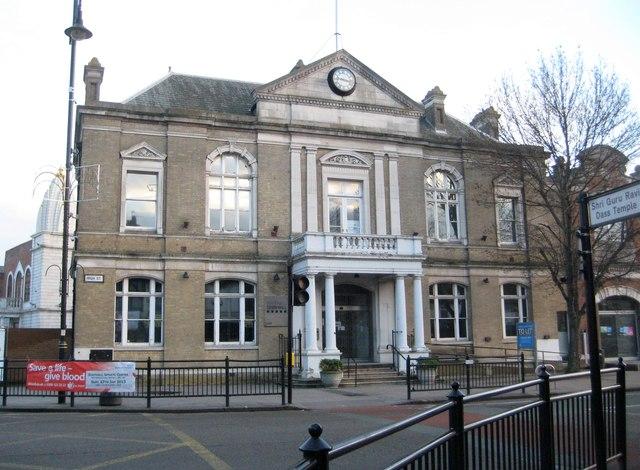
The group were not deterred, and by midday they had reached the Town Hall, now over 100 strong, as young people joined them along the route. The crowd were harassed by several police units, moved on by force, and arrests were made if they refused or reacted. Over the following two hours, the group grew to 200, and then 300, as more SYM members and onlookers combined. Some students from a local school left their lessons and joined the moving protest in the streets around the Town Hall.
Backed by the Southall Chamber of Commerce, around 1.00pm the IWA-inspired ‘close down’ began. Shops and businesses shut, workers left their jobs, and major factories in the area, such as Ford’s truck plant at Langley, Sunblest bakery, Wall’s and Quaker Oats, fell silent. In many cases, workers ignored the police advice to return to their homes and stay there. Instead, groups headed to the centre of Southall to prepare for the sit-down protest at the Town Hall that was advertised for 5.00pm.
Attempts by the police to forcibly disperse the crowd at the Town Hall were failing. Around 1.30pm, the SYM banner was seized by police and ‘snatch squads’ were deployed to arrest leading SYM activists. However, each time police broke the crowd of protesters up and forced them back, they reappeared in greater numbers, attracting support from those on the streets. By 3.00pm the crowd on the Broadway was several hundred strong.
At this point A8 deployed large contingents of police, driving the protesters westwards and closing the Broadway down with a cordon. A bus trapped in the traffic was boarded by a contingent of protesters and this was stormed by truncheon-wielding police:
To flee the ferocity of the police violence and to avoid arrests, people inside the bus panicked and some youth tried to kick and smash the bus windows to escape whilst others jumped out of the top floor of the bus through broken windows.
In response, some of the crowd damaged a police car or threw missiles. Police deployed riot shields and once again attempted to violently disperse the crowd on Broadway.
Around 4.00pm, A8 changed their tactics and made the decision to completely seal off the whole area around the Town Hall to ensure the NF would have access to their meeting. Police officers, supported by dog units, mounted officers and shield units, placed cordons across the High Street, South Road, the Broadway, and Lady Margaret Road.
The SYM-inspired crowd, along with people who were planning to participate in the ‘sit-down’ protest or merely support it, as well as those trying to get home from work, began to gather at all four cordons. Police estimated that these crowds were at least 2-3,000 strong; others have stated that ‘thousands’ more were present.
Frustration and anger grew amongst the crowds of protesters and onlookers as it became clear that the centre of ‘their town’ had been occupied by huge numbers of police to allow racist ‘outsiders’ entry to ‘their Town Hall’. They had been excluded and weren’t even being allowed to carry out the ‘Ghandian style’ peaceful protest that had been agreed by the IWA and other groups in meetings with the police.
A large crowd gathered at the cordon at Southall railway bridge (Figure 1, Location f), many of whom had arrived from work and were prevented from returning to their homes. They staged a ‘sit-down’ protest in response which was forcibly broken up by police, who made numerous arrests. . Over the next couple of hours, attempts to breach the cordons by the crowds were brutally rebuffed, which led to missiles being thrown and further attempts by the police to disperse the crowds.
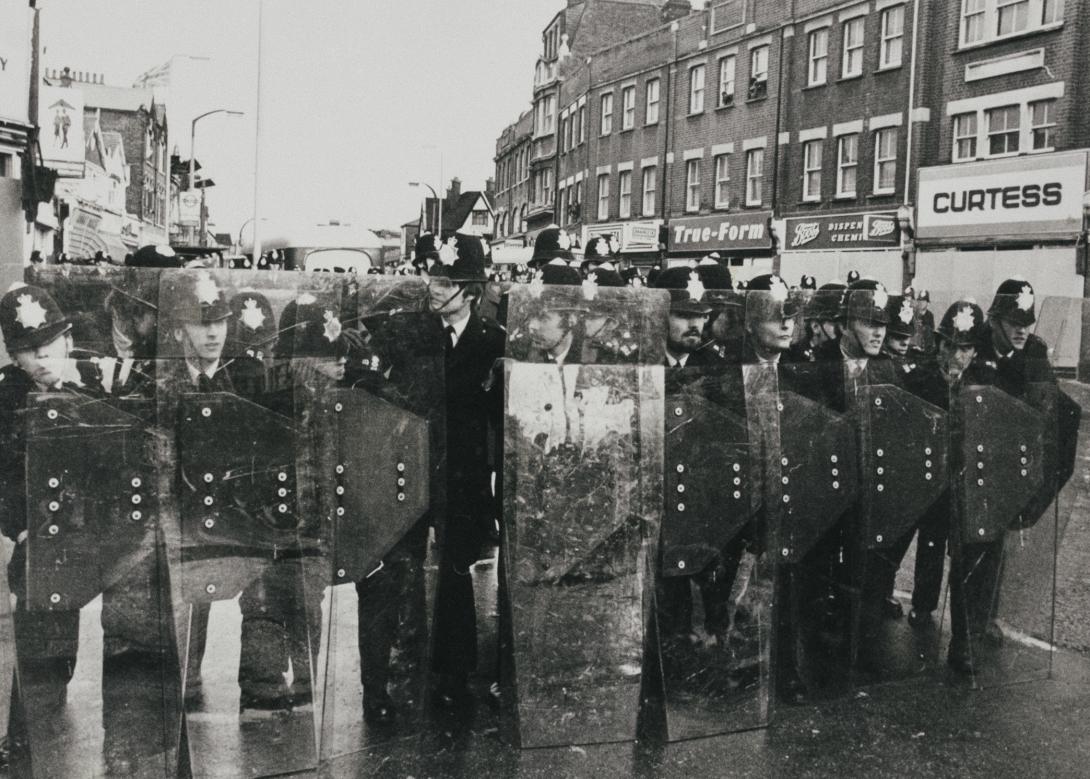
Because of the ‘breaches of the peace, the injuries and damage’, A8 now deployed another part of its plan, the use of ‘double cordons’ (see Figure 1, Locations a-h). This involved setting a second police line behind the crowds of demonstrators, effectively trapping them between cordons in a section of each street. This crude ‘kettling’ was achieved on three sides, to the west on the Broadway, to the east on High Street and on South Road.
At 5.15pm, a brief sit-down protest was allowed by police in one of the ‘kettles’, and it was then forcibly dispersed by the same police who arrested anybody who resisted. From this point on, the violence intensified, with police units described as going ‘berserk’ and there being ‘a considerable loss of [police] discipline’ within the kettles. Police vehicles were driven at speed into crowds, demonstrators were hit with riot shields and batons, and police horses charged with impunity.
Central to this ‘police riot’ were the actions of the SPG, who, as mobile reserve units, were only released later in the afternoon. An eyewitness stated:
They [the SPG] formed square shaped units, with each side of their square and top totally enveloped and protected by their shields, moved towards protesters, indiscriminately hitting and dragging protestors into their ‘protective envelopes’ to make arrests and beat them.
On High Street, to the east of the Town Hall, a crowd of 3,000 was violently dispersed by mounted officers using their long truncheons and police shield units. As the protestors retreated towards the junction with Park View Road, some chose sanctuary in Southall Park, others in the People’s Unite HQ, which was being used as an ad hoc first aid post (Figure 1, Location 4). This was a music cooperative based in a squatted building, which was described by police as being run by ‘Rastafarians … [who] intended to cause a disturbance’.
Police units stormed the building, fighting their way from room to room. Those sheltering inside the house were ‘forced out through a gauntlet of police wielding truncheons, and then everything in the building was smashed, including PA equipment worth thousands of pounds.
Over 80 people were arrested either inside or outside the premises, many of whom were hurt, some seriously. These included doctors, nurses and solicitors. A young Black musician, Clarence Baker, manager of the reggae band Misty in Roots was beaten into a coma and then detained by police despite his injuries. According to police sources 12 officers were injured in the assault on the squatted cooperative, and they later claimed that either one or two had been stabbed.
Whilst the violence unfolded to the east of the Town Hall, units of the SPG were in action to the west. At 6.30-7.00pm the crowd on the Broadway was estimated to be 1,500 strong and there was ‘continuous chanting of anti-Nazi and anti-police slogans’, along with the sporadic throwing of missiles. A police bus travelling eastwards along the Broadway at speed drove through the crowd forcing residents to take evasive action. This was followed soon after by a van carrying an SPG unit driving aggressively at the crowd.
Around 7.30-8.00pm, after reports that some shop windows were broken, mounted police, shield and mobile SPG units were sent in to violently disperse the crowd on the Broadway. During this action, six SPG officers chased a group of protesters up Beachcroft Avenue who were trying to escape the police charges on Broadway (Figure 1, Location 3). Among their number was Blair Peach, a 33-year-old school teacher, anti-racist campaigner and member of the SWP. Peach was struck a fatal blow on the head by a weapon wielded by one of the SPG officers and died a few hours later.
The police had arranged with the NF leadership for their members attending the meeting in the Town Hall to gather at Ealing Broadway underground station, about five miles from Southall. Around 130 NF members arrived at 6.00pm, 60 of whom, including the NF leadership group and the prospective candidate, travelled in a convoy of private vehicles to Southall. The convoy was brought into the north of the Town Hall, along the largely residential Lady Margaret Road, by a police escort.
As the NF leadership and their entourage arrived at Southall Town Hall around 7.00pm, they were greeted by the ‘sterile area’ created by the police cordons, devoid of any residents apart from a group of Asian youth who were blasting anti-NF and anti-police slogans interspersed by music from a PA set up on a balcony opposite the Town Hall entrance. This, along with the sounds of intermittent violent clashes at the police cordons, continued throughout the meeting in the Town Hall.
The remaining 70 or so of the NF contingent at Ealing Broadway decided to march as a group to Southall along the Uxbridge Road. However, they were stopped a mile short of their destination by police who were aware that a pitched battle was going on Southall High Street. After about half an hour, most of the NF supporters realised they were unlikely to be able to get to the Town Hall and so drifted away.
By the time the NF meeting was over at 10.00pm around 800 people had been arrested, of whom 342 were eventually charged. The cells of police stations across west London were full of protestors; some were merely dumped far away from Southall and told to make their way home. The vast majority of the arrestees were residents of Southall, which contradicted the media, politicians and police who were foregrounding the influence of ‘outside agitators’, notably the SWP and ANL, as being the reason for the violence. Some newspapers even claimed that these groups were responsible for the death of Blair Peach.
Of the 120 police officers injured, 21 required hospital treatment and three were detained overnight. Police sources stated that 83 of those arrested had been injured, and 10 other civilians, with one fatality (Peach). The latter figure is a massive underestimate; injuries to the public are rarely recorded accurately. It was estimated by Southall Rights that hundreds of residents of Southall were injured by police, including some who sustained very serious blows to the head from police truncheons.
Along with the death of Peach, those seriously injured included Clarence Baker, who was in a coma and hospitalised for five months and the NF organiser for Wandsworth, Richard de Jong Wangere. The latter suffered a broken leg and other injuries after a fight between Asian youth and skinheads on a stationary train at Southall railway station.
Read the second part of this trilogy of articles here: The Battle of Southall (part two): Surveillance.