
A8 Branch, or the Public Order and Operations Branch, was the Metropolitan Police’s central unit for crowd control from 1968 until 1993.
It received intelligence from the Special Demonstration Squad (SDS) and was one of its main intelligence customers. A8’s role was to centralise the policing of public demonstrations and large-scale gatherings.
Police witnesses gave evidence on the functioning of A8 and on its interactions with the SDS and, more broadly, Special Branch.
However, the evidence given by senior officers who worked for A8 at the Inquiry provides limited insight into whether SDS intelligence was utilised, as officers who received Special Branch assessments were not apprised of the original source of the information.
Several major historical and public order events involved both A8 public order policing and SDS infiltration among the organising left-wing groups and political parties. These include the Grunwick Strike (1976-78) , The Battles of Lewisham (1977) and Southall (1979). These are dealt with in detail within their respective analyses; this article outlines the history and functions of A8, as well as its interaction with Special Branch.
Public order policing has been subject to substantial criticism due to its repressive and violent nature. This article does not integrate these critiques but is simply an outline of A8's history and functions.
Thai article owes a debt of gratitude to Jac St John’s ‘ The Metropolitan Police and the politics of public order:1968-1981’.
The unit was formed as part of the Metropolitan Police’s reorganisation following a report by PA Management Consultants in 1968 - the same year as the SDS was founded. A8 absorbed public order responsibilities previously handled by smaller units, such as the A2 branch. It introduced systematic planning, intelligence coordination, and a centralised command structure based at New Scotland Yard.
A8 also developed the ‘serial’ deployment system. Each serial included one inspector, three sergeants, 20 constables and a radio operator. This system also standardised operational control and communications.
As well as the reorganisation of public order functions recommended by the management consultants, the changes in tactics were also further catalysed by the anti-Vietnam War demonstration in March 1968. These changes occurred at the same time and for the same reason as the Special Demonstration Squad’s founding.
At the same time, the idea of forming the SDS was being developed by Special Branch and the Home Office, A8 were systemising police crowd control tactics in preparation for the 27th October demonstration. A series of one-day training courses was held at Hendon Police College.
Changes in tactics included:
…Serials organising together to establish a ‘double cordon’ to resist crowd pressure, while a ‘wedge’ formation could be used to disperse crowds and clear a path through a mass of protesters.
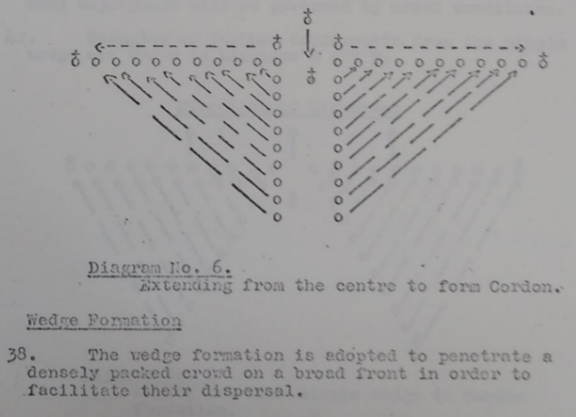
The use of the more mobile Special Patrol Group was deemed a success at the March 1968 demonstration) was also part of the plan.
John Cracknell , who worked in A8 during the 60s and 70s described A8 and its work:
At this time [late 1960s], there were 24 divisions in the Metropolitan Police District, each of which was looking after local policing. When events got too big, help was required — hence the need for A8. There was then no other mechanism available to gather sufficient policemen to police these large demonstrations. When I first joined A8, I think there were eight to 10 people in it. It comprised a Chief Superintendent who was in charge of the department, a Superintendent, an Inspector who was the office manager, a Sergeant, and about six Constables who would type up the operation orders. A8 was always around this size.
By the early 1970s, A8 had become a hub for intelligence exchange between Special Branch, the Criminal Intelligence Division, and provincial police forces. Coordination between A8 and Special Branch, especially during major demonstrations such as those against the Vietnam War in 1968, was praised, leading to the introduction of joint training for regional forces.
The unit later oversaw the introduction of CCTV along main routes by 1971 and used the Metropolitan Police helicopter for monitoring crowds. It also trialled the use of new protective equipment such as riot helmets and shields, which later became standard nationally.
Organisationally, A8 sat within A Department, alongside the Mounted Branch (A5), the Community Relations Branch (A7), the Special Patrol Group (A8(2)/ A9), and the Complaints Investigations Branch (A10).
Public order and operational planning functions previously located within A8 were later reorganised under Central Operations, where they formed part of the responsibilities of CO11 (Public Order Operational Command Unit). After further organisational restructuring within the Metropolitan Police in 2018-2019, A8’s responsibilities transferred to Public Order Planning (M06).
Four witnesses provided evidence regarding A8’s functions and its interactions with the SDS and, more broadly and directly, with Special Branch. John Cracknell , HN1742 Anthony Speed , and HN691 Charles Pollard were all senior Metropolitan Police officers who served within A8. Also giving evidence was the former SDS officer HN3093, Roy Creamer, who later served as the liaison officer between Special Branch and A8.
Special Branch compiled assessments estimating attendance, identifying organisers, and predicting the likelihood of disorder at demonstrations, and circulated these to both A8 and the Home Office.
Like Speed and Cracknell, Pollard only learned of the SDS decades after the unit closed. He stated that he ‘did not even know it existed’ and had assumed that Special Branch used informants to gather intelligence.
Anthony Speed’s testimony gives the fullest operational account of A8’s dependence on Special Branch. Having been both a clerk sergeant (1970-1972) and later a chief inspector, he described A8 as having ‘no means of gathering intelligence itself’. A8 was ‘entirely reliant on Special Branch for assessments’. Information flowed one way:
A8 only received information from Special Branch. We were a customer; A8 did not provide information to Special Branch.
Speed explained that Special Branch reports – known internally as assessments – were requested before any major event and were ‘imperative’ to operational planning. A8 could not allocate the correct level and mode of police resources until it knew where the demonstration would take place, how many people would attend, the expected level of violence, and whether there would be any opposition.
Assessments were typically one or two pages, signed by a chief superintendent. They were occasionally attached to local intelligence, such as posters seized by uniformed police.
Speed also recalled that Special Branch’s information was ‘right enough of the time for us to rely on them’, although it occasionally overstated the case. Nevertheless, Speed emphasised, there was never tension between the branches: ‘We relied on them to do their job… they were independent in a sense, although we all worked for the Commissioner.’
Referring specifically to the SDS, Speed stated:
A8 did not obtain intelligence from the SDS and he had ‘no detailed knowledge’ of how Special Branch acquired its material, beyond the recurring phrase ‘a delicate and reliable source’.
John Cracknell, who served as chief inspector and later chief superintendent of A8 from 1969 to 1973, corroborated this. He described a weekly rhythm in which Special Branch reports ‘start coming in… from Tuesday’, allowing A8 to finalise operation orders by Friday.
These Special Branch assessments came from ‘a delicate source, whatever that was’. Cracknell suspected they were based partly on telephone intercepts, but said Special Branch never disclosed its methods. The early reports were often vague – ‘the organisers themselves did not know how many people would turn up’ – but became more specific close to the event.
Charles Pollard’s account, from slightly later in the 1970s, shows that A8 routinely sought a Special Branch assessment for virtually every demonstration, except very small ones. He recalled a ‘close working relationship’ and a ‘Special Branch Liaison Officer’ within A8.
Assessments typically arrived within a week of request and were marked ‘secret’, identifying their provenance as ‘a secret and reliable source’. Pollard treated these reports pragmatically: ‘All I was interested in was the bit… about the potential impact on public order’.
Pollard confirmed that A8 accepted Special Branch’s material ‘at face value’, seldom questioning its reliability:
Special Branch worked hard not to exaggerate what the risks would be… The information we received was reasonably accurate and as accurate as you would expect in the circumstances.
These senior uniformed officers could only speak to the efficacy – or otherwise – of Special Branch in general. However, Special Branch’s HN3093 Roy Creamer, as a former SDS and A8 liaison officer, could give more informed insight.
Creamer said that C Squad officers produced weekly assessments and detailed post-demonstration reports for the Home Office and A8. These included descriptions of attendance, banners, and speeches:
A8 used these reports to ‘confirm or reassure them that they were on the right lines’.
Sometimes Special Branch officers felt that A8 ‘did not properly value or use the intelligence provided’. An example of this would have been at the Battle of Lewisham.
Creamer further emphasised that the SDS’s intelligence was rarely helpful for operational policing:
It was called the Special Demonstration Squad, but it didn’t do what you would expect… I thought we could manage without; go back to the old-fashioned methods and be all right.
Asked how useful SDS intelligence was to A8, Creamer admitted:
In my time, probably not much… I didn’t think what they had to offer the ordinary squad officer doing an assessment could have been a lot better.
Creamer’s assessment of the very modest contribution that the SDS made to public order policing was shared by the Inquiry Chair, Sir John Mitting, who concluded that although SDS intelligence occasionally helped with tactical deployment, such as during the Battle of Lewisham in 1977, it mostly confirmed what police already knew.
Mitting added that SDS reporting sometimes enabled the Metropolitan Police to avoid unnecessary large‑scale deployments when no disorder was expected. However, at many major public-order incidents, such as in Southall in 1979, Mitting said that SDS contributions were minimal at both the strategic and tactical levels. Many ‘successfully policed’ events relied on other intelligence sources rather than the SDS, he noted.
Mitting concluded that this limited contribution certainly did not justify the intrusive methods used by the SDS.