
The ‘Battle of Southall’ principally occurred on Monday 23 April 1979, though it comprised several protests, spread over two days. The confrontations were a result of the openly racist, far-right National Front (NF) organising a pre-election meeting in Southall Town Hall in west London.
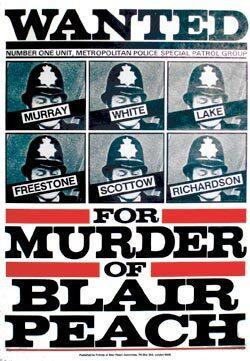
The local community, many of whom were migrants of South Asian and African-Caribbean descent, opposed the meeting, along with anti-racist groups and left-wing organisations. The Metropolitan Police facilitated the gathering of the NF, and in the subsequent violent clashes, mainly between residents and the police, a member of the Socialist Workers Party (SWP) and Anti-Nazi League (ANL), Blair Peach, was killed by Special Patrol Group (SPG) police officers.
At least two Special Demonstration Squad (SDS) undercovers reported on some of the organisations involved in the events at Southall. The undercovers were HN126 ‘Paul Gray’ and the unnamed HN41. The former had infiltrated the SWP and the Anti-Nazi League (ANL) in west London and though the details of the groups that HN41 had spied on have not been disclosed, the latter was present at the events in Southall.
There are three connected articles on this topic:
Part 1: provides a history of the precursors and the events in Southall on 22 and 23 April 1979.
Part 2: This part analyses the spying by Special Branch and SDS undercover officers on community organisations and political groups involved in the protests in Southall.
Part 3: considers the aftermath of the death of Blair Peach and the involvement of the SDS in reporting on the protests and the campaign for justice.
The ‘Battle of Southall’ on 23 April 1979 was clearly the most important public order event of that year on the British mainland. Not only was the deployment of police resources to a political protest the largest for a single day in 1979, but the number of arrests (over 700) and the violence unleashed by the police was unmatched outside of Northern Ireland.
The death of Blair Peach at the hands of the Special Patrol Group (SPG) , although not unprecedented (for example, see the death of Kevin Gately at an anti-fascist demonstration in Red Lion Square in 1974), to an extent masked the fact that several protesters could have died that day as a consequence of the ‘police riot’.
Unsurprisingly, in the Special Branch annual report for 1979, the events in Southall appear as the first and most important item in the summary section entitled ‘Public Disorder’. They are preceded by the statement ‘the potential for public disorder in connection with the ethnic minorities’.
An account of the IWA-led march on Sunday 22 April, also appears in the monthly summaries of the Annual Report. However, what is surprising is that details of the far more significant events of the following day, Monday 23 April, including the death of Blair Peach, are completely absent from the report.
Similarly, in the redacted SDS annual report for 1979, apart from the general statement:
Information supplied by SDS staff was of great value in enabling uniformed officers to deal effectively with the public order problems which arose both during the period before the election and on subsequent demonstrations held in connection with the death of PEACH.
There is no mention of what actually happened in Southall or the part played by the SDS undercovers before or during the events. Other lesser events, such as the anti-fascist protests in Leicester in April and the role of SDS intelligence gathering are, however, noted.
What is emphasised is that the death of Peach was a ‘consequence of the anti-fascist protest’ and ‘provided the extreme left wing with an opportunity to mount a sustained campaign to discredit and criticise the Police’.
The notable reluctance to discuss the details of the events in Southall by Special Branch and the SDS may have been a consequence of distancing the two organisations from what turned out to have been a major policing disaster, despite the supposed ‘success’ of facilitating the NF meeting in Southall Town Hall.
Additionally, at the time these annual reports were written, an investigation by Commander John Cass of the Metropolitan Police's Complaints Investigation Bureau (CIB) was underway, which began almost immediately after Peach’s death and concluded in February 1980. The evidence of SDS undercovers who had been at Southall, particularly those who had infiltrated the SWP, Peach’s organisation, may have been vital to such an inquiry.
Despite these glaring omissions concerning Southall in the annual reports of the Special Branch and SDS, Metropolitan Police Assistant Commissioner, Gilbert Kelland wrote to the Home Office in March 1980 stating:
The focal point of much of the extremist activity in 1979 was the General Election held in May, with the extreme Left contriving to take advantage of the National Front's election campaign to provoke hostile confrontation whenever possible. The culmination of the virulent anti-fascist demonstrations was the death of the Anti-Nazi League supporter Blair PEACH and the subsequent campaign against Police. During this period the Special Demonstration Squad was able to provide useful information which was invaluable in enabling uniformed officers to be effectively deployed.
This statement is useful, as it is a summary of the institutional mindset amongst the Metropolitan Police leadership in 1979. That is, the ‘extreme Left’ were the problem, not the openly racist and violent NF marching and meeting in multi-racial areas. The ‘extreme left’ were essentially responsible for Peach’s death, and they were using his death to campaign against the police. Kelland’s final statement warrants investigation regarding Southall.
Even though the Socialist Workers Party (SWP) was the most spied upon group by the SDS, and some of their members were involved in the protests in Southall, the documented engagement of undercovers in the events leading up to and particularly on Monday, 23 April, in Southall is relatively thin.
The SDS undercover HN126 ‘Paul Gray’ had initially infiltrated the SWP in North West London and by the end of 1978 was an organiser in the Kilburn branch and often chaired their meetings. He joined the West Hampstead branch of the SWP's sister organisation, the Anti-Nazi League , and in October 1978, was elected as a delegate to the Camden Against Racism committee. Gray also reported on decisions of the North West London District Committee (NWLDC) of the SWP, becoming district organiser for the party in January 1979.
On 19 April 1979, Gray reported to his SDS superiors the decision of the NWLDC to encourage participation of SWP and ANL members in the counter-demonstration against the NF at Southall Town Hall on Monday 23 April.
Although Gray stated that he did not attend the protests in Southall, another unidentified SDS undercover HN41 did attend and provided an interesting retrospective account of the events.
HN41 stated to the Inquiry in 2022 that there had been an intransigent and inflexible response by DAC Helm and A8, as the events on the Monday in Southall unfolded. HN41 also severely criticised the decision by Helm in the late afternoon to seal off the area around the Town Hall:
It upset many local people who couldn't move to work or come back from work or go out and do shopping. It antagonised the [Redact] and I don't know what it achieved rather than demanding more police officers spread out further.
HN41’s opinion was that this is why the ‘police lost control of events at Southall…there was too much going on spread out over a wide area’. This dispersal of police resources, HN41 claimed, led to the SPG mobile units being the only available and effective units to deal with the outbreaks of disorder. In the ‘chaos’ that ensued, police units also experienced organisational difficulties and communication problems.
HN41 also recounted that, unusually, his SDS managers had advised him not to attend the protests in Southall:
…it was because the uniform police were going to clamp down on the demonstrations … and, therefore, I believe the management considered that the dangers were more than normal.
This ‘clampdown’ was considered by the Special Branch to be so dangerous that they were advising their own undercovers not to take part.
Based on the evidence published so far, outside of Gray and HN41, there were apparently no SDS officers reporting on left-wing groups immediately before the event or who were actually present in Southall on either the Sunday or the Monday. This is surprising, as there were contingents from the IMG, SWP, and ANL present on the march on Sunday, and these groups were all infiltrated by SDS undercover agents in 1979. The warning given to HN41 was apparently taken seriously, not just by that officer, but seemingly also by any other SDS officer who may have considered attending.
The Special Branch assessments prior to the events in Southall provide some explanation for the policing disaster that was to come and expose other sources of intelligence. A report on 19 April, which analyses the IWA-organised march on Sunday 22 April, pushes the view that two organisational groups have formed, representing the violent ‘ultra-left’ and the peaceful so-called ‘Gandhian Asians’. Consequently, the latter would:
only offer minimal support for the anti-National Front demonstration proposed for the following day, Monday 23rd, which they see as an event organised by the white left.
The report goes on to estimate the number of people expected to attend the march as 3-5,000 and provides an in-depth assessment of the views of Vishnu Dutt Sharma, the leader of the IWA in Southall, and the likelihood of support from IWA branches around the country. This information, it claims, comes from meetings in Southall and ‘several separate sources’, and concludes by stating ‘contact is being maintained with informants’.
This assessment is honed in a report the following day, which claims that although the IWA and other community groups were organising protests, the real threat came from the ‘extremist (white)’ left-wing organisations such as the IMG, SWP and ANL. In particular, Tariq Ali is named as a potential leader of a left-wing attempt to shut down the NF meeting.
Referring to ‘reliable informed sources’, the report then states that the march on the Sunday would ‘constitute the main Asian protest’ along with the close-down on the Monday. This would:
Thus leave the streets to the white extremist groups and the more militant Asian groups who have a propensity for violent behaviour such as the Indian Workers Front and the Naxalite (Marxist Leninist) factions of the IWA.
The report then claimed that only around 1,000-1,200 protesters would be present on the Monday afternoon and they would be divided as ‘it was known’ that the IWA ‘would not tolerate any interference in the direct organisation of events on the Monday from 'white' extremist groups’.
Crucially, this understanding, which portrayed the ‘left-wing’ groups as the principal and numerical threat to public order, was echoed in the police briefing notes issued by A8 for the Sunday march and Monday protest.
It is unclear exactly who the ‘reliable and informed sources’ were who provided this intelligence. Still, the slant of the information suggests that Special Branch had at least one source, if not more, within the Indian Workers Association in Southall.
In fact, the number of left-wing protesters who took part in the protests on Sunday and particularly on Monday was far lower than expected, whereas the number of residents of Southall involved was far higher, due to the policing tactics employed on both days. It is also clear that the portrayal and supposed influence of the left-wing groups in Southall were hugely exaggerated by Special Branch.
If there was a clue to the militancy and importance of the SYM which Special Branch missed, it was in a public meeting called by the IMG to discuss racism, held at Southall Town Hall two weeks before the protests.
Young Rebels - The Story of the Southall Youth Movement. Digital Works. 2014.
A Special Branch ‘secret and reliable source’ who was present, reported on an intervention from the floor by an ‘Indian’ youth from the SYM:
He referred to the spontaneous upsurge of anti-racist feelings that had arisen…amongst young Indians in the wake of the Chaggar murder and which manifested themselves in direct action on the streets of Southall. This awareness and propensity for action … had been betrayed and crushed by the ‘establishment’ leaders of the Indian community. He also blamed the white left (and by implication the IMG) for not doing more to support the militant youth of Southall and for not following up the initial interest they displayed at the time of the murder.
This statement exposed not only political and, to an extent, generational divisions amongst the south Asian community in Southall, but also the lack of influence of left-wing parties amongst the young in the area.
A clue to the ‘clear and present’ danger that young non-white youths faced in Southall from racist violence was in the Special Branch assessment of the potential backing for the NF meeting:
Support for the [NF] meeting is likely to be locally based and to come mainly from the Ealing and Hounslow branches of the NF who are extremely active and are supported by a youthful element well disposed towards violence and disorder.
The SYM were not afraid of acting on their own terms in the face of racist violence. Sometimes portrayed as merely a ‘street gang’, the SYM were a far more sophisticated organisation. They had organised pickets and protests in other areas of London, put spies into the NF and carried out ‘social welfare activities such as actions on homelessness, sports activities and the organisation of a youth club’
The SYM had also overcome ethnic divisions amongst the youth of Southall which, by 1979, had helped build the organisation to its estimated membership of 400. However, the strength of the organisation lay not merely in its numbers, but in the influence it had in the wider youth and community of Southall. This would become apparent on Monday afternoon when the SYM were in the vanguard of the fighting.
It appears that neither the police nor left-wing parties had grasped the fact that the SYM did not perceive their reaction to the NF meeting as a protest, but rather as community defence. This was not a formal protest march or political rally in a far-off park in central London but, instead, a police-facilitated ‘invasion’ by racists where they lived.
DAC Helm, in his report in the aftermath, stated:
However, it was very noticeable that there were very few white left extremists in the area on Monday … They were in evidence on the march on the previous day. The most violent group certainly came from the Asian youths of the Southall Youth Movement, and this was also obvious on the Sunday march.
Information gathering about the events in Southall by Special Branch undercovers in left-wing organisations was hindered by the fact that these groups had few contacts in the area and had missed opportunities in the past to at least partially overcome ethnic barriers. This also applied to Special Branch informers in Southall, who, it is likely, were connected to the IWA, the very ‘establishment’ politicians being criticised by the SYM.
These divisions were glibly described by Special Branch as ‘difficult relationships between the elders and youngsters of the Community’, and the actions of the SYM and other young south Asians were reduced to racial stereotyping in their reports. For example, DAC Helm:
This was a particularly violent demonstration, and the violence was mainly from the Asian youths, who appeared quite often to lose complete control of their emotions.
Or a Chief Superintendent from Special Branch:
It is generally recognised that Asians can be extremely emotional, volatile and violent on occasions.
Leadership during the events in Southall was a question that intrigued the Special Branch. Initially, as has been demonstrated, they were warning of ‘extreme left-wing outside agitators’ manipulating south Asian youth. However, after the event a Special Branch officer noted:
No valid explanation can be offered for the unprecedented level of physical attacks made today by the young Asians and some West Indians. Although the concerted charges had every appearance of being pre-planned no single person or group could be identified as directing operations…Despite the prior publicity given to the protest by the extreme-left, there was an insignificant number of white supporters – probably less than one hundred.
This post-hoc statement essentially scotched the ‘outside agitator’ theory and pointed towards more organic forms of influence and organisation, which a group like the SYM had, embedded as it was amongst the youth of Southall.
Despite this assessment based on eye-witness accounts, the agitator theory was a more popular explanation amongst the Metropolitan Police hierarchy for the violence. This was because it both fitted a racist trope that the Asian youth had to be led by white ‘outsiders’ and deflected attention away from the massive (over)policing operation within a multi-racial community that led to Blair Peach’s death. For example, in the aftermath, the local Chief Inspector at Southall stated:
I am aware, and have been for years, that the young ones within the community of Southall will produce the policing problem of the future. This, nevertheless, is no different to that which exists in any community of a similar situation ... I am sure that at no time did they intend to involve themselves in so serious a disorder as that which was occasioned, and were in fact stimulated by outside influence of Left Wing origin.
This was echoed by the Commissioner of the Metropolitan Police David McNee’s report to the new Conservative Home Secretary William Whitelaw on the events in Southall. McNee argued that the disorder:
had not been the result of police mistakes, but rather that generational divisions within the local South Asian community had been exploited by ‘extremist elements’ from outside Southall. McNee rejected claims of a widespread loss of police discipline and Whitelaw reassured his colleagues in the Commons that there had been no change in police methods.
Read the third and final part of this trilogy of articles here: 'The Battle of Southall (part three): Aftermath and surveillance of justice campaign.'