
This is the third and final part of three articles on the topic of the Battle of Southall. This part focuses on the surveillance by Special Branch and SDS undercover officers of organisations connected to the justice campaign for Blair Peach.
The ‘Battle of Southall’ principally occurred on Monday 23 April 1979, though it comprised several protests, spread over two days. The confrontations were a result of the openly racist, far-right National Front (NF) organising a pre-election meeting in Southall Town Hall in west London.
The local community, many of whom were migrants of South Asian and African-Caribbean descent, opposed the meeting, along with anti-racist groups and left-wing organisations. The Metropolitan Police facilitated the gathering of the NF, and in the subsequent violent clashes, mainly between residents and the police, a member of the Socialist Workers Party (SWP) and Anti-Nazi League (ANL), Blair Peach, was killed by Special Patrol Group (SPG) police officers.
At least two Special Demonstration Squad (SDS) undercovers reported on some of the organisations involved in the events at Southall. The undercovers were HN126 ‘Paul Gray’ and the unnamed HN41. The former had infiltrated the SWP and the Anti-Nazi League (ANL) in west London and though the details of the groups that HN41 had spied on have not been disclosed, the latter was present at the events in Southall.
There are three connected articles on this topic:
Part 1: provides a history of the precursors and the events in Southall on 22 and 23 April 1979.
Part 2: analyses the spying by Special Branch and SDS undercovers on community organisations and political groups that were involved in the protests in Southall.
Part 3: This part considers the aftermath of the death of Blair Peach and the involvement of the SDS in reporting on the protests and the campaign for justice.
The infiltration of Socialist Workers Party (SWP) branches by the SDS in the late 1970s and early 1980s placed their undercovers in a fortunate position to report on protests and the formation of a campaign group to fight for justice for Blair Peach. This section briefly reviews who those undercovers were and their recent histories within SWP branches.
At least seven SDS undercovers spied on the protests and the campaign for justice in the aftermath of the death of Blair Peach. HN126 ‘Paul Gray’ has already been examined in this article, and HN41 who had been on the ground in Southall, although questioned about the events in Southall on Monday 23 April 1979, was not involved in reporting on matters concerning Blair Peach after that point.
HN80 ‘Colin Clark’ penetrated several branches of the SWP in north London in 1977, helped form Anti-Nazi League groups in 1978 and spied on both organisations until March 1982.
HN106 ‘Barry Tompkins’ joined the SDS in 1978 and collected intelligence on a series of Trotskyite groups including the Spartacist League of Britain (SLB) , the Revolutionary Communist Tendency (RCT) (latterly the Revolutionary Communist Party (RCP) and their front group East London Workers Against Racism (ELWAR). Tompkins completed his deployment in September 1983.
HN96 ‘Michael James’ was deployed between 1978 and 1983. He infiltrated SWP branches and their district committee in Hackney in east London. James shared a flat with Tompkins and went on to concentrate on penetrating the Troops Out Movement (TOM).
HN356/HN124 ‘Bill Biggs’ infiltrated SWP, ANL and Campaign Against Racism and Fascism (CARF) branches in south east London from 1978 to 1982.
HN155 ‘Phil Cooper’ started infiltrating the Waltham Forest branch of the SWP in July 1980. He then became an organiser for the SWP based in their head office and continued to report on the party until 1984.
The unamed HN21 was engaged by the SDS to infiltrate SWP branches between 1979 and 1981.
Almost immediately after the death of Blair Peach, detailed testimony from eyewitnesses who saw the SPG officers strike the blows that killed him in Southall began to appear in some of the London and national media. For example, a detailed and comprehensive account of the incident, featuring five witness accounts from protesters and local residents, appeared the following evening in the (London) Evening News.
For many, especially those who had experienced the police violence in Southall, these vivid statements appeared to leave little for debate about the incident, other than naming which of the Special Patrol Group officers was responsible for the mortal blow. The real issue appeared to be how, or if, the authorities were going to deal with the perpetrator(s).
Peach’s partner Celia Stubbs commented:
Blair's killing outraged thousands of people for whom the consequences of his death have real significance. A national campaign to disband the SPG was instituted. Many schools stopped allowing police into the classroom. 50 police stations were picketed on the eve of the Inquest.
The death of Peach, combined with the scale and intensity of the violence in Southall led to widespread calls for a public inquiry into the events that day, the policing operation and the circumstances of his demise. These calls were resisted by the Home Secretary Merlyn Rees who stated the Home Office would instead review the Public Order Act 1936 and the Metropolitan Police would conduct their own internal investigations.
Commander John Cass of the Metropolitan Police's Complaints Investigation Bureau was tasked with investigating the facts of Peach’s death, in preparation for the inquest, which was optimistically planned to begin at Battersea Coroners Court on Thursday 26 April, less than three days after his death. Although he began interviewing police officers immediately, any hopes Commander Cass may have had of a quick resolution to his internal investigation were soon dashed. Consequently, the inquest was adjourned for around a month, until 23 May.
Although Cass was able to isolate the SPG carrier and its crew who had assaulted Peach and others on Beechcroft Road, he immediately met a combination of a conspiracy of lies, refusals and silences from the six police officers who were implicated. Identification parades were sabotaged by SPG officers who altered their appearance or refused to take part, and the unit’s uniforms were dry-cleaned before they could be inspected. As a result, the inquest was delayed once again until he delivered his report on 30 May 1980.
Whilst Cass was being wilfully obstructed by his subordinates, the SWP began to organise a response to Peach’s death and the events in Southall. From the very inception of campaigning over Peach, Special Branch made it a priority to report on these activities. Three days after his death, Special Branch reported on a meeting of the North West London District Committee (NWLDC) of the SWP. The events in Southall were discussed, and a march protesting the police's actions and a vigil for Blair Peach were announced. This would be in collaboration with the ANL and Indian Workers Association, meeting at the Dominion cinema in Southall, the following Saturday, 28 April 1979.
Notably, the ANL and the Asian community had also planned to march in an anti-racist protest past the headquarters of the NF in east London that weekend. However, Metropolitan Police Commissioner David McNee decided to ban this march using his powers under the Public Order Act 1936.
The demonstration in tribute to Blair Peach in Southall attracted around 15,000 people, but was barely reported by the national media. Several SDS undercovers, including ‘Colin Clark’ and ‘Phil Cooper’, must have either been present and/or studied surveillance materials post-hoc, as the report on the protest contained seven pages of redacted names of those present, certainly more than 150 people. Unredacted participants included prominent activists Peter Hain , Peter Gowan and Piers Corbyn.
Within days of the Southall march and vigil, SDS undercover ‘Paul Gray’, who sat on the NWLDC, was reporting that the SWP had set up an ‘HQ’ in Southall in order to investigate Peach’s death and a fund to support his ‘dependents’. It was around this time that the ‘Friends of Blair Peach Committee’ (FBPC) was set up by his partner Celia Stubbs and others, according to SDS sources, because of a disagreement with the approach of the SWP central committee. The FBPC planned to expand their campaign for justice into the trade unions and encouraged supporters to contact their MPs and organise meetings and pickets.
Peach’s funeral took place on Wednesday 13 June 1979. His body had been laid in an open coffin in the Dominion cinema in Southall the previous day, and an estimated 8,000 people filed past to pay their respects. The president of the IWA stated to the media:
Blair Peach died for us. He sacrificed his life fighting against racism and fascism. This we will not forget.
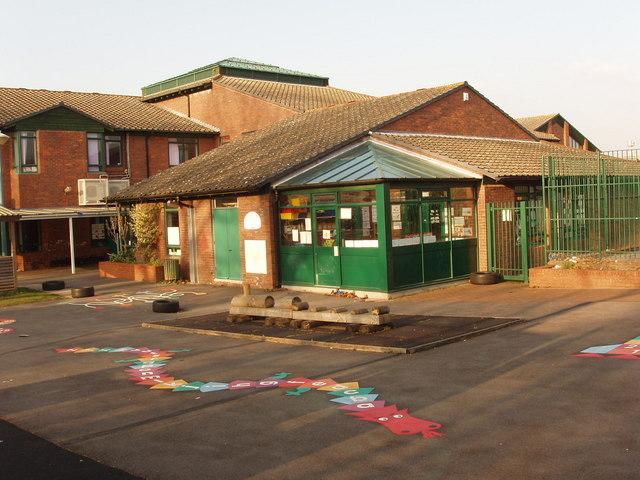
The following morning, Peach’s body was taken to the Phoenix school in the east end of London, where he taught. The subsequent funeral procession of around 5,000 people walked from the school through the east end to Grange Road cemetery in Plaistow, where Peach was laid to rest.
The funeral provided another opportunity for the SDS undercovers to spy. The unknown officer HN21 was present, and it is likely that ‘Barry Tompkins’ (despite his denials) and several other SDS undercovers attended on either, or both days. A previously unreleased film of the funeral was shown at the hearings.
HN21, who had been specifically tasked by his SDS senior officers with reporting on the ‘justice campaign’ for Blair Peach (presumably the FBPC) recalled that Members of Parliament who attended the funeral were a particular target for surveillance, along with those ‘identified being as a member of an extreme left group or if they were if a prominent figure’. A list of around 50 redacted names was gathered at the funeral, along with photographic portraits of identified individuals.
The failure of the government to instigate a public inquiry into the events in Southall, the policing and the death of Blair Peach, led community leaders in June 1979 to approach the National Council for Civil Liberties (NCCL) to launch an unofficial inquiry.
A committee of academics, trade unionists, religious leaders, and local politicians, chaired by Michael Dummett, a professor of philosophy at Oxford University, spent the following months interviewing and receiving evidence from over 120 individuals and organisations. The Metropolitan Police refused to cooperate with the inquiry.
On 12 July 1979, Commander Cass delivered his first report on the death of Blair Peach to the coroner John Burton, who was tasked with carrying out the inquest. This, and a subsequent report from Cass on 14 September 1979, were not made available to the public at the time and, crucially, not to Peach’s partner, Celia Stubbs and her legal advisors.
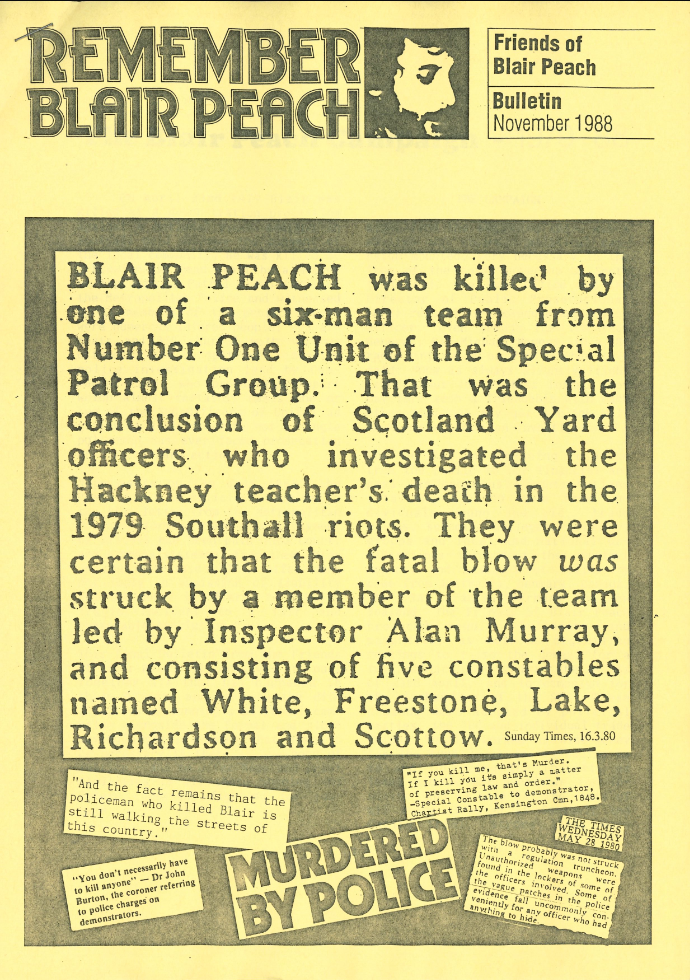
The conclusion the reports carried was essentially that an SPG police officer had killed Blair Peach. However, Cass had been unable to determine which of the group of six SPG officers had mortally wounded him and with what kind of weapon. Cass was clear in stating in the reports that this was because of the collective ‘attitudes and untruthfulness’ of the SPG officers.
Even more revealing was the fact that searches of the SPG unit’s lockers at Barnes police station, where they were based, had uncovered a range of weapons from coshes and whips to crowbars and knives. This pointed to the use by an SPG officer of an unofficial weapon in Peach’s killing, which concurred with the autopsy reports. A search of one of the officers' houses also turned up a collection of Nazi regalia and further weapons.
Despite this damning internal investigation, the Director of Public Prosecutions (DPP) refused to proceed with any prosecutions of police officers. This left the campaigners for Peach with the upcoming inquest as the only possible location for redress.
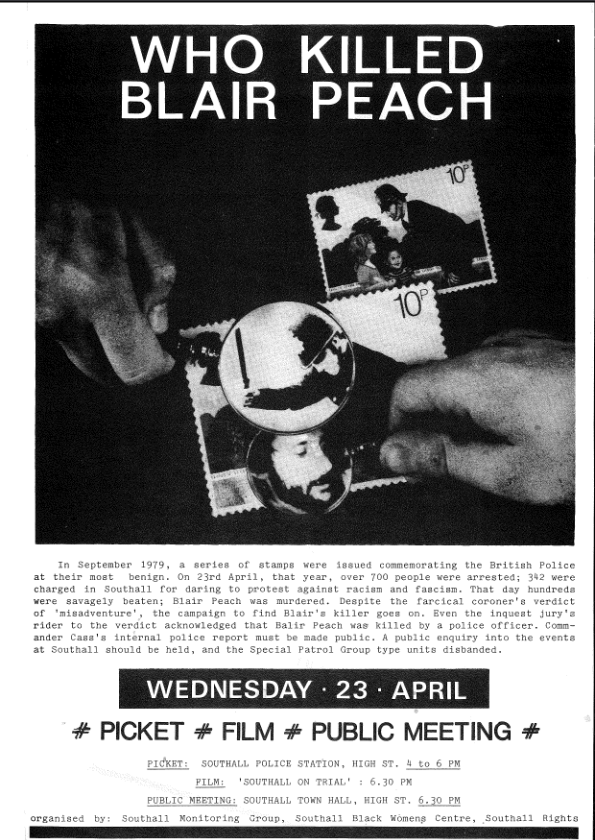
The inquest date was set to 11 October 1979, and during the run-up, the FBPC organised a series of public meetings and pickets of 16 police stations involving 700 people on the evening of 10 October. Many of these were spied upon by SDS undercovers, including HN126 Paul Gray , HN96 Michael James and HN356 Bill Biggs. The pattern was similar, providing Special Branch with forward intelligence on the plans of the Blair Peach campaigners and using public events to identify and pass on lists of ‘subversives’.
The inquest itself became a legal battleground with the refusal of the coroner, John Burton, to allow a jury or to disclose the contents of the Cass reports. This led the FBPC to launch legal action, which was eventually successful in introducing a jury but, crucially, failed to gain access to the Cass reports. As a result, the inquest was delayed by six months until 28 April 1980.
Further calls in this period for a public inquiry into the events in Southall from 140 organisations, including the Labour Party and trade unions, were soundly rejected by William Whitelaw, the Conservative Home Secretary.
With the inquest set to resume at the end of April 1980, the FBPC launched another series of pickets at police stations in London over the winter of 1979-80 and then around 50 similar protests in the run-up to the inquest. These provided further opportunities for surveillance by SDS undercovers Gray, James, Biggs and latterly Colin Clark. As a key organiser in the FBPC, Celia Stubbs (‘the widow’, as she was referred to in SDS reports) and many other campaigners and supporters repeatedly entered Special Branch files via SDS reports.
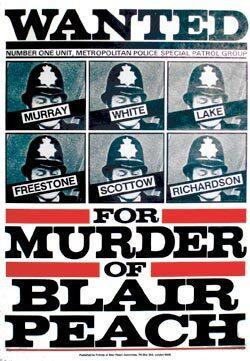
In March 1980, information from the suppressed Cass inquiry was leaked to the Sunday Times, further pressuring the forthcoming inquest. Consequently, the ANL printed thousands of posters naming the six SPG officers responsible for Peach’s death, which were used at the pickets outside police stations.
Special Branch responded by providing information gathered by the SDS undercovers on the leading members of the FBPC and other details of the organisation, in support of a proposed High Court injunction prohibiting the dissemination of this information in the public domain.
The same month, the unofficial inquiry led by Michael Dummett published its report. This heavily criticised the policing operation in Southall on 23 April 1979, the ‘excessive and unnecessary violence’ used and recommended that the SPG ‘should have no place in the policing of demonstrations’. It called for the Home Secretary to establish a public inquiry and asked the DPP ‘to reconsider his decision not to pursue a case against any of the officers involved in Peach’s death’.
In the run-up to the long-awaited inquest, the FBPC organised a mass protest march under the slogans ‘Remember Blair Peach’, ‘Disband the SPG’, ‘Amnesty for Southall’ and ‘Stop Tory Racist Laws’. This was planned to take place the day before the inquest began (27 April 1980), meeting at Speakers' Corner and marching via Scotland Yard to a rally in Trafalgar Square.
The protest was supported by numerous left parties and anti-racist organisations, including the IWA (Southall), Southall Youth Movement (SYM), Anti-Nazi League (ANL) and the Campaign Against Racist Laws (CARL). Around 4-5,000 people took part in the peaceful march and rally. SDS undercovers Michael James and HN106 'Barry Tompkins' reported on the protest, providing eight pages of identified and named persons who were present, approximately 200 people in total.
The inquest into Peach’s death lasted the best part of a month, but was fatally flawed from the off. First, by the refusal of the coroner, John Burton, to disclose the crucial evidence of the Cass report(s) to either Celia Stubbs and her lawyers or to the jury. Second, Burton clearly displayed a bias towards the police narrative. This understandably affected the jury's verdict.
During the inquest, Burton made the ludicrous and outrageous assertion that Peach had been murdered by the ANL in order to make him a martyr against the police. As far as Burton was concerned, the idea that Peach had been killed by the police was a ‘political fabrication’.
The consequent verdict of ‘death by misadventure’ rather than ‘unlawful killing’ effectively prohibited any further criminal prosecution.
After the failure to achieve a verdict of ‘unlawful killing’ Celia Stubbs and the FBPC were left with few, if any, remaining options to obtain justice. It might be assumed at this point that the SDS surveillance of the campaign would have ceased. However, the obsessive prominence given to the campaign (rather than the circumstances of Peach’s death) in the Special Branch annual reports for 1979 and 1980 demonstrates that the issue was very much alive.
In July 1980, SDS undercovers Michael James and Barry Tompkins reported on the attempt of the FBPC to form a national coordinating body with other campaigners to deal with cases of state brutality by police and prison authorities. Some of these campaigning groups were already in registry files, suggesting that they had already been spied upon. It was noted in the report that the FBPC:
feel that such a move would widen the political arguments behind the alleged 'brutality' and increase publicity for any new incidents that might occur.
Spying on the FBPC and its supporters also extended to the legal team involved in the inquest. For example, in February 1981, Sir Stephen Sedley, a Court of Appeal judge who had represented Celia Stubbs, appeared in a Special Branch report on an anti-racism conference held in Conway Hall in London. The brief account of Sedley’s speech at the conference is clearly cross-referenced with ‘family of Blair Peach’. Sedley, along with a number of other attendees and groups, already had Special Branch references. Michael Seifert, a solicitor who represented Celia Stubbs, had also been under Special Branch surveillance ten years previously.
Reporting by SDS undercovers, including Michael James, Phil Cooper and Bill Biggs, on Celia Stubbs and the FBPC and the collation of lists of supporters identified by them continued as the second anniversary of Peach’s death approached. These reports included meetings of witnesses to Peach’s killing, attempts to broaden the campaign and plans for a memorial march on the anniversary.
In June 1981, Celia Stubbs helped form the campaign group INQUEST. This organisation aimed to help families who had a relative who had died at the hands of the police, whilst in custody or in prison, through the legal process. She and other members of the now largely moribund FBPC continued to be spied upon by SDS undercovers through the 1980s and 1990s. This typically occurred as INQUEST intersected with other campaigns for justice that were also being reported upon by Special Branch, these included the Hackney Community Defence Association (HCDA), the Colin Roach Centre and the Stephen Lawrence campaign.
On 24 April 1999, the twentieth anniversary of Peach’s death, a peaceful memorial march of hundreds of people took place in Southall. Needless to say, a Special Branch report noted this four months before the event, drawing reference to the Stephen Lawrence campaign and predicting violence:
The Monitoring Group which is organising the Blair PEACH demonstration (20th anniversary of his death) on 24.4.99 will be viewed as being synonymous with the LAWRENCE death and will therefore unite all of the disparate groups under one banner… given the large number of groups and individuals who are likely to attend this march, the potential for disorder is high.
Eleven years after this march to remember Blair Peach and 31 years after his death, the Cass report(s) were finally released into the public domain. No police officer has ever been prosecuted for his killing.
In summary, it is worth turning to the comments made on behalf of Celia Stubbs by her legal team on the surveillance of both herself and the FBPC:
The purpose of gathering such intelligence had nothing to do with public disorder; it was solely concerned with protecting the Metropolitan Police from criticism, and its officers from justice. The intelligence was, as a matter of fact, used for that purpose.