The Special Patrol Group (SPG) was a mobile reserve within the Metropolitan Police, established in 1965 to address crime and maintain public order. It was part of A9 and later A8 (2) within the Metropolitan Police organisational structure.
Image
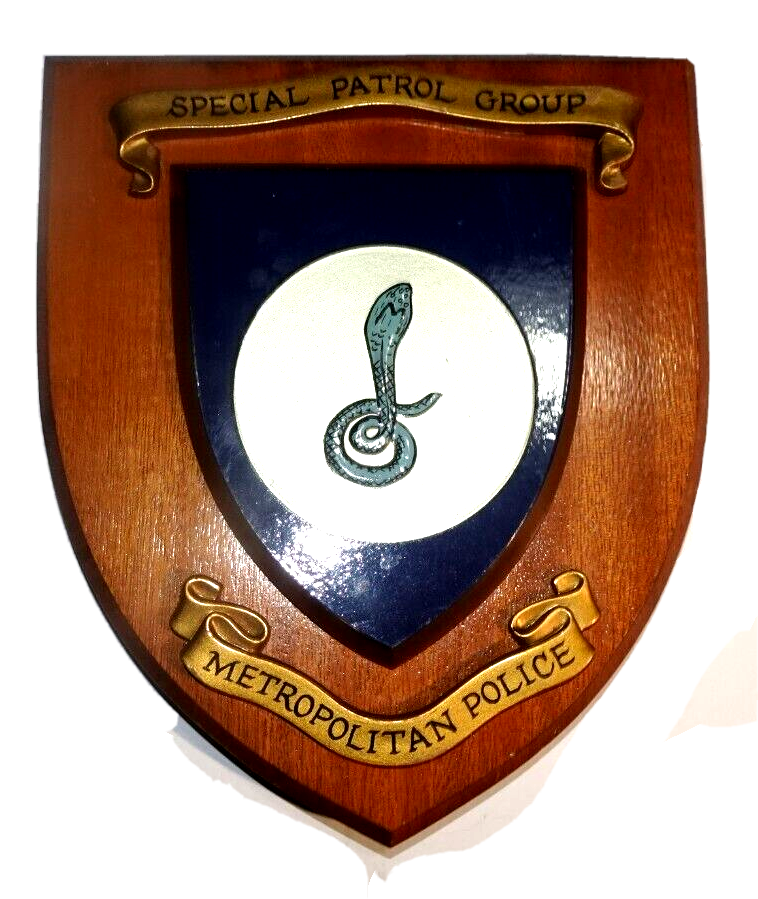
Special Patrol Group's emblem
Where A8 primarily planned public-order policing, the SPG was an operational unit. The SPG was replaced by the Territorial Support Group (TSG) in 1987, after several controversies. Both units were colloquially referred to as ‘riot squads’.
Infamously, SPG officers were responsible for the death of anti-racist protester Blair Peach, whose partner, Celia Stubbs, a core participant in the Inquiry, was then closely surveilled by the SDS for trying to hold the police to account. In 1981, they played a part in the heavy-handed policing that was the catalyst for the Brixton riots.
Background
The Special Patrol Group (SPG) was established in April 1965 as a mobile reserve within the Metropolitan Police, intended to reinforce police divisions across London. Chief Inspector M.J. Keene, The Special Patrol Group, The Police Journal: Theory, Practice and Principles, 1967. The SPG was first deployed as a crowd control tool in the March 1968 anti-Vietnam war demonstration.Background and Foundation of the SDSThe Special Demonstration Squad was formed on 31 July 1968, in the wake of the furore over the disorderly anti-Vietnam war demonstration in March that year that took place outside the US embassy in London. HN325 Conrad Dixon credited with its creation, and was it senior officer during its first months of operation.Full page: Background and Foundation of the SDS
Deemed successful, it was used in the following October demonstration. It became part of a new set of tactics developed by the then-new A8 public order department within the Metropolitan Police.A8 - Metropolitan PoliceThe Metropolitan Police's A8 Department (1968-1993) was responsible for policing public order events in London. Several of these overlapped with SDS' infiltration of the groups that organised these demonstrations and protests.Full page: A8 - Metropolitan Police
Originally tasked with combating motor crime and ‘hooliganism’, the SPG evolved into a public order unit. Within policing circles, the SPG was supposedly effective in emergencies but quickly gained a reputation for aggressive, militarised policing.A8 - Metropolitan PoliceThe Metropolitan Police's A8 Department (1968-1993) was responsible for policing public order events in London. Several of these overlapped with SDS' infiltration of the groups that organised these demonstrations and protests.Full page: A8 - Metropolitan Police
During the 1970s, the SPG gained a reputation for heavy-handed, racially targeted operations, especially in Black and working-class communities. Stuart Hall, Chas Critcher, Tony Jefferson, John Clarke & Brian Roberts, Policing the Crisis: Mugging, the State, and Law and Order, Palgrave, 1978. As the decade progressed, the SPG worked with and as part of the A8 branch during significant events, such as the Red Lion SquareRed Lion Square & the Killing of Kevin GatelyIn 1974, anti-fascist protesters, including members of the International Marxist Group and the Communist Party of England (M-L), mobilised to challenge a National Front march through central London that demanded compulsory repatriation of migrants, that was due to end at Conway Hall in Red Lion Square, Holborn. When police tried to prevent counter-protesters reaching Conway Hall, there were clashes and mathematics student Kevin Gately died. The 1975 public inquiry chaired by Lord Scarman criticised policing on the day but found ‘no evidence that [Gately] was struck any blow by any policeman or injured in any way by a police horse’. of 1974, at the Notting Hill Carnival in 1976, the Grunwick mass picketsGrunwick StrikeThe Grunwick dispute was a major UK industrial strike to demand trade union recognition, that mobilised mainly South Asian workers, including women. The 1976-1978 dispute at Grunwick Film Processing Laboratories in north-west London won support across the wider labour movement, including from the postal workers' and mineworkers' unions. Several SDS undercovers reported on picketing at Grunwick, reflected in SDS and Special Branch Annual reports.Full page: Grunwick Strike and at the Battle of LewishamThe Battle of Lewisham'The Battle of Lewisham' refers to the anti-fascist mobilisation against the fascist National Front's (NF) march through the ethically diverse and working-class area of Lewisham on 13 August 1977. Some 4000 people were involved in resistance to the NF and the Metropolitan Police's attempt to force the march through. A number of SDS officers attended the march and meetings prior to it.Full page: The Battle of Lewisham both in 1977, and in Southall in 1979.The Battle of Southall (part one): BackgroundOn 23 April 1979, a National Front election meeting was held at Southall Town Hall in west London. Southall was, and still is, known for having a relatively large number of migrants, particularly from India. The meeting was intended to be - and was seen as a provocation. There were large counter-demonstrations on the day, but aggressive police tactics resulted in 345 arrests. Blair Peach was attacked by members of the Metropolitan Police's Special Patrol Group and died as a result of head injuries from baton blows. His partner, Celia Stubbs, was key to the justice campaign that continued for decades afterwards, the Friends of Blair Peach, which was spied upon by the SDS.Full page: The Battle of Southall (part one): BackgroundDepending on the source, the SPG was either designated with A9 or A8 (2) within the Metropolitan Police structure. A 1973 internal reference points to ‘A8(2) SPG’, while 1985 Hansard lists SPG as A9.See Jac St Jon (2021).
The Southall demonstration in 1979 marked the nadir of the unit, even though it continued to operate for another eight years. The killing of a teacher and anti-racist activist, Blair Peach, following an SPG assault heightened its reputation for violence.
The Cass Report into Blair’s killing found evidence of SPG obstruction, false testimony, and attempts to pervert the course of justice. Despite this, the director of public prosecutions declined to prosecute any of the SPG officers responsible.
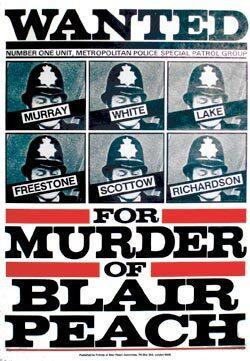
Critics saw this as proof that the SPG acted ‘with virtual impunity’. Public anger deepened after it emerged that SPG officers had altered their appearance before identification parades, described as part of a ‘massive cover-up’.The Metropolitan Police and the politics of public order, 1968-1981
Image
Campaigners produced this poster.
The Battle of Southall, Blair's killing, as well as the campaign for justice, is covered in detail here.The Battle of Southall (part one): BackgroundOn 23 April 1979, a National Front election meeting was held at Southall Town Hall in west London. Southall was, and still is, known for having a relatively large number of migrants, particularly from India. The meeting was intended to be - and was seen as a provocation. There were large counter-demonstrations on the day, but aggressive police tactics resulted in 345 arrests. Blair Peach was attacked by members of the Metropolitan Police's Special Patrol Group and died as a result of head injuries from baton blows. His partner, Celia Stubbs, was key to the justice campaign that continued for decades afterwards, the Friends of Blair Peach, which was spied upon by the SDS.Full page: The Battle of Southall (part one): BackgroundThe Battle of Southall (part three): Aftermath and surveillance of justice campaignThis is the third and final part of three articles on the topic of the Battle of Southall. This part focuses on the surveillance by the SDS of undercover officers amongst organisations connected to the justice campaign for Blair Peach, who was killed by Metropolitan Police officers during the demo.Full page: The Battle of Southall (part three): Aftermath and surveillance of justice campaignThe Battle of Southall (part two): SurveillanceOn 23 April 1979, a National Front election meeting was held at Southall Town Hall in west London. Southall was known for having a relatively large number of migrants, particularly from India. The meeting was intended to be - and was seen as a provocation. There were large counter-demonstrations on the day and aggressive police tactics resulted in 345 arrests. Blair Peach was attacked by members of the Metropolitan Police's Special Patrol Group and died as a result of head injuries from baton blows. This is the second of three articles analyses the spying by Special Branch and SDS undercover officers on community organisations and political groups involved in the protests in Southall. Full page: The Battle of Southall (part two): Surveillance
Brixton
The Brixton uprising of 1981 followed years of over policing of Black communities. Operations such as ‘Swamp 81’ conducted thousands of stop-and-search operations over a short period, involving the racist targeting of young Black men. Community leaders and members of parliament cautioned that these approaches would spark open conflict, a prediction that came true in April 1981. Simon Peplow, Race, Policing, and Public Inquiries During the 1980-81 Collective Violence in England, Exeter University, 2015.
Further incidents at the Notting Hill Carnival and SPG policing tactics throughout the early 1980s in Tottenham, Hackney, and Lambeth provoked similar complaints of racial harassment and excessive force. Despite the public outcry and official inquiries, police chiefs resisted calls to abolish the SPG, fearing this would appear to yield to ‘vociferous and unreasonable critics’. The Metropolitan Police and the politics of public order, 1968-1981
The SPG’s record regarding use of force, its impact on race relations, and questions about its remaining a controversial issue until the unit was disbanded in 1987.
Letter from Ministry of Public Building and Works to Commissioner MPS re Vietnam Solidarity Campaign application for a demo in Trafalgar Square in March 1968
Report on meeting of Waltham Forest District SWP on 'Police are the Murderers - Disband the Special Patrol Group' with 2 police spotted among attendees, held at Leytonstone Library E11 on 5 July 1979
Report on District Committee meeting of NW London SWP inc a talk on 'Selling the Socialist Worker' and discussion of demos at police stations regarding the murder of Blair Peach, held at redacted addtess on 24 Sept 1979
Report on meeting of Kilburn SWP discussing the campaign against the proposed Abortion Amendment & ANL Blair Peach demo, held at redacted venue on 26 Sept 1979
Report on a NW London District Committee meeting of the SWP inc planning demos for Blair Peach inquest and against the National Front, held at The Vale W3 on 1 Oct 1979
Report on meeting of Clapton Socialist Workers Party chaired by HN96 inc discussion of Blair Peach inquest, held at Trades and Labour Club, Dalston Lane E8 on 3 Oct 1979
Report listing participants in a picket at Woolwich Police Station on the eve of the inquest into the death of Blair Peach, held at Woolwich Police Station on 10 Oct 1979
Report enclosing a photograph taken at the funeral of Blair Peach of a woman who has left the SWP but is involved in Women's Voice and the Anti-Nazi League (attached but redacted)