
HN80 ‘Colin Clark’, a police cadet, was recruited into the Metropolitan Police in the mid-1960s and moved to Special Branch in the 1970s. He joined the Special Demonstration Squad (SDS) in December 1976 and was deployed on active duty as an undercover three months later. Harris was one of the few SDS officers to question the use of a deceased child’s identity for his cover.
During deployment in March 1977, Clark was instructed to spy on activists in the borough of Haringey in north London. Subsequently, he infiltrated the Seven Sisters branch of the Socialist Workers Party (SWP), becoming its treasurer and taking on a similar role at the party’s district level.
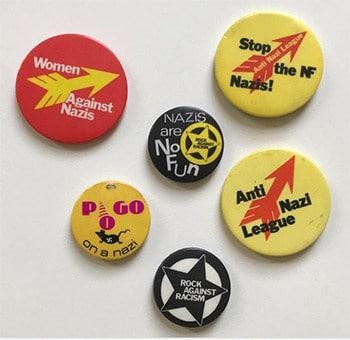
In parallel with this, Clark reported on the SWP’s organisation, membership, finances, and links to trade unions and educational institutions from a national perspective. He also spied on the Anti-Nazi League (ANL).
In 1980, Clark became the national treasurer for the SWP’s Right to Work (RTW) campaign, helping to organise an RTW march from South Wales to the Conservative Party conference in Brighton.
Clark’s detailed and comprehensive reports on the SWP conferences and the RTW campaign were commended by the Metropolitan Police and MI5. He was withdrawn from undercover duties in March 1982, after five years in the field, and left the Metropolitan Police in the 1990s.
Although Clark was able to give a witness statement for the inquiry, dated 1 April 2021, he died after providing his written evidence.
Unless otherwise indicated, the information below is taken from the first witness statement of HN80 ‘Colin Clark’.
HN80 ‘Colin Clark’ was born in the late 1940s, and after being a police cadet, joined the Metropolitan Police as a constable in the mid-1960s. After five years of service, Clark joined Special Branch, where he worked in C and B squads as well as other roles, for several years. B squad was concerned with Irish-related groups and C squad with counter-subversion.
During this period, Clark encountered HN244 Angus McIntosh , who joined the SDS as a detective inspector in spring 1976 and managed Clark over much of his time in the SDS.
Clark stated that although his work for Special Branch ‘involved occasionally attending meetings in plain clothes,’ he had not ‘done any undercover policing or used a cover identity prior to joining the SDS’. By this stage of his career, Clark held the rank of detective constable (DC).
Clark claimed that he was unaware of the existence of the SDS during his daily activities in Special Branch, principally because he was ‘never provided with intelligence that was identified as coming from the SDS because of that unit’s top-secret nature’.
However, through his friendship with undercover officer HN297 Richard Clark (‘Rick Gibson’) , who had been working in the unit since 1974, Colin Clark said he became aware of the SDS in 1976.
Recruitment
Richard Clark explained to Colin Clark that SDS undercover work was ‘demanding and required high standards of intelligence and initiative’. Colin Clark had recently married and had a young child. Consequently, he was unsure how much time he would have to commit to an SDS undercover deployment.
Despite these concerns, Richard Clark persuaded Colin Clark to make himself available for recruitment to the SDS, which he did in September 1976.
Richard Clark was forced to withdraw from SDS undercover duties the same month, as his cover had come under serious scrutiny by members of his target group, Big Flame. Colin Clark was seen as a potential replacement and was accepted into the SDS in December 1976.
Training and tradecraft
Clark, like many other SDS recruits in the period, began his term in the back office of the unit in Scotland Yard. Over three months, he was given reports by SDS undercovers and other documentation to peruse. He stated that this was not training as such, more familiarisation with the kinds of information that Special Branch wanted, how it could be obtained and understanding the left-wing groups and their affiliates that he might be tasked with infiltrating.
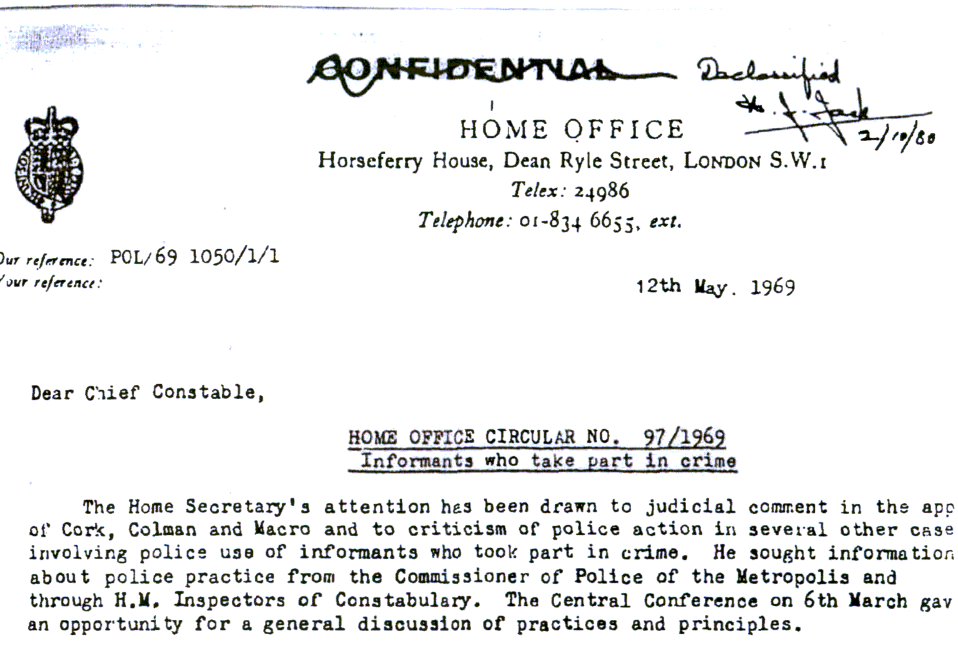
Clark maintained that while in his back office role, he had never seen anything resembling a tradecraft manual or the Home Office circular 97/1969, titled Informants Who Take Part in Crime.
Instead, he stated that his training consisted of a series of, sometimes lengthy, discussions with SDS managers. Unlike some other recruits, it appears he was not introduced to the weekly meetings of SDS undercovers in safe houses, and he claimed he did not discuss methods with current undercovers.
Clark stated that he was given neither formal training nor guidance on how much he should get involved with the private lives of individuals whilst deployed, nor was he given advice ‘on intimate relations’ with members of target groups. He also noted that SDS management did not speak with his wife, before he joined the SDS or afterwards.
As for the danger of arrest, court appearance and conviction, during his deployment, Clark stated that he had been given no guidance or advice about what to do if this occurred. He asserted that:
...the general impression I had at the time was that the management trusted us to get on with our tasks sensibly and if guidance was required they would provide it.
This laissez-faire approach was maintained by his SDS managers throughout his deployment.
Undercover identity
After a long discussion with HN135 Detective Inspector Mike Ferguson , an SDS undercover who had been active from 1969-1970, Clark decided to take his advice and use a working nickname (‘CC’ in this case) to determine his cover name, ‘Colin Clark’. Unlike most other SDS undercovers in the period, he refused to take the identity of a deceased child, stating:
It distressed me to consider using the details from a dead child's birth certificate and I knew that it would necessarily cause distress to that child's family if it was discovered.
Instead, he found a death certificate at the Registry of Births, Marriages and Deaths for a Paul Clark, brought it back to Scotland Yard and proposed to his managers that he use the name ‘Colin Clark’ and his own birthdate, to which they conceded.
Clark’s cover accommodation was a single-bedroom flat in Muswell Hill, north London. This location was chosen by his SDS managers as they regarded it as a ‘a good place to be based in order to make contact with the more important individuals on the extreme left wing’.
Clark claimed that he never allowed anyone to stay overnight at this address. When Clark had to attend events away from his cover address, particularly the 1980 Port Talbot to Brighton Right To Work march, he arranged to sleep alone in the cab of the support truck he was driving.
The location of Clark’s cover accommodation in north London was problematic for his cover workplace in Woodford Green, more than ten miles away in north-east London. Clark noted that this:
[did] not really fit well with the location of my cover accommodation, or give me enough time to build my back story in that area and engage with groups on the extreme left-wing.
Special Branch did supply him with vehicles, though, to ease his travel issues: a Morris 1100 on deployment and later a Ford Cortina.
Clark’s supposed employment was as a mechanic working in a garage, though he clearly felt uneasy about the owner, who he described as a ‘curious individual’. After several months, Clark left his employer and went ‘freelance’ doing vehicle repairs.
As soon as Clark joined the SDS and before his deployment, he grew his hair and a beard and began ‘dressing down’. In preparation for his eventual exfiltration and to ‘reject any advances towards me by female activists’, Clark fabricated a back-story involving a long-term, long-distance relationship with an airline stewardess who lived in New Zealand.
Immediately prior to his deployment, Clark stated that he had lengthy discussions with his SDS manager, Detective Chief Inspector HN34 Geoff Craft and former SDS undercovers HN135 Mike Ferguson and HN68 ‘Sean Lynch’. Neither Ferguson nor Lynch was in the SDS at this point, and their exact role within Special Branch at this time is unknown. Both returned to the SDS later as managers.
Lynch had infiltrated the International Socialists (IS), the precursor organisation to the SWP, in the late 1960s. Clark stated that he was given three overall objectives by Craft:
to gather the best information on extreme left-wing activists and groups that I could be involved with to protect the public in London, assist the MPS [Metropolitan Police Service] to deal with demonstrations and the Security Service in its counter-subversion role.
Clark was deployed into the field on 15 March 1977, but decided not to make any immediate approaches to left-wing organisations, instead spending time building his cover identity. He expected to spend four years undercover, which gave him the ‘preparation time required… to develop a credible legend.’
Clark was not given a target organisation as such by his SDS managers; instead, he was directed to ‘obtain information in the extreme left-wing arena generally in the Haringey area’ of north London. Clark spent as much time as he could in the borough, and it soon became clear to him that SWP paper sellers were only out on Saturdays. Clark recalled:
I was approached by one of them as they were keen to recruit, and I very gently got into conversation with him.
From this meeting, Clark made tentative steps to take part in the party’s local, public activities.
Socialist Workers Party
By the end of April 1977, Clark was attending public events such as meetings, pickets and demonstrations organised by the SWP in the borough of Haringey. The following month he began attending and reporting on meetings of the Seven Sisters branch of the SWP. Clark stated that by summer 1977 he had formally joined the Seven Sisters branch of the SWP:
I paid my subscriptions fairly regularly, attended meetings and made myself generally useful…to begin with I believe I helped out with selling the SWP newspaper.
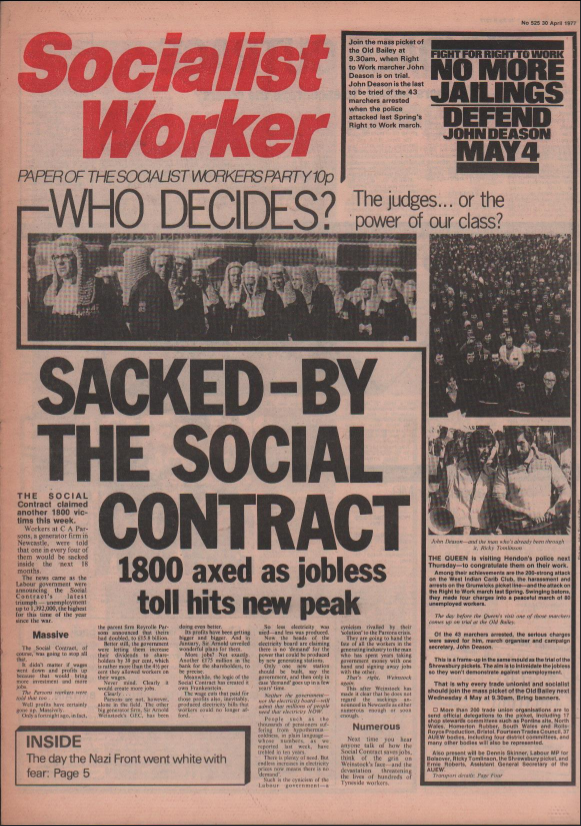
Over the next few months, Clark provided numerous reports to Special Branch garnered from the branch meetings. These included details of political discussions and disagreements, proposals for future campaigns, reports from protests and tactics to be used at major pickets and demonstrations such as at the Grunwick dispute in July 1977 and the confrontation with the National Front (NF) in Lewisham in August.
These reports carried a significant amount of personal information, ranging from regular lists of attendees, their employment details and trade union memberships. They included photographs of individuals and dubious material concerning a schoolboy member of the SWP and details about other branch members’ marriages, sexual relationships and living arrangements.
Through his increasing networking in the SWP in north London, Clark encountered sub-groups within the SWP, such as Flame and Women’s Voice , though he did not engage directly in either.
In October 1977, Clark reported on an aggregate meeting of the Lea Valley district of the SWP, which included his home branch. This meeting announced the formation of an SWP-led, broad-front organisation to fight the NF during future election campaigns. It would soon become known as the Anti-Nazi League (ANL).
In November 1977, Clark was elected treasurer for the Seven Sisters branch of the SWP. This role allowed Clark to access membership lists for the local branch, containing personal information such as home addresses and bank account details.
As treasurer for the Seven Sisters branch, Clark was now regularly attending the Lea Valley district meetings of the SWP. Soon after he was appointed treasurer for the district, which automatically made him a member of the district committee. This meant he could attend meetings of other branches in the district and the annual national delegate conferences for the party. And this post gave him wider access to more personal details of SWP members.
In parallel to these promotions in 1977-1978, Clark was making himself useful to local SWP organisers through his skills as a motor mechanic:
I helped colleagues out if they had problems with their cars … including for SWP activists who worked at the headquarters. This 'can do' attitude also led to them asking if I could spare the odd few hours to help out with administrative work at the headquarters and, because I was self-employed, I agreed.
‘Headquarters’ was the national office of the SWP, based in Hackney, north-east London. Through SWP sporting activities, Clark developed a close friendship with John Deason, a leading activist in the party and member of the central committee, whom he regularly met at the national office.
Over the following months, on an ad hoc basis, Clark insinuated himself into the national office, offering administrative help, getting to know leading organisers in the SWP and using his relationship with Deason to enhance his credibility. He gained access to documents such as the party’s weekly internal bulletin, which contained details of the party’s paper sales, priorities and plans.
Clark remarked that penetrating the national office:
very conveniently granted me access to the kinds of information that even a district treasurer would struggle to obtain… It was also a good opportunity to understand the dynamics of the organisation.
This is reflected in two reports in June 1978. The first lists the membership of the party central committee and their respective roles, and the second, again attributed to Clark, is a comprehensive and detailed 171-page report on the SWP National Delegates Conference (NDC).
The report, which earned Clark a police commendation, provided considerable detail on the party’s organisation, membership with statistical information, finances and links to trade unions and educational establishments. It listed Clark as a steward responsible for security at the NDC. Clark attended the next three SWP NDCs, from 1979 to 1981, working as a steward or administrator.
By 1980, Clark was fully ensconced in administrative work in the national office of the SWP and, he claimed, was trusted by members of the central committee to the point where he was asked to join the body. Clark refused on the basis that he was too busy with administrative work; he claimed retrospectively that:
I saw membership of the Central Committee, and the role this would necessarily have given me in directing national policy [of the SWP], as wholly inconsistent with my responsibilities as a deployed UCO.
Clark may not have been a ‘member’ of the central committee, but this did not mean he was excluded from the meetings. His other roles, too, would have involved him in some decision making, albeit at a more junior level. Central committee member Lindsey German recalled:
I know that 'Colin Clark' would have been invited to attend the Socialist Workers Party National Committee and the Party Council. He would have listened into all of our discussions, debates, and plans for action.
Speaking to Clark’s influence on the party, his role as a branch and district treasurer and growing status within the party bureaucracy also enabled him to start giving lectures on the topic ‘political standards and recruitment’ to SWP branches in London and elsewhere in the country.
Anti-Nazi League
Although Clark claimed in his witness statement that he ‘was not involved to any great extent’ with the ANL, and ‘certainly not as an organiser’ he still was able to file detailed reports on the organisation:
Just because an individual was involved with ANL, it did not necessarily mean that they were members. Given the significant overlap with the extreme left-wing, I did not need to expand my contacts any further when attending ANL events.
This was due to the organisation’s close contact with the SWP, Clark’s infiltration of the party’s national office and his relationships with leading SWP organisers. For example, Clark’s friend John Deason was credited with setting up the stewards groups, or ‘squads’ as they became known, in 1977; these protected SWP paper sales from fascist attacks.
That year, Deason also founded the football fan group Spurs Against the Nazis. Clark also implied that he was in regular contact with one of the founders and national organiser of the ANL, and another member of the central committee of the SWP, Paul Holborrow.
Despite Clark’s claim that he was not directly involved in the ANL, he was present at the meeting in north London when the formation of the League was announced; the SWP Lea Valley district aggregate meeting in September 1977. His more detailed reporting on the ANL to the SDS began in January 1978, and he was at the founding meeting of the Haringey and Enfield branch of the ANL in April.
Clark was present at most of the major events and protests organised by the ANL in London in 1978, including the two Rock Against Racism carnivals in May and September and at protests at Brick Lane in the East End in September and the Cenotaph in November.
He clearly contributed to the contents of the SDS reporting on these events, which were principally lists of, in total, more than 500 identified attendees from the ANL and SWP.
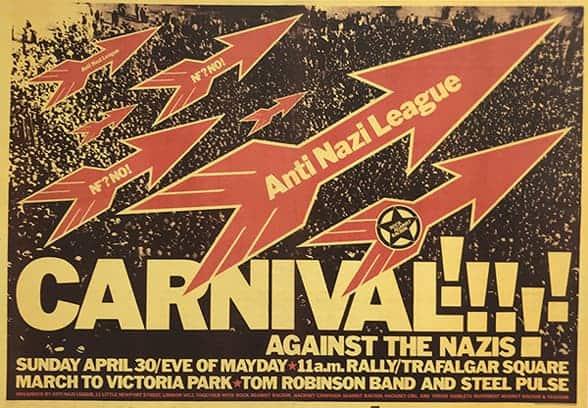
Crucially, in November 1978, Clark also attended a national conference of the SWP in Birmingham, which was called to discuss the relationship between the party and the ANL and the direction of the latter.
This conference was important, as Clark notes in his report the first signs of internal dissent, and latterly a schism, over the changing role of the ANL from ‘direct action’ to a ‘broad front’ and ‘more moderate tactics’.
After the spate of pre-election confrontations with the NF, which culminated in clashes in Southall in April 1979 and the death of ANL member Blair Peach, Clark reported on some of the memorial events and pickets for Peach in the aftermath.
Irish solidarity groups
Clark noted in his witness statement that outside the SWP and ANL he had contact with a number of other groups because of his focus on the extreme left-wing in the Haringey area. These included:
the Troops Out Movement, trade union and Labour party members, others on the left-wing and PIRA [Provisional Irish Republican Army] terrorist supporters in North London and the Kilburn area… This contact was largely only peripheral. I do not believe I was ever a member of any other group, whether formally or otherwise.
However, Clark's published evidence provided little information on these groups and their protests. He claimed in his witness statement that a large number of his reports concerning the struggle in Ireland were missing, particularly from the latter years of his deployment.
At this point, Special Branch was the lead agency on the ‘mainland’ for IRA activity, not MI5. This may be why the reports are missing: they were not within MI5’s remit for ‘subversion’, while most of the disclosure in the Inquiry came from the Security Service archives.
Right to Work Campaign
The Right to Work campaign (RTW) was initiated by the International Socialists (IS) in 1976 and consisted of a series of marches and rallies over the following decade. With the election of the Conservative government in 1979, the RTW campaign was rejuvenated by the SWP central committee.
In 1980, a march was planned from Port Talbot steelworks in South Wales, through southern England and terminating at the Conservative Party conference in Brighton in October.
As plans for the RTW march were being formulated in April 1980, Clark offered his services to the party in two roles: as a bookkeeper and as a combined driver and caterer. Clark’s friendly relationship with John Deason, the national secretary of the RTW campaign, was important in this instance.
Consequently, Clark became the national treasurer for the RTW march as well as driving and sleeping in a truck, one of the support vehicles. As Clark noted, the two different roles gave him both an overview of the organisation of the march and a day-to-day perspective ‘on the ground’.
This is reflected in Clark’s comprehensive post-hoc report on the RTW march, which was commended by the deputy assistant commissioner for the Metropolitan Police. This covered the political background to the RTW campaign, details of planning meetings, financing, administration, an extended account of the march itself and the post-event review carried out by the central committee of the SWP.
Clark was joined on the three-week RTW march by another SDS undercover, HN155 ‘Phil Cooper’ , who drove one of the other support vehicles. Both undercovers were aware of each other and communicated clandestinely while working on the logistics of the march.
During the march, Clark provided intelligence reports by telephone to his SDS managers 'when necessary'. This information, he claimed, was passed on to local police forces and thus ‘thwarted’ the marchers’ attempted occupations of work centres, army recruiting offices, Conservative Party offices, military bases and a public school.
The end of the RTW march at the Conservative Party conference in Brighton on 10 October 1980 attracted somewhere between 5,000-8,000 protesters and saw the deployment of 2,000 police. This huge police presence included 500 officers from the Metropolitan Police, along with units with riot shields and mounted police. This deployment may have been partly the result of Clark’s intelligence, which warned of a large turnout of RTW protesters at the conference.
When police tried to move the RTW marchers and their supporters from outside the conference by force, many resisted and 16 people were arrested. Clark described the incident as the first time that he ‘was not able to stay on the sidelines’. Instead, police used their truncheons and Clark:
was badly assaulted around the head and shoulders, receiving severe bruising. It was also the only occasion when I struck out, although only in self-defence.
As treasurer for the RTW campaign, Clark continued to help organise and report on marches in 1980-1981. These included those from Manchester to Liverpool in November 1980 and from Liverpool to London in May 1981.
Although Clark claimed that he did not personally take part in any further RTW marches after South Wales to Brighton in 1980, this was contested by a member of the SWP central committee who worked with him on a ‘day-to-day’ basis on the RTW campaign. Lindsey German stated that Clark was present and helped to organise the RTW march from Liverpool via Manchester to the Conservative Party conference in Blackpool in September and October 1981.
Clark recalled that outside of the SDS office in New Scotland Yard, the unit ran two flats as ‘safe houses’, one in west and the other in south London. In the early stages of his deployment, he attended biweekly meetings with other SDS undercover agents and his managers at one or the other of these flats.
These meetings were an opportunity for undercovers to submit their written reports, claim their expenses and discuss personal issues with their managers. They also provided time to compile joint reports from several SDS officers, identify people from photographs and determine which of several undercovers should attend larger events.
Clark disliked these meetings as he felt they were a potential security risk, so over time, as his deployment became busier, he reduced his attendance to, at most, once a week. For similar reasons, he rarely met other undercovers socially and, if they did, he claimed they did not speak about their deployments.
Outside of supplying written reports to his SDS managers, Clark made regular weekday phone calls to his managers in the SDS office. At weekends or if there was an emergency, he could call his managers at their home addresses.
Clark considered himself off-duty when he was with his family at his real home, though he did use this time to type up his sometimes lengthy reports. The rest of the time, he considered himself to be on duty. This included:
My time […] spent with the SWP and other groups, as well as spending an appropriate amount of time in my cover employment and giving the impression to the world that I lived at my cover accommodation.
Clark said that his cover identity was compromised only once during his deployment, when he was shopping with his wife and young child. One of a group of SWP paper sellers recognised him, whilst another engaged with his wife, learning his real name and address.
This forced Clark to stay at his cover accommodation for three months and seek permission from Special Branch for him and his wife to move house, which was denied.
Relationships
Clark was clearly well known in the SWP, a familiar face to people from across the party, because of his presence in district committees, the national office, the central committee, at delegate conferences and through the extended day-to-day collaborations on the RTW marches. He also admitted to knowing central committee members Paul Holborrow and John Deason, acknowledging that he had a ‘close’ relationship with the latter.
Although he did not disclose their names, as evidenced elsewhere, other leading members of the SWP knew him well. Lindsey German, a member of the SWP central committee and witness in the inquiry, worked closely with ‘Colin Clark’ for a period on the Right to Work Campaign. She felt a real sense of betrayal of trust at both a political and personal level:
It is also worth noting that I was a young woman, I was between relationships at that time. [...] Working with someone who was a professional liar, so close to an undercover police officer, is deeply unsettling.
Clark claimed that he:
maintained a friendly distance as much as possible from all of the individuals with whom I had contact during my deployment.
He stated that he had no sexual relationships with women while in his undercover identity, claiming that this subject was not discussed by his contemporary undercovers, and denied any awareness of his former colleagues having such relationships.
MI5 was being sent most of the SDS reports written or contributed by Clark concerning the SWP. It became particularly interested in Clark when he had infiltrated the party’s national office. Towards the end of his deployment in 1981, MI5 made several requests for information to the SDS via Special Branch, to which Clark apparently responded.
Clark’s importance to the upper echelons of the Security Service was underscored by his debriefing by an MI5 officer at the end of his deployment, as one of the first SDS undercovers. In a letter to the deputy assistant commissioner of the Metropolitan Police, MI5 thanked Clark for a ‘very fruitful discussion’, noted that it had ‘filled a number of gaps in their knowledge’ and in later correspondence, they stated ‘we would welcome the opportunity to do this on a regular basis’.
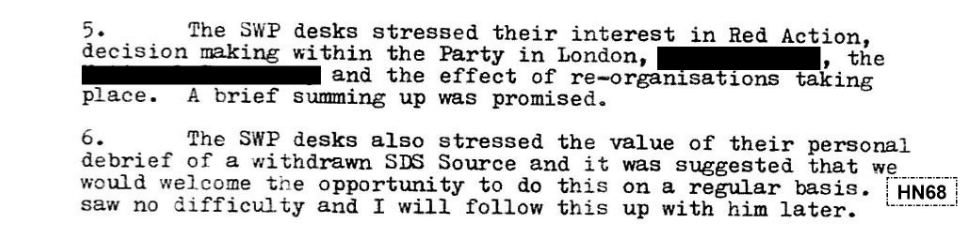
Of all the deployments up to this point in time, that of Clark probably represents the most well-documented close cooperation between the SDS and MI5 during this period.
Clark’s exfiltration was delayed by approximately a year on the grounds that the SDS was bringing in another undercover into the higher echelons of the SWP. This was HN155 ‘Phil Cooper’ , who replicated Clark’s involvement in the national delegate conferences of the SWP and the RTW campaign.
Cooper’s path into helping to organise the former and taking the national treasurer position for the RTW campaign in January 1982 may have been directly aided by Clark before he was exfiltrated. By the time Clark began the process for his exit in early 1982, he had been on active undercover duty for nearly five years, a longer period than normal in that era of the SDS.
Clark stated that his exfiltration was planned by his managers, but that he was responsible for its execution. Clark let John Deason and others in the party know that he ‘was going out to New Zealand to spend more time with my partner and start a new life’, as he had intended back in 1977.
Clark asked Deason to help him to dispose of his few possessions and made sure that Deason saw his passport and flight ticket to New Zealand. A week or so later, there was a large leaving party for him which was attended by those in the SWP, and other organisations Clark had worked with, other left-wing acquaintances and ‘hangers-on’ as he described them. Deason even drove him to the airport to see him off.
After a fortnight’s leave, Clark was moved to his next posting, without ‘any advice or support’ or ‘physical and psychological checks’. He complained about this to his SDS managers as ‘I understood that the work affected some of my colleagues quite badly’.
It was to no avail, and worse still, Clark believed that his new posting ‘put him at risk of harm’. Generally, post-SDS officers were not supposed to have public-facing roles, but this was not always heeded. Additionally, his role in the SDS could not be recorded on his personnel file because of the secrecy surrounding the squad.
Consequently, Clark argued, his new Metropolitan Police managers would have been unaware of his previous undercover activities and thus the potential dangers of him being recognised by a target. Clark retired voluntarily from the Metropolitan Police in the 1990s and enjoyed a successful second career in a commercial, non-policing role.
On 20 Feb 2018, directions were issued that applications for restriction orders to be submitted by the end of Feb 2018. The Inquiry published HN80’s cover name, and confirmed which groups he spied on, on 26 June 2018.
In March 2018, Inquiry Chair Sir John Mitting said he was ‘minded to’ not release HN80’s real name. A decision was confirmed on 30 July 2018. HN80 provided a witness statement on 1 April 2021, but did not appear as a witness at the Inquiry. He is now deceased.
All relevant procedural and evidential material can be found in the documents tab.