Founded in 1970, Pavement was a grassroots collective based in Wandsworth, London, that wrote and edited an eponymous community newspaper and organised demonstrations in support of local initiatives on housing and redevelopment.
The Lower Down collective was part of a cluster of local organisations in the Wandsworth/Battersea area. One well-known activist (and Inquiry core participant), Ernest Rodker, a former member of both collectives, provided much of the information below in a written statement to tha Inquiry.Witness Statement of Ernest Rodker, given in the NSCPs, Tranche 1, Phase 2, 24 Feb 2020.View DocumentPavement was infiltrated by HN300 'Jim Pickford'HN300 'Jim Pickford'‘Jim/Jimmy Pickford’ was the assumed name of an SDS undercover who from November 1974 to December 1976 infiltrated the Freedom Collective, Pavement Collective, Battersea and Wandsworth Trades Council Anti-Fascist Committee, Kingston Anarchist Workers Collective, South London Anarchist Workers Association and Federation of London Anarchist Groups. HN300 had a reputation as a philanderer in the SDS and was withdrawn from his deployment in December 1976 after he told another undercover that he had fallen in love with a member of his target group. After leaving the SDS he divorced his wife and married this activist. He is dead but his real name has been restricted.Full page: HN300 'Jim Pickford'and HN298 'Michael Scott'.HN298 'Michael Scott'‘Michael Scott’ is the assumed name of a former SDS undercover officer who infiltrated the Putney branch of the Young Liberals, Croydon anarchist group Commitment, the Little Ilford branch of the Workers Revolutionary Party and the central London branch of the Anti-Internment League between 1972 and 1976. In 1972, he did not reveal his true identity to the court when convicted alongside three anti-apartheid activists, leading to their convictions being overturned in 2024. The reliability of his testimony about the Young Liberals was challenged in the Inquiry by core participant Peter Hain.Full page: HN298 'Michael Scott'
Pavement
Image
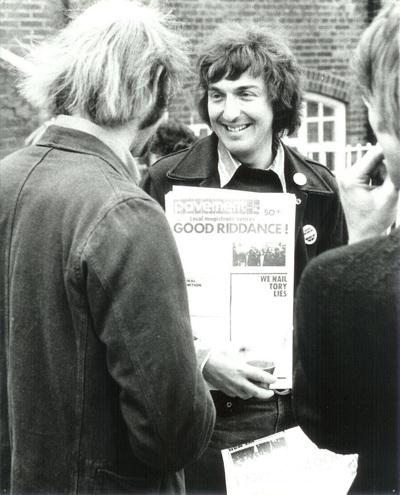
Street Sales of Pavement. Credit: Martin Lipson
The Pavement Collective was mainly centred on the eponymous Pavement, a socialist community newspaper. The paper ran from 1970 for about 20 years and reporting had a special emphasis on community defenders and campaigns on issues such as housing, race and jobs. It was infiltrated principally by HN300 'Jim/Jimmy Pickford'HN300 'Jim Pickford'‘Jim/Jimmy Pickford’ was the assumed name of an SDS undercover who from November 1974 to December 1976 infiltrated the Freedom Collective, Pavement Collective, Battersea and Wandsworth Trades Council Anti-Fascist Committee, Kingston Anarchist Workers Collective, South London Anarchist Workers Association and Federation of London Anarchist Groups. HN300 had a reputation as a philanderer in the SDS and was withdrawn from his deployment in December 1976 after he told another undercover that he had fallen in love with a member of his target group. After leaving the SDS he divorced his wife and married this activist. He is dead but his real name has been restricted.Full page: HN300 'Jim Pickford' but also by HN298 'Michael Scott'.
Published once a month, Pavement was circulated on the streets and in sympathetic newsagents, housing estates and community centres. In addition to writing, editing and selling the paper, the collective also sought to challenge the council on policies such as housing and redevelopment, by organising public meetings and demonstrations and writing letters to local and national newspapers.
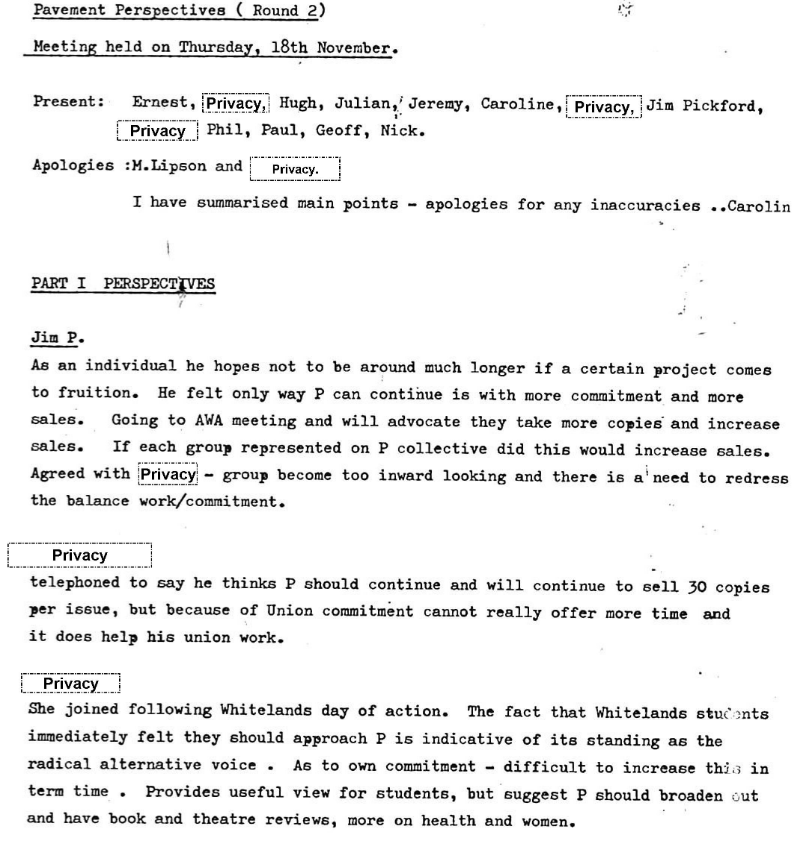
Minutes from a Pavement meeting recorded Jim Pickford's presence.Pavement Perspectives, group’s minutes of meeting, with HN300 Jim Pickford present, 18 Nov 1976, NSCPs, UCPI0000033629.View Document
Image
The collective took action by gathering outside Wandsworth Town Hall on the evenings of council meetings or, rarely, by holding demonstrations near councillors' homes. The number of attendees ranged between just a handful and hundreds, depending on the issue at hand. Meetings around the development of Battersea Power Station, for example, were popular, but gatherings were also organised on the sale of council houses and cuts in council services. The core group of the collective itself, however, was only about ten members strong.Witness Statement of Ernest Rodker, given in the NSCPs, Tranche 1, Phase 2, 24 Feb 2020.View DocumentBoth Pavement and Lower Down had meetings at Battersea People's Aid and Action Centre, as well as members' such as Ernest Rodker's private home.Ernest RodkerErnest Rodker was a founder with Bertrand Russell of the Campaign for Nuclear Disarmament (CND) [[link]] and of the anti-war Committee of 100. From 1958, Rodker helped to organise the Aldermaston anti-war marches. He later became active in the anti-apartheid movement through Stop the Seventy Tour. Although the earliest-dated police reports on Rodker released through the Inquiry start in 1969, other Special Branch reports indicate that his Registry File opened in 1960.
Ernest Rodker, a core participant in the Inquiry and a prominent Wandsworth-based activist also active in Stop the Seventy TourStop The Seventy Tour (STST)Stop the Seventy Tour (STST) was an anti-apartheid group active from 1969 to late 1970, specifically aimed at preventing or disrupting a South African cricketers’ tour of England. It was started by members of other anti-apartheid campaigns, including Anti-Apartheid Movement (AAM), South African Non-Racial Olympic Committee (SANROC) and the Reading Joint Anti-Apartheid Committee. STST was spied on by HN135 Michael Ferguson, HN298 'Michael Scott', HN336 'Dick Epps', and HN346 Jill Mosdell.Full page: Stop The Seventy Tour (STST)and Battersea Redevelopment Action Group (BRAG)Battersea Redevelopment Action Group (BRAG)Battersea Redevelopment Action Group (BRAG) was community campaign based in south-west London and active in the 1970s. One focus of the group was the demolition of the Morgan Crucible site in Battersea and its subsequent redevelopment. BRAG was reported on by HN300 'Jim Pickford'.
Full page: Battersea Redevelopment Action Group (BRAG), said he was 'one of the main motivators' behind Pavement. In his witness statement, Rodker described the collective as a 'grassroots, community initiative' and asserted that most members of the collective 'had known each other over a long period of time and therefore trusted each other'. Rodker's records indicate that 'Michael Scott' was involved in selling Pavement. Undercovers extensively reported on Rodker himself and it is possible that SDS's interest in Pavement was due to his involvement.Witness Statement of Ernest Rodker, given in the NSCPs, Tranche 1, Phase 2, 24 Feb 2020.View Document
Lower Down
Lower Down was a left-wing community magazine circulating in Wandsworth, London, that covered the activities of local activist organisations such as women's and gay liberation groups, claimants' unions and BRAG. The magazine began publication in April 1974 and ran for at least three years, long enough to print an article about the Grunwick strike in Dollis Hill, London.Grunwick StrikeThe Grunwick dispute was a major UK industrial strike to demand trade union recognition, that mobilised mainly South Asian workers, including women. The 1976-1978 dispute at Grunwick Film Processing Laboratories in north-west London won support across the wider labour movement, including from the postal workers' and mineworkers' unions. Several SDS undercovers reported on picketing at Grunwick, reflected in SDS and Special Branch Annual reports.Full page: Grunwick Strike Jim/Jimmy Pickford also reported on the collective behind Lower Down, but there are fewer reports on it than on Pavement.
The Lower Down collective described itself as 'a group of about ten individuals who live or work in the borough' of Wandsworth. The zine was named after the fact that all those involved lived in a basement in Battersea. Ant Jones, THE WANDLE TRAIL MYSTERY - PART 2, Lavender Sweep Records, 1 Jan 2015.Although the group disavowed party politics and claimed to consist of 'individuals each with their own political opinions' and that 'no one view predominates' among the members of the collective, it also declared to be 'against poverty, discrimination on racial, sexual or religious grounds, bad housing, high prices, exploitation, landlordism, injustice and so on'.Witness Statement of Ernest Rodker, given in the NSCPs, Tranche 1, Phase 2, 24 Feb 2020.View DocumentThe magazine was sold on the street, in sympathetic local shops and via subscription.
The magazine also published political comic strips, local news and articles on various social movements, such as anti-racism and reproductive rights. Lower Down also ran short adverts for community centres and groups such as People's Aid and Action Centre, Balham Nursery Action Group, Campaign for Homosexual Equality, Men Against Sexism and Pavement.
Sources
Copies of Lower Down and Pavement are deposited with Wandsworth Libraries & Heritage Service.
Report on the arrest and court appearance of Ernest Rodker for Highway Obstructon while selling Pavement on Northcote Road SW11 on 1 Feb 1975, held at South Western Magistrates Court
Report on a meeting of the Wandsworth group of the Anarchist Workers Association, held at the Peoples Aid and Action Centre, 8 Falcon Road SW11 on 27 Nov 1975
Report on public meeting of Wandsworth branch of the Anarchist Workers Association, held at the Peoples Aid and Action Centre, Falcon Rd Battersea 27 Jan 1976