
HN300 ‘Jim Pickford’, joined the Metropolitan Police in 1969, and was recruited by Special Branch in 1973. In May 1974, he was approached by Special Demonstration Squad (SDS) managers to join the unit, which he did the following month.
Pickford, in his second marriage and with two children, spent a few months in the SDS back office before being deployed in October 1974 to report on anarchist groups in London.
Pickford was the first substantial SDS deployment into anarchist groups. Whilst HN326 'Doug Edwards' and HN349 both attempted to infiltrate such groups earlier, neither was successful.
Pickford began by infiltrating the Freedom newspaper collective in east London, before moving on to spying on community housing and anti-fascist campaigns in Battersea and Wandsworth in south west London. Many of his earlier reports concerned activist Ernest Rodker, who was already an established Special Branch target.

In March 1975, Pickford infiltrated the Anarchist Workers Association (AWA), helping form the Kingston (latterly Wandsworth) branch of the organisation. He became treasurer and chairperson of the branch and was elected to be a delegate for the group at national AWA meetings and conferences. Pickford came close to becoming the national secretary of the AWA and represented the organisation at meetings of the Federation of London Anarchist Groups.
In December 1976, after claiming to a fellow undercover that he had fallen in love with one of the members of his target groups, Pickford was rapidly withdrawn by his SDS managers. He later went on to divorce his second wife, remarry and have a child with the person he had reported on.
HN300 ‘Jim Pickford’ was deceased by the time of the inquiry. The lack of an oral or written statement by Pickford presents difficulties in recording his background before joining the SDS, aspects of his training and tradecraft, his life undercover, exfiltration and his post-SDS career.
Unless otherwise indicated, the information below is taken from the Counsel to the Inquiry’s Opening Statement for Tranche 1 Phase 2.
Pickford was born in 1944 and joined the Metropolitan Police in late 1969. At the rank of constable, he moved into Special Branch in 1973 and became part of the surveillance section of C squad, responsible for left-wing subversion and later domestic extremism.
During his time in C Squad, he passed promotion examinations, achieving the rank of detective sergeant, and by May 1974, he had been approached by SDS managers about joining the unit. Pickford indicated his willingness to join the squad.
When Pickford was recruited by the SDS, he was 30 years old, engaged in his second marriage, and he and his partner had young children. Pickford was chosen by SDS managers to be next in line after undercover officer HN351 ‘Jeff Slater’ , who had completed his ‘training’ in the SDS back office at New Scotland Yard and was ready for deployment. Pickford formally joined the SDS back office in June 1974.
Due to the lack of witness statements or oral evidence from Pickford, there is a paucity of sources covering his recruitment, training and cover identity.
Information provided by his second wife and two daughters stated that Pickford had ‘radically’ changed his appearance on joining the SDS, ‘growing his hair and a voluminous beard’.
Reporting by the Inquiry suggests that he began his field deployment around October 1974 and was provided with a cover vehicle by Special Branch. His cover employment was working for a small building firm.
Freedom Collective
It is unclear from the evidence if Pickford’s SDS managers targeted a particular group for him to infiltrate, though it appears he was directed towards the anarchist movement in London. Initially, he focused on the longest-running anarchist paper in the capital, Freedom, which was produced in Whitechapel in east London.
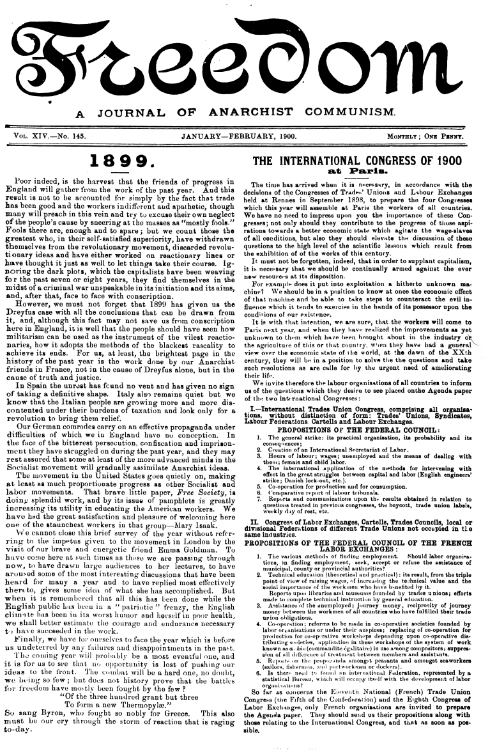
Pickford reported on a series of meetings of the Freedom Collective in the autumn of 1974, during which he participated in discussions and preparations for distributing the paper. These reports follow a familiar SDS pattern, with details of the meeting place, discussions within the meeting, disagreements with other political groups, and lists of identified attendees at the conclusion.
Pickford spied on the Freedom Collective only until February 1975, after which he appears to have focused on other targets in the London anarchist scene. In retrospect, it appears the Freedom Collective were merely a stepping stone for Pickford.
Pavement Collective, Battersea Redevelopment Action Group (BRAG) and Battersea & Wandsworth Trades Council Anti-Fascist Committee
Within a few weeks of starting his deployment, Pickford expanded his reach by engaging with several anarchist-related, grass-roots campaigns in Battersea and Wandsworth in South West London. These included the Battersea Redevelopment Action Group (BRAG) and the Pavement Collective. The former was a local campaign that fought for affordable council housing, community projects and facilities and the latter a community newspaper in support of local initiatives on housing and redevelopment.
The link between these collectives was the activist Ernest Rodker , who had been targeted for surveillance by Special Branch for several years previously. In May 1972, Rodker was described by Commander of the Special Branch HN585 Matthew Rodger as having control and directing a group of ‘anarchist orientated extremists’ and a ‘thorn in the flesh for several years now’. Pickford first identified Rodker, as the ‘well known left-wing activist in the Battersea area’, in a report in late November 1974. He also provided Rodker’s home address, a description of his car and the registration number.
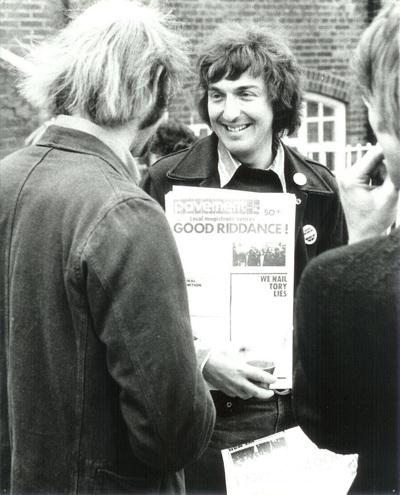
Pickford had come by this information as the first private meeting of the Pavement Collective he infiltrated was held at Rodker's home in Wandsworth, south London. Pickford specifically spied on Rodker throughout his deployment, giving details of his employment, health, legal proceedings, and even the birth of his son, in a series of reports. These reports provide further evidence that Ernest was a target for Special Branch and suggest that Pickford had been ordered by his SDS managers to spy on him in particular.
When Pickford began reporting on BRAG in January 1975, the organisation was engaged in a campaign to oppose the development of the Battersea Funfair site in Battersea Park into a ‘Disneyland’ by the Trust House Forte Group. BRAG raised petitions, distributed leaflets, organised public meetings with residents, lobbied Council meetings and held pickets at Wandsworth Town Hall.
Within a few weeks, BRAG had spawned a new group, the Battersea Park Action Group (BPAG), specifically aimed at opposing the redevelopment and run by an ad hoc committee of local tenants. By this stage, Pickford was not only spying on the meetings of both groups but also socialising afterwards with organisers. Consequently, his reports were inflated with longer lists of identified attendees. He also began reporting on BRAG social events, identifying those present.
In March 1975, Pickford began to spy on leading members of the recently formed Battersea & Wandsworth Trades Council Anti-Fascist Committee.
A few weeks later, an alleged arson attack against a local social centre by the NF, led to another meeting of the committee. Pickford attended and proposed protecting the building physically and engaging squatters to act as ‘nightwatchmen’, both of which were agreed by the group.
In June, it was agreed in a subsequent meeting of the Anti-Fascist Committee that Pickford and another group member would give a series of public education classes on the relationships between fascism and racism, the family, trade unions and the state. This provides some evidence of Pickford’s knowledge and confidence to speak politically in public, less than a year into his deployment.
From this point on Pickford began to reduce his reporting on the anti-fascist committee, BRAG and BPAG. Although he retained his involvement with the Pavement collective, his attention turned towards a new anarchist organisation.
Anarchist Workers Association (AWA)
The AWA was the new name for the Organisation of Revolutionary Anarchists (ORA), which had recently split from the Anarchist Federation of Britain (AFB). Pickford attended his first AWA meeting in March 1975 where he obtained and passed on to Special Branch the articles of the organisation. These included the AWA's aims and principles, the constitution, organisational charts, and some position papers.
Fortunately for Pickford, the meeting resolved to set up a new branch of the AWA in Kingston, south west London. A few days later Pickford, along with four others, attended the inaugural meeting of the Kingston Branch, in Surbiton south London. At succeeding meetings in April 1975, Pickford became a full member of the branch and was chosen as chairperson for the meeting.
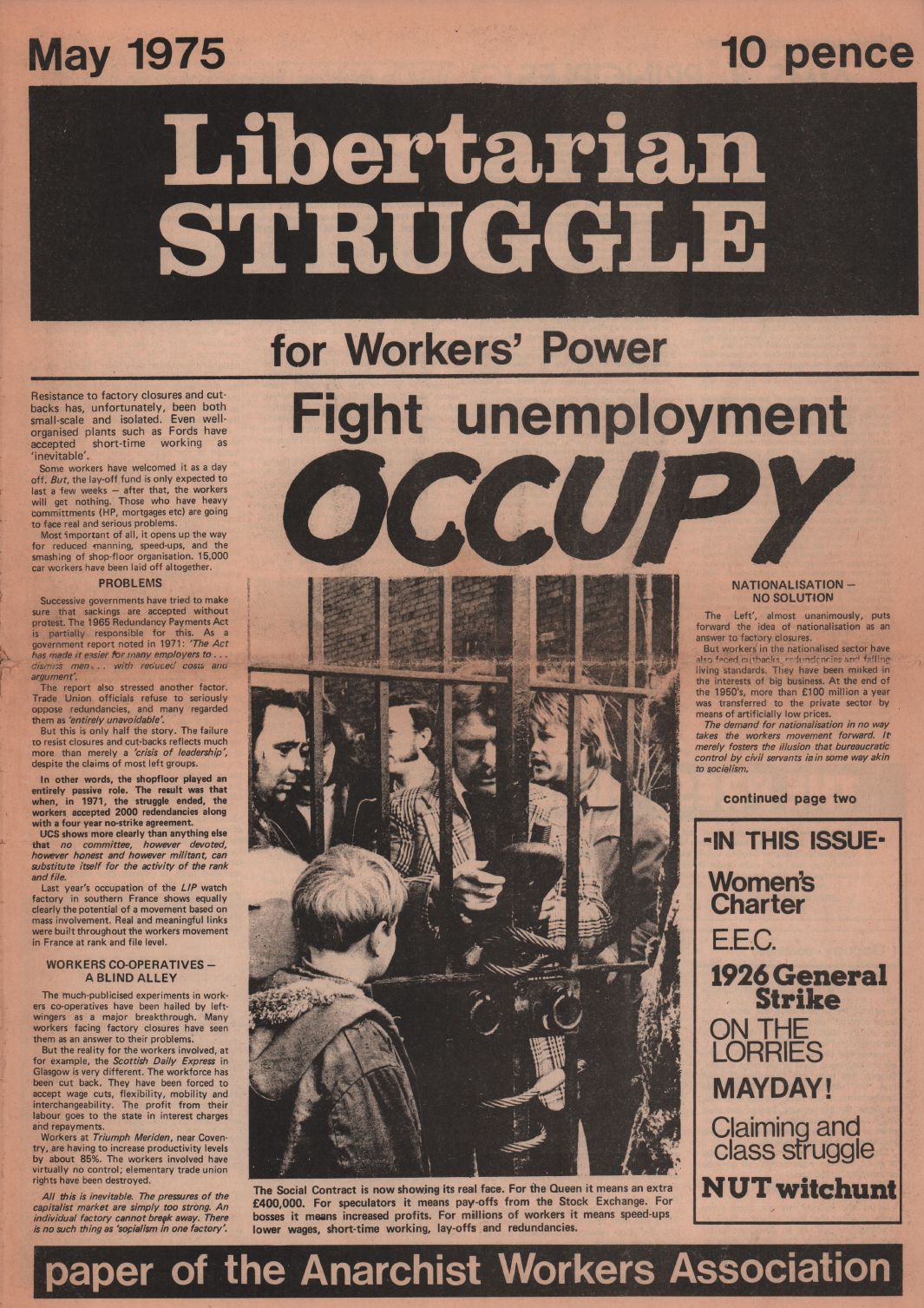
In May, Pickford was tasked by the group with contacting the Campaign Against Jenkins Oppressive Laws (CAJOL) which was regarded by the branch as a front organisation for Peoples Democracy. He was also asked to write an article for the AWA paper Libertarian Struggle. From this point on, Pickford would be largely focused on AWA activities.
That same month, Pickford attended the AWA national conference in Leicester as the delegate for the Kingston branch and penned his most comprehensive report yet. This included details of membership, finances, international contacts, discussions and disagreements over policy, as well as listing and identifying around 30 attendees from nine different AWA branches.
In July 1975, Pickford was involved in the decision to spawn another branch of the AWA from the existing Kingston group. This became the Wandsworth branch of the AWA, with Pickford a leading member of the new group. This was demonstrated by his increasing ability to veto or defer majority decisions made by the branch. It was also reflected in his election as branch treasurer and as the branch's representative at the AWA delegate conference.
Pickford attended the AWA delegate conferences in August 1975 and February 1976, providing the conference agenda, detailed reports of the debates, an outline of policy outcomes, and a list of attendees. The latter meeting was organised and hosted by the Wandsworth branch, and Pickford stood (unsuccessfully) as a candidate for the national secretary of the AWA. He also reported on contacts and collaborations between AWA and anarchist organisations in Portugal, the Netherlands, Sweden and Denmark. In addition, he provided copies of various AWA position papers regarding the struggle in Ireland.
One report attributed to Pickford, which appears to be an anomaly compared to his other efforts, was his assessment of the national conference organised by the Medical Campaign Against Private Practice, held in October 1975 at City University in east London. This large event, attracting more than 500 delegates and observers from trade union branches, trades councils and other organisations, was billed as ‘Fight against the cuts in the NHS’. Pickford provided an account of the debates, the agenda, the conference position paper, a comprehensive list of more than 250 organisations that supported the conference, a list of delegates to the national coordinating committee of the campaign and details of other attendees.
Even judging by the overly broad interpretation the SDS normally applied to their supposed remit of investigating violence at protests or providing information to MI5 on subversion, this report stands out as clearly outside of those bounds. Despite this, Pickford’s information was formatted into a report by the SDS staff and signed off by his managers, in this case, Detective Inspector (DI) HN34 Geoffrey Craft and Detective Chief Inspector (DCI) HN819 Derek Kneale.
In a similar vein, attempts to further democratise the trade union the National and Local Government Officers' Association (NALGO) were also reported on by Pickford in November. He provided an internal leaflet for NALGO branches published by the NALGO Action Group (NAG), which was in dispute with the union leadership.
January 1976, saw the Wandsworth branch of the AWA experiencing serious problems. Several leading members of the branch resigned, and it appeared that the ‘future of the group was in doubt’. It is unclear why this instability suddenly appeared, but it appears to have been due to personal reasons among members of the branch. Pickford, who was chairing the meeting, intervened, offering to mentor a new secretary for the group and noting a series of problems that would now arise with the resignations. In effect, Pickford’s reports suggest he was now leading the group and apparently struggling to keep it active.
Another interesting development appears in a routine report based on Pickford’s intelligence, which was signed off on the following month. The account of a meeting of the ailing Wandsworth branch of the AWA lists a series of ‘local action groups’ that were being discussed. Of these, Pickford had been or was associated with three of the seven groups. These were all concerned with housing and local healthcare, including tenants' associations, redevelopment campaigns and a squatting group. This meeting reflected Pickford’s growing knowledge and, perhaps, dominance of the debate.
The report concluded with the phrase ‘Nothing of security interest was discussed’, a rarity in SDS reports in the period. It is unclear who wrote this, but it suggests that Pickford’s description of the meeting was largely irrelevant to Special Branch. This may have been in the light of his extensive reports on conferences to stop cuts in the NHS and internal battles in NALGO. Their content and relevance to ‘national security’ are non-existent.
In the spring of 1976, Pickford became embroiled in internecine arguments in the anarchist milieu concerning the relationship between AWA, the existing Anarchist Federation of Britain (AFB) and the short-lived Confederation of British Anarchists (CBA).
In April, the Wandsworth branch of the AWA apparently reorganised with other nearby branches and was renamed the South London branch. This was probably due to internal issues in January and dwindling membership. Pickford remained in his post as treasurer and was selected as the AWA delegate for the upcoming meeting of the Federation of London Anarchists (FLAG). He retained this position for similar meetings later that year.
Several members of Pickford’s target groups (in particular the Battersea & Wandsworth Trades Council Anti-Fascist Committee and Anarchist Workers Association) remembered him in interviews carried out in 2020. One respondent, a member of AWA, described him as:
Really easy fellow to get on with. Took me in totally if he was guilty as charged [...] He picked up the jargon of the Group [AWA] and used it to push his ideas. Jim was an enthusiast for anti-fascist activity. Along with [redacted] and a few others in the AWA orbit.
Another member recalled Pickford as ‘Sussed, enthusiastic, nice enough. Working Class [...] and ordinary [...] not (a) provocateur.’ They added that he had a calming effect on some of the younger and angrier members of his target groups. An activist who had been involved with the publication Pavement stated that Pickford was ‘often distributing copies of the AWA paper and presenting himself as a committed anarchist’.
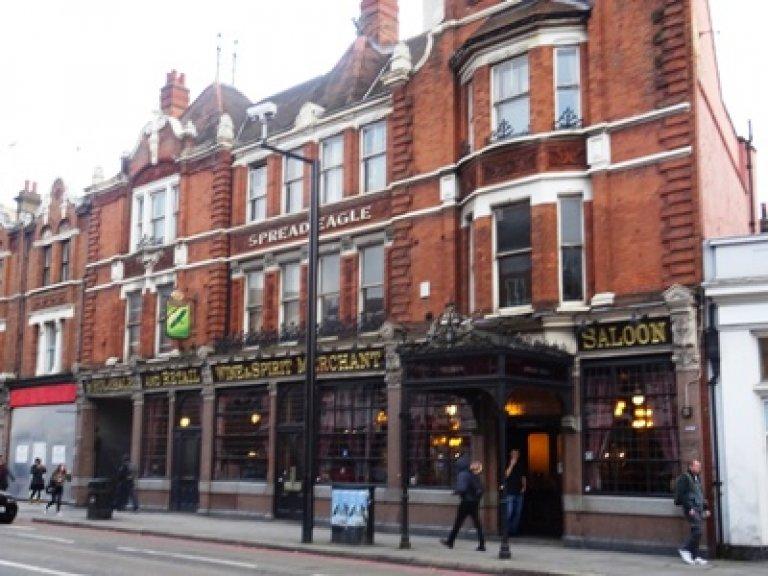
Another aspect of Pickford’s cover lifestyle, which he employed to aid his spying, was drinking and socialising after meetings of his target groups. Several respondents recalled Pickford being present after meetings in pubs across south west London. One anti-fascist committee member suggested that a lot of the information he gathered came from one nexus in particular, 'The Spread Eagle' Pub on Wandsworth High Street, where comrades from the AWA and WAFARC regularly gathered.
Several SDS undercovers referred to Pickford as being an alcoholic or ‘drinker’, with one recalling that ‘he was confined to the [SDS] office because he was an alcoholic’. It is unclear from the evidence whether Pickford’s role as an undercover officer contributed to his heavy drinking.
What little information is available about Pickford’s life as an SDS undercover comes from his second wife and two daughters, with whom he was with for most of his deployment. They remembered that Pickford would never talk about his undercover work and would disappear for long periods without any means to contact him.
Apparently, SDS managers did not provide any emergency contact details or support for Pickford’s spouse during his deployment.
When the family did see Pickford, often it would often be without warning, causing significant disruption. They remembered that he would park his cover vehicle away from their home to protect his cover identity, then return to it later in the evening or at night. Pickford insisted on a strict security culture amongst his family, as his daughters remembered:
He [Pickford] also focused much of his time talking to us as children and adolescents about the importance of being vigilant, not divulging information and maintaining a level of suspicion of any individual/organisation seeking information (no matter how innocuous it seemed) through overt or covert means.
In keeping with this culture of secrecy, there were no ‘joint social engagements (i.e. no attendance to social gatherings or visits to friends or entertaining in the home)’ which involved Pickford and his wife. Needless to say, this left his wife socially isolated and ‘vulnerable’ whilst bringing up two young children, and effectively ‘a single parent’. No support was offered or provided by Special Branch.
It was in this environment that his wife learned that Pickford had begun a relationship with another woman.
Pickford was retrospectively described by a number of his colleagues and SDS managers as having a ‘reputation as someone who was always chasing after women’ (HN304 ‘Graham Coates’) , a ‘womaniser’ (HN200 ‘Roger Harris’ , DI HN244 Angus McIntosh ), and a ‘sexual predator’ (Unattributed comments by SDS officer).
Another unnamed undercover was less damning:
He [Pickford] was, he couldn't hold himself. He genuinely fell in love with people all over the place…falling in love all over the place was his reputation.
In August 1976, less than two years into Pickford’s deployment, Chief Superintendent HN357 David Bicknell of S Squad was already planning for Pickford to be moved in early 1977 as he was coming to the end of his ‘tour of duty’. However, these plans were thrown into disarray a few months later when Pickford arrived at the door of a fellow SDS officer’s cover flat. The unnamed officer recalled:
He [Pickford] tearfully told me that he had fallen in love with a lady who was associated with his group... He was beside himself because he wanted to tell her everything including his undercover role which he realised could seriously impact the entire SDS operation.
The unnamed officer kept Pickford in his flat over the weekend, worried that he might leave and compromise his cover. The officer contacted the SDS office. They responded by calling Pickford into a meeting with SDS manager DI McIntosh and the decision was made to withdraw Pickford immediately.
Pickford claimed to the unnamed officer and, in all likelihood, to his SDS managers that he ‘hadn’t entered into a relationship, he was approaching that rather than having done it’, suggesting that he had not begun a sexual relationship with a person he was reporting on. This, however, was contradicted by his wife, who stated in her evidence that she was aware he was in a relationship during his deployment.
Pickford required a rapid exfiltration story. At a meeting of the south London branch of the AWA in mid-December 1976, which only attracted four members, Pickford announced he was resigning from the organisation. His supposed grounds for leaving were political, a ‘protest against the “minority tendency”’ and practical, as branch treasurer, because of the ‘current financial situation of the Association’.
According to members of AWA, Pickford was also peddling a separate background story which apparently related to ‘his increasing involvement with a girlfriend’, who he had met in his undercover identity, and a proposed trip to Italy. After he left the organisation, Pickford had letters sent from Italy to AWA members, claiming:
He [Pickford] was involved in militant union activity in Italian car factories - a subject for which he displayed considerable knowledge of within the letter.
Pickford’s exfiltration narrative appeared to be successful, and Pickford left the AWA, but unlike most other SDS undercovers, he did not sever all his links with those associated with the groups he had targeted for spying.
On 29 January 2018, the Metropolitan Police Service applied to restrict HN300's real identity.
Three months later, in March 2018, a 'Minded To' note stated that HN300's second wife and two children had provided a joint statement about their experiences during his deployment and the impact disclosure of his real name may have on them. Mitting indicated that because publishing his real name would interfere with their rights, he would grant the restriction order over it.
Given that HN300 had a relationship in his cover name, this ran counter to Mitting’s previously stated policy of publishing the real name when such relationships were identified. This decision was confirmed on 15 May 2018.
On 24 September 2019, HN300’s target groups were released.