
HN296 ‘Geoff Wallace’ was a member of A Squad in the Special Branch of the Metropolitan Police in the 1970s and joined the Special Demonstration Squad (SDS) in 1975.
Wallace created an undercover identity by using a deceased child’s name and date of birth. His cover occupation was as a van driver, and Special Branch provided him with a driving licence and an appropriate vehicle.
Wallace infiltrated the International Socialists/Socialist Workers Party (IS/SWP) via the Hammersmith branch. Over the succeeding years, he took on roles at branch level as treasurer and organiser of the party’s various papers, culminating in his appointment to the logistics-organising committee for the Anti-Nazi League (ANL) carnival in April 1978.
Wallace’s reports cover a variety of campaigns and activities organised by the IS/SWP. These included the Right to Work (RTW) marches, protests against the introduction and use of the Prevention of Terrorism Act (PTA) and local protests to stop hospital closures.
HN296 ‘Geoff Wallace’ did not give evidence to the Inquiry as he does not reside in the UK, and the global pandemic prevented him travelling to the hearings in November 2020.
The lack of either an oral or written statement by Wallace presents difficulties in recording his background before joining the SDS, some aspects of his training and trade craft, his life undercover and his post-SDS career.
HN296 ‘Geoff Wallace’ was a member of Special Branch of the Metropolitan Police in the 1970s. He was working in A Squad, which dealt with administration and VIP protection duties.
In July 1975, when Wallace had reached the rank of detective constable (DC), Chief Superintendent HN332 Cameron Sinclair , head of the Special Demonstration Squad (SDS), agreed that Wallace would transfer over from A Squad, after he had completed his Criminal Investigation Department (CID) course.
It appears that Wallace was replacing SDS undercover HN351 ‘Jeff Slater’ who, for the best part of a year, had been infiltrating a branch of the International Socialists (IS) in north London. Slater’s withdrawal from the field had been somewhat unexpected, hence the rapid response.
Wallace joined the SDS at the end of July 1975 and was deployed a few months later. Like many other undercovers, he likely spent this time in the ‘back office’ of the SDS in New Scotland Yard.
This provided an opportunity to read reports collated from information supplied by SDS undercovers in the field and, typically, to sit in on their weekly meetings with SDS managers in the unit’s safe houses. Other than this, there was no formal training in this period of the SDS.
It also gave time for Wallace to create his undercover identity, starting with his cover name and date of birth, which were taken from a deceased child. He held a driver’s licence in the child’s name and was supplied by Special Branch with a vehicle.
His occupation is listed by one of his target organisations as a ‘van driver’ operating in the transport sector, and he was a member of the Transport and General Workers Union (TGWU). This is all that is known about his cover employment.
Target groups
International Socialists/Socialist Workers Party
Based on available SDS reports attributed to Wallace, it appears that he attended a closed meeting of the International Socialists (IS) in early December 1975. This was held in Hammersmith, west London and was organised by the Inner West London district of the party.
This evidence suggests Wallace had already infiltrated the Hammersmith branch of the IS, and his formal membership of the party is confirmed by his first subscription payment at the end of January 1976.
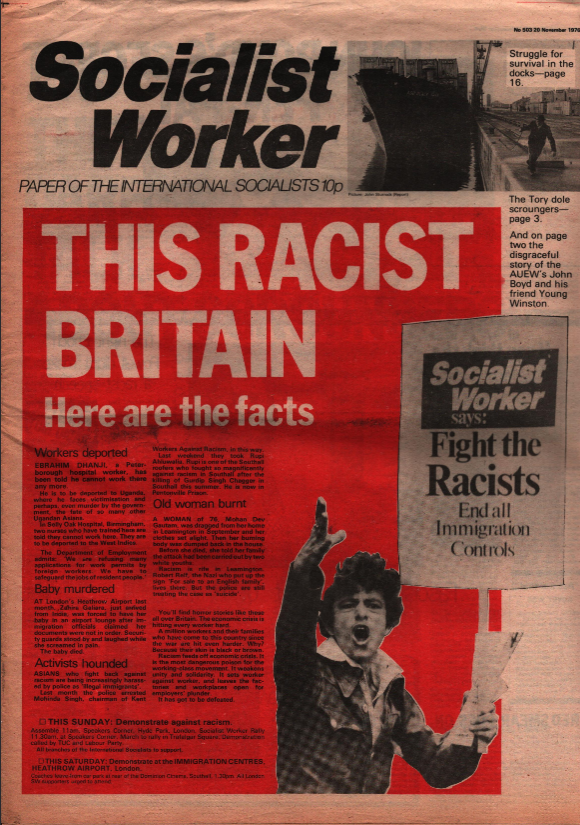
At some point between January and May 1976, Wallace was elected treasurer of the Hammersmith branch of the IS. At a meeting in May 1976, he was offered the position of secretary, which he turned down.
In June, the branches of Hammersmith and Paddington amalgamated to form a new Hammersmith/Kensington branch. This was mirrored at a higher organisational level by the union of Inner West London with North West London districts.
By July 1976, Wallace had added to his role of treasurer of the Hammersmith/Kensington branch by becoming the organiser for the party’s paper, Socialist Worker. He followed this up in January 1977 by being elected as the branch organiser for the Flame sub-group within the SWP and newspaper of that name.
Wallace’s reporting on the branch, district and the various campaigns and activities of the IS/SWP followed the standard patterns of SDS information gathering. Typically, reports began with the political and organisational content of meetings broken down into paragraphs, followed by lists of identified attendees and where possible, personal details such as home addresses, telephone numbers, political and trade union affiliations and occupations.
The kinds and numbers of people reported on ranged from assessments of individuals and couples who were in relationships, through to lists of dozens of attendees to meetings, pickets and protests. It is also likely that Wallace participated in joint reports on major events, such as the Grunwick dispute and the Battle of Lewisham , identifying participants from photographs shown to undercover officers at SDS meetings in safe houses.
Throughout 1976, Wallace reported on the burgeoning Right to Work (RtWC) campaign , the formation of a Hammersmith RTW committee and a Trades Union Committee Against the Prevention of Terrorism Act, all organised and led by the IS/SWP.
As part of the former, Wallace reported on the activities of three schoolchildren from Chiswick Comprehensive School who attended a branch meeting to discuss holding an Right To Work meeting among school-leavers.
The latter contained details of ‘telephone pyramids’, or telephone trees , and semi-spontaneous pickets of police stations in the event that activists were arrested under the Prevention of Terrorism Act (PTA).
Other reports by Wallace in 1976 concerned local campaigns, such as efforts to save Acton Hospital and to reduce fares on London Transport.
In terms of violent protests and demonstrations, Wallace reported on clashes in Coventry between the IS/SWP and the National Front (NF) , and the NF’s recent split, the National Party (NP) , on 23 February 1976.
There were also references to support for those arrested during the Notting Hill Carnival ‘riot’ in late August, with two Black Power organisations highlighted in particular.
In 1977, violent clashes between the NF and NP and the anti-fascist left proliferated, the police typically facilitating far-right marches and the anti-fascists trying to stop or impede them. A new element within these street battles was increasing resistance from multi-racial communities to invasions of their neighbourhoods by racist groups and large numbers of police. Wallace was present and reported on a number of these important events.
SDS managers learned about national mobilisation by the SWP and International Marxist Group (IMG) to counter a march by the NF in the Stechford area of Birmingham, on 26 February 1977.
SDS manager HN34 Detective Chief Inspector (DCI) Geoff Craft knew that several undercovers from the unit might be present, so he requested that HN368 Detective Sergeant (DS) Richard Walker should travel up to Birmingham to ‘look after our [SDS] interests’. The suggestion is that Walker would be monitoring the event, liaising with West Midlands Police force, and intervening if any SDS undercovers were arrested.
The coach trip to Birmingham by Wallace and approximately 40 members of the North West London and West Middlesex districts of the SWP was disastrous. Well before the coach reached Birmingham, there were serious clashes with hundreds of NF supporters at Watford Gap service station. Wallace described this in his report:
At that juncture, however, the party, which had entered the [service] station for refreshments, was sat by 5 coaches full of National Front supporters en route to Birmingham. Immediately, stones, bricks, hot soup and anything also available were hurled at the SWP coach, which made an immediate retreat back onto the motorway.
During this period, the SDS chose not to deploy any undercover officers into the far right.
Upon entering Birmingham city centre, the coach was forced to stop by a march of 700 NF supporters, and the SWP members had to disembark, failing to reach the counter-protest.
The summer of 1977 was dominated by three political issues in different arenas; the national celebrations of the Silver Jubilee of Queen Elizabeth II, the strike at the Grunwick film-processing plants in Willesden in the west London borough of Brent, and the confrontations with the NF in July, in Lewisham in the south of the capital.
Wallace reported on plans by the SWP to disrupt a visit by Princess Anne to the new Kensington Town Hall at the end of May. This anti-jubilee protest was expected to attract an estimated 1,500 people ‘of which about 1,000’ would be local trade unionists, who although not ‘revolutionaries’ were violently opposed to the jubilee celebrations.
Although the Grunwick dispute had been ongoing since August 1976, it only began to attract the attention of the SWP when mass pickets were announced in June 1977. Wallace’s report on the strike and the planned pickets in May 1977 was among the first to highlight the importance of the dispute, which soon gained massive media exposure.
Wallace was likely present at these mass pickets, or at least some of them. In July 1977, he reported on the Hammersmith & Kensington branch meeting which resolved to send two vanloads of SWP members to Lewisham to oppose the NF march and give them a ‘real hammering’.
The confrontations between the NF and their apparent protectors the Metropolitan Police, and the anti-fascist left allied with the local community in Deptford and Lewisham, became an iconic moment in anti-racist British history. It is likely that Wallace was at the event, along with nine other SDS officers, but no reports attributed to him have been disclosed.
The Anti-Nazi League (ANL)
The struggles between the NF and the SWP, the latter as part of the recently formed Anti-Nazi League (ANL) , continued into the winter of 1977-1978, during which the emphasis shifted to control over newspaper sales space. Wallace reported on several confrontations on pitches in King Street, between Chiswick and Hammersmith.
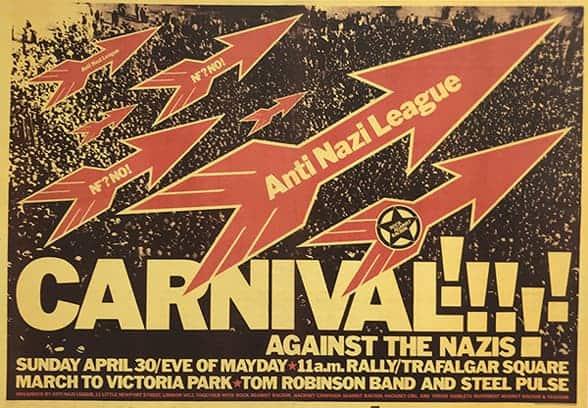
Again, it is likely that Wallace was present at these engagements and his increasing presence in the ANL is reflected in a relatively substantive SDS report on the organisation, its politics and leadership, which appeared in early March 1978. This report included comments on the fractious personal relationships between leading figures on the controlling committee, such as Peter Hain and Paul Holborow, the national secretary of the ANL.
This evidence suggests that Wallace was close to the ANL leadership and this, along with his cover employment, and increasing status in the SWP, may have influenced him being invited onto the three-person ‘logistics’ organising committee for the upcoming ANL carnival at the end of April 1978.
There are no reports after this point by Wallace, and it appears he was withdrawn from his three-year deployment at some point in mid-1978.
On 15 January 2018, the Inquiry published a minded-to-grant restriction order over HN296’s real name. No application was submitted in relation to his cover name, which was confirmed in a ruling in March 2018. His deployment details were released on 4 June 2019.
‘Geoff Wallace’ did not give evidence to the Inquiry as he did not reside in the UK, and the global pandemic prevented him from travelling to the hearings in November 2020. A witness statement is ‘expected when circumstances allow’, although that now seems unlikely. At the time of writing, more than five years had passed.
All procedural and evidential material can be found in the Documents tab.