
Formed in 1883 as the Special Irish Branch, the Metropolitan Police Special Branch (MSPB) grew into a significant division with the Metropolitan Police, headed by an officer of the rank of Commander. It has also been known as B12 and SO12.
In 2006, it was merged with SO13 Anti-Terrorism Branch to form SO15 Counter-Terrorism Command.
The Special Demonstration Squad was set up within the MPSB and run by it until October 2006, after which, for a briefer period, it sat under the new SO15 (Counter Terrorism Command) structure until the beginning of 2008. Many Special Branch officers were involved in the setting up of the National Public Order Intelligence Unit from 1999.
The MPSB was divided into Squads and Desks, each with particular areas of work. For much of the period 1968-2006, the Squads were:
- A: VIP protection duties, administration
- B: Irish-related groups
- C: counter-subversion / domestic extremism, oversaw SDS for some of its existence
- CE: In 1992, 'C' Squad merged with 'E' Squad to form a public order squad.
- D: naturalisation issues
- E: foreign politics and liaison-related issues
- P: ports security
- S: technical matters including surveillance, oversaw SDS for some of its existence
- R: research, referred to as Room 588 or similar
However, responsibilities did change over time.
Individual desks might include ‘Industrial Relations’, ‘Extreme Left Wing’, ‘Black Power’ etc.
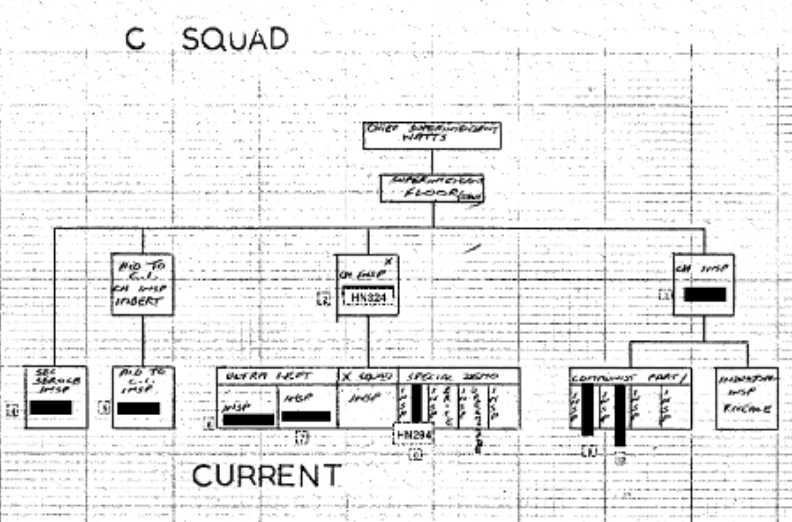
Officers of superintendent or chief superintendent rank headed these squads.
Until 1992, the MPSB had national responsibility for investigating terrorism and coordinating policing responses. It was the main point of contact between the police and the Security Service (MI5), working closely with them, especially as MI5 relied on Special Branches to conduct arrests and prosecutions on its behalf, as it had no power of arrest itself.
It also maintained the Special Branch Registry, a vast database of intelligence reports on political groups and their members.
The squad that the SDS belonged to changed over time:
C Squad 1968-69
'free floating' 1970-72
C Squad 1972-1974
S Squad 1974-1993
CE Squad 1994-2006
Special Branch merged with the Anti-Terrorist Branch in October 2006 to form CO15 (Counter-Terrorism Command)
Operational Support (CO15) October 2006-January 2008
In 2006, Special Branch merged with the Anti-Terrorism Branch to form SO15 (Counter-Terrorism Command), at which point the Special Branch squad structure ceased to exist. However, the SDS continued to function until January 2008, under the new command structure.
The SDS provided intelligence to C squad, which combined it with other sources to produce reports for public order policing units, MI5 or the Home Office. This intelligence collection included intercepting communications, running informers and attending events in plain clothes. Undercover policing developed from this tactic, designed to obtain supposedly higher-grade intelligence by penetrating groups rather than passively observing them.
Each year, the MPSB provided an Annual Report. The Inquiry has released redacted versions, available on the documents tab of this page.
MPSB is not a core participant within the Inquiry, but is represented by the Commissioner of the Metropolitan Police.
The head of Special Branch has changed rank over the years. Understanding rank is complex as the word Commander is also used to refer to Commander Operations, who acted as a deputy head, but not necessarily of Commander rank - though for much of the period concerned, it was. There are also numerous vacant periods for the Deputy Assistant Commissioner rank during which the position would have been taken up by the deputy head.
When the Special Demonstration Squad was founded in 1968, the head Ferguson Smith was a Commander, with several Chief Superintendents serving under him. In June 1969, he became Deputy Assistant Commissioner, still as head of Special Branch. Under him was Commander Operations, as his deputy, and then each of the Squads was head by a Chief Superintendent.
It stayed this way until 1996, when the rank of Deputy Assistant Commissioner was temporarily abolished and the Head of Special Branch was back to rank of Commander.
Deputy Assistant Commissioner returned a few years later, but with an expanded portfolio 'Security', which included Special Branch.
In the table below we present both DAC and Commander ranks.
| Ferguson Smith | Jun 1969 - Jun 1972 |
| vacant | Jun 1972 - Jan 1973 |
| Victor Gilbert | Jan 1973 - Feb 1977 |
| vacant | Feb - Jun 1977 |
| Robert Bryan | Jul 1977 - Sep 1980 |
| vacant | Sep-Nov 1980 |
| Colin Hewett | Nov 1980 - Jul 1985 |
| vacant | July-Aug 1985 |
| Simon Crawshaw | Aug 1985 - Jun 1987 |
| vacant | Jun - Dec 1987 |
| Peter Phelan | Jan 1988 - Dec 1991 |
| vacant | Dec 1991 - Apr 1992 |
| John Howley | Apr 1992 - Aug 1996 |
| DAC discontinued Aug 1996 | |
| DAC (Security) | |
| Barbara Wilding | 2001-2002 |
| Suzanna Becks | 2003-2006 |
| DAC SO15 Counter -Terrorism Command | |
| Peter Clarke | Oct 2006 - Feb 2008 |
Ferguson Smith to John Howley would all be considered Head of Special Branch and appear as such in the histories of Special Branch.
| Ferguson Smith | 1966 - Jun 1969 |
| Arthur Cunningham | Jun 1969 - Aug 1971 |
| vacant | Aug - Sept 1971 |
| Matthew D Rodger | Sept 1971 - Apr 1976 |
| vacant | Apr - Aug 1976 |
| Rollo Watts | Aug 1976 - Apr 1978 |
| vacant | Apr-July 1978 |
| John Wilson | Jun 1978 - May 1983 |
| vacant | May - Oct 1983 |
| Peter Phelan | Oct 1983 - Nov 1987 |
| vacant | Dec 1987 - Feb 1988 |
| "Ben" Dennis G. Gunn | Feb 1988 - Dec 1990 |
| vacant | Dec 1990 - Mar 1991 |
| Donald Buchanan | Mar 1991 - Dec 1994 |
| vacant | Dec 1994 - May 1995 |
| Barry Moss | Jun 1995 - 1999 |
| Roger Pearce | 1999 - 2003 |
| Janet Williams | 2003 - 2006 |
Janet Williams is considered the last Head of the Metropolitan Police Special Branch per se, as afterwards the Branch was merged into SO15 Counter Terrorism Command.