
HN106 ‘Barry Tompkins’ joined the Metropolitan Police in the early 1970s, and moved to Special Branch. For the six months prior to joining the Special Demonstration Squad, he carried out plain-clothes surveillance work. He joined the SDS in 1978 and was deployed into the field from 1979 to 1983.
He spied upon a number of Trotskyist groups, his main targets being the Spartacist League of Britain and the Revolutionary Communist Party. He also co-founded a tiny splinter group with just two other people.
Tompkins was thought by both Special Branch and MI5 to have engaged in two sexual relationships during his deployment. In his written statement to the Undercover Policing Inquiry, submitted on 11 November 2019, Tompkins denied any sexual relationships.
Unless otherwise cited, the material in this profile comes from his witness statement.
Unusually Tompkins had two encounters with foreign intelligence services, including the KGB.
After submitting his written statement, HN106 was excused from giving live evidence by the Inquiry due to ill-health. In 2022, it was announced that his real name would remain restricted despite his death.
HN106 ‘Barry Tompkins’ joined the police in the early 1970s. For six months before joining the SDS, while in Special Branch, he carried out plain-clothes surveillance work but did not have an undercover identity.
Tompkins recalled being told there were vacancies within the SDS, so he approached SDS manager HN135 Mike Ferguson. Tompkins, who was married, said he was aware that the SDS preferred to recruit married men; he assumed this was due to the support their spouse could offer them – and that married men would be less likely than single men to ‘go rogue’.
Tompkins joined the SDS during 1978, but was not deployed until 1979.
He said there was no formal training given when he joined the SDS but he read intelligence reports and activist literature to familiarise himself with various activist groups’ activities.
Tradecraft
HN106 used the name and date of birth of a deceased child called Lionel Barry Tompkins to construct his cover identity. His cover employment was as a delivery driver for a garden centre. Tompkins said that he had a number of cover flats during his deployment, and that towards the latter part of his deployment he shared a flat in north London with fellow undercover officer, HN96 ‘Michael James’.
HN106 ‘Barry Tompkins’ infiltrated a number of Trotskyist groups.
Tom Fowler and Chris Brian discuss Tompkins' deployment in a Spycops info podcast.
His target groups included the Spartacist League of Britain , Revolutionary Communist Tendency, Revolutionary Communist Party , East London Workers Against Racism , and Revolutionary Marxist Tendency (RMT). Additionally, in his statement, he admitted to being one of three people who co-founded a small group; this was probably the Revolutionary Labour League.
The Spartacist League of Britain (SLB) was the main focus of Tompkins’ reporting until around mid-1980. Tompkins stated that he was not a member; former members have described the group as having a rigorous membership process.
The large majority of Tompkins’ reporting from 1980 concerned the Revolutionary Communist Tendency/Party and, from the end of 1980, a group connected to it; Workers Against Racism (WAR).
Tompkins’ reporting contains a significant amount of coverage of anti-racism campaigning, including this group and others related to it. This included the New Cross Massacre Action Committee and the Afua Begum anti-deportation campaign.
Tompkins co-founded a group
Tompkins referred in his statement to forming his own three-person activist group. He could not remember the name of the group but said he created it with two others who had expressed dissatisfaction with groups they were involved with.
Two of the smallest groups spied on by Tompkins were the Revolutionary Labour League and the Revolutionary Marxist Tendency – both appear to have been short-lived and tiny. One activist recalled the RLL having just three members.
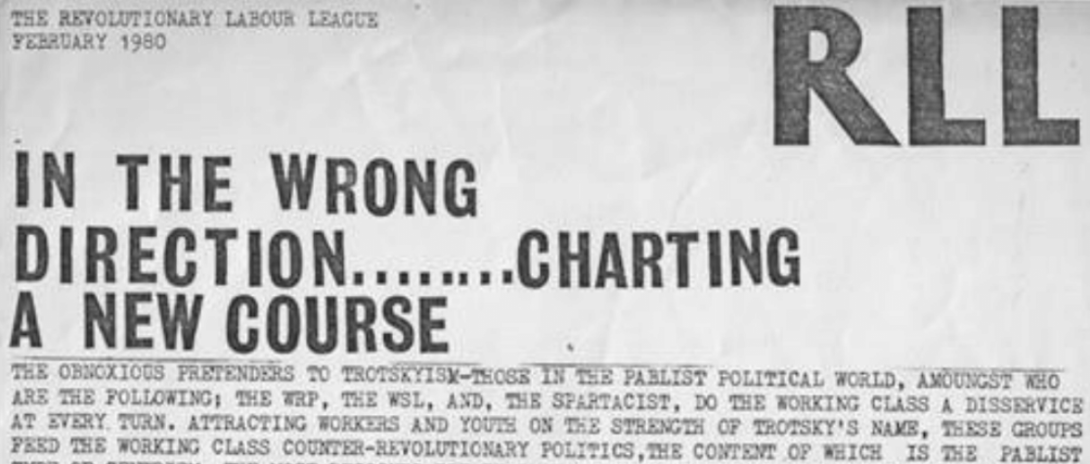
The fact that Tompkins drifted between several established groups and was allowed to form his own faction highlights the leeway that SDS undercovers were allowed. Although he could not recall the new group’s name, Tompkins did remember who the other two members were. He said being associated with them gave him extra credibility. In addition, it allowed him to attend meetings of other groups as his group’s representative.
Reporting on personal details
Some of Tompkins’ reporting on these groups delves into intimate personal details. One report touches on an individual’s immigration status, his job and alleges that he is in a ‘marriage of convenience’. It also gratuitously mentions that this person is in a ‘sexual relationship with another RMT member’ and that ‘judging by the depressing regularity with which [privacy] suffers from attacks of cystitis, neither is permitting [privacy]’s tenuous position in the United Kingdom to interfere with more immediate needs’.
Another report states that a member of the Revolutionary Communist Party had an abortion. Tompkins said in his written statement that he could not see how he would have been privy to such information. However, this does not explain why the SDS would have considered the information relevant in general. Notably, this is the only information contained in this report – other than speculation about who the father may have been.
Other groups reported on
The earliest report that related to HN106 is dated 30 May 1979 and relates to a leaflet issued by the Friends of Blair Peach Committee concerning the alleged circumstances that led to the death of Blair Peach on 23 April 1979 during an anti-National Front demonstration. Tompkins filed other intelligence reports concerning Blair Peach, including information about his funeral. Again, Tompkins denied responsibility for any such reporting. Tompkins also reported on many other justice campaigns, including the Richard 'Cartoon' Campbell and Jimmy Kelly Campaign , the Bradford 12 , and the Afua Begum campaigns.
The most controversial aspect of Tompkins’ deployment was the allegation that he engaged in sexual relationships while undercover.
This was a common issue among many SDS officers and, in Tompkins’ case, both MI5 and his SDS managers appear to have believed he had relationships with two women. However, Tompkins himself denied both allegations, claiming he never engaged in any romantic or sexual relationships while undercover.
The two allegations involved two women, whose names were censored by the Inquiry for privacy reasons. For clarity, they will be referred to here as ‘Woman One’ and ‘Woman Two’.
‘Woman One’
MI5 records suggest Tompkins may have had a sexual relationship with a female activist, (‘Woman One’), who it considered a potential recruit for intelligence work.
MI5 mentioned in the context of a meeting with SDS manager HN99 Dave Short that Tompkins had ‘probably bedded her and been warned off by his bosses’. Tompkins denied any sexual involvement, stating that he barely remembered ‘Woman One’ and only recalled her due to an alleged ‘party trick’ – that she could lactate on demand.
Tompkins refers in his statement to a police investigation called Operation Randwick, part of the broader investigation into the SDS called Operation Herne. According to Tompkins, it was put to him that MI5 had asked the SDS whether it possible to approach this woman with a view to her becoming an informer. Tompkins denied this, as well as the central allegation that he had a sexual relationship with her.
It was submitted by lawyers representing activists deceived into sexual relationships by undercover officers that MI5 having minuted this information made Tompkins’ explanation unconvincing.
‘Woman Two’
Tompkins conceded that he spent significant time with another woman, referred to here as ‘Woman Two’. She was the ex-partner of an activist he had spied on who was in the Revolutionary Communist Party (RCP). After the woman split with her activist partner, Tompkins said he bumped into her and started a friendship in his cover identity. He stated that they socialised frequently and that he stayed over at her home at least five times after drinking too much. Tompkins admitted that the woman was not a surveillance target herself.
Tompkins recalled HN307 Trevor Butler , his manager in the SDS, mentioning that an intercepted telephone call between RCP members suggested that Tompkins had started a sexual relationship with ‘Woman Two’. A telephone intercept included a reference to ‘Barry’s girlfriend’s place’. Tompkins remembered Butler saying something like ‘You’re not going to get us into trouble are you?’ and that he (Tompkins) replied: ‘No, it’s nothing like that.’ Butler denied that this exchange took place.
Tompkins insisted that the relationship was entirely platonic, claiming he slept in the woman’s child’s room on the occasions he stayed over. He acknowledged that activists referred to ‘Woman Two’ as ‘Barry’s Girlfriend’, but said this was a misperception he chose not to correct because it helped to maintain his cover.
In a statement on behalf of the Category H Core Participants, it is stated that in the case of ‘Woman Two’:
it is unlikely this intimate and close relationship remained entirely platonic as HN106 suggests over a sustained period of time. That he became known as her boyfriend suggests a common understanding among his target group that a sexual relationship did develop.
An extraordinary aspect of Tompkins’ deployment was his attempted recruitment by the KGB and contact with a South African agent. These are the only two known examples of an SDS officer being involved with foreign intelligence services.
The first interaction began after Tompkins attended an RCP meeting that was also attended by a member of the Soviet embassy staff, identified as the military attaché. The Russian was later confirmed to be KGB. Tompkins believed the attaché approached him without knowing he was an undercover officer.
The KGB officer directly asked Tompkins to transport documents or information as a courier. The officer suggested that Tompkins travel to the USSR for training. A further meeting was set up at a pub opposite Hackney Town Hall.
SDS and MI5 response
Tompkins immediately reported the interaction to SDS management. SDS contacted MI5, which unsurprisingly took a keen interest in the matter. At a meeting on 16 June 1982, the SDS leadership made it clear to the Security Service that no follow-up meeting would be allowed between Tompkins and the Soviet attaché. The main reason was to protect SDS from potential exposure due to:
...the considerable expense involved and its primary objective being law and order rather than an intelligence gathering context.
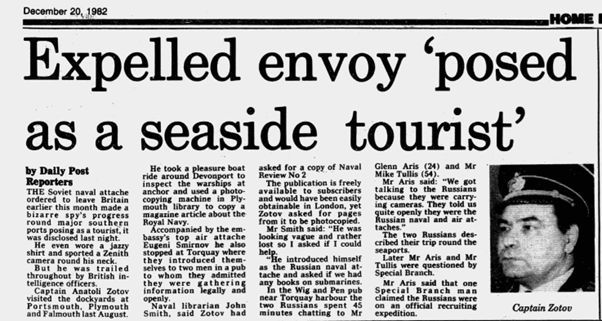
Tompkins had no further contact with the Soviet attaché and later recalled reading in a newspaper that the officer was expelled from the UK for attempting to recruit British Navy personnel in Plymouth.
In 1982, Russian naval attaché Captain Anatoli Zotov was expelled from the United Kingdom for trying to acquire information near various British naval bases, including Devonport in Plymouth. It is not certain whether Zotov is the person that Tompkins referred to.
Contact with another foreign security agency
Tompkins also stated that a member of small Trotskyist group the Revolutionary Marxist Tendency and the RCP was linked to another intelligence agency. This foreign agent provided funding in exchange for information, particularly on views regarding apartheid.
The name of the agency was redacted, but the focus on apartheid strongly suggests that it was the apartheid-era South African intelligence service, BOSS. Although Tompkins said he reported this to SDS management, no intelligence reports exist to back up this claim. Tompkins expressed surprise that no such record could be found.
HN106 said that five years after he left the SDS, while still working in Special Branch, he was contacted by Detective Chief Inspector HN115 Tony Waite, who was in charge of the SDS between 1984 and 1986.
HN106 says he was asked to attest to the accuracy of his reporting about a particular individual who was under threat of deportation from the UNuted Kingdom. HN106 confirmed the information was true but never found out whether any action was taken.
After retirement in the late 1980s from Special Branch, at the rank of detective sergeant, HN106 became a private investigator. On one occasion, he used a false identity to obtain information but said this was not comparable to his SDS undercover role.
You can see the documents referred to below by clicking on the Procedural section at the bottom of the Documents tab.
Lawyers for the Metropolitan Police applied to restrict HN106’s real name only in an application made on 28 January 2018. On 7 March 2018, Inquiry chair John Mitting said he was willing to agree with the application to protect HN106’s and his family’s privacy.
On 26 June 2018, HN106’s cover name and target groups were released, but a ruling confirming the restriction of his real name was issued on 18 July 2018.
In January 2019, ‘Roy’, a former member of the Spartacus League, applied to be a core participant in the Undercover Policing Inquiry due to HN106’s infiltration. However, in a letter from the Inquiry’s solicitor, Michael Pretorius, this was refused.
On 11 November 2019, HN106 submitted a written statement to the Inquiry. However, due to Tompkins’ ill health, a request for him to submit a supplementary statement was withdrawn by the Inquiry. Tompkins died soon afterwards.
Nevertheless, on 22 July 2022, Inquiry chair Sir John Mitting chose not to revoke the restriction order on HN106’s real name, citing concerns about the Tompkins family’s privacy.