
The Strategic Intelligence and Briefing (SIB) unit within NPoCC is the latest iteration of the UK’s national-protest intelligence system. It took over this responsibility from the National Domestic Extremism and Disorder Intelligence Unit (NDEDIU).
Since 2020, SIB has been responsible for assessing national‑level protest and disorder risks, producing intelligence used for public order policing.
Following the abolition of the National Public Order Intelligence Unit (NPOIU) in 2011, its protest and public‑order intelligence functions were absorbed into the National Domestic Extremism Unit (NDEU) and later into the National Domestic Extremism and Disorder Intelligence Unit (NDEDIU).
Within the NDEDIU, the Strategic Sensitive Intelligence Unit (SSIU) coordinated Covert Human Intelligence Sources (CHIS) and managed all intelligence on protest movements.
By 2015, NDEDIU’s functions were reduced, and its protest‑related responsibilities were integrated into the National Police Coordination Centre (NPoCC). The formal establishment of the SIB within the NPoCC occurred on 1 April 2020, when its analytical and assessment functions transferred from the Counter Terrorism Policing Headquarters (CTPHQ).
This structural change coincided with the reassignment of national security primacy for Extreme Right‑Wing Terrorism (ERWT) and Left‑, Anarchist‑ and Single‑Issue Terrorism (LASIT) to MI5. As previously stated, the SIB was established in 2020.
The SIB works alongside the NPoCC Operations team, providing the national policing network with intelligence support to assess strategic threats arising from protest and public disorder. It issues daily and weekly intelligence briefings to police forces and government agencies. Its primary function is to assess incidents that may meet the ‘national strategic protest threshold’, defined as events likely to cause large‑scale disruption or community tension.
For instance, in 2023, the NPoCC reported that more than 800 protests and vigils were reported to the SIB in a single monitoring period, with 88 events assessed as meeting the national strategic threshold.
The SIB also collates and circulates intelligence on what His Majesty’s Inspectorate of Constabulary and Fire and Rescue (HMICFRS) calls ‘aggravated activism’ – protest activity involving criminality or disorder significant enough to affect regional or national stability. The concept of ‘Aggravated Activism’ has been criticised by the Network for Police Monitoring (Netpol) as unfair and subjective.
The SIB produces a series of intelligence products, including group assessments, event briefings, and thematic reports. Each product is built using a structured risk‑assessment framework derived from the People, Object, Place, System – Strategic Risk Assessment (POPS‑SRA) model. This method supposedly evaluates protest groups based on their capability, intent, and impact.
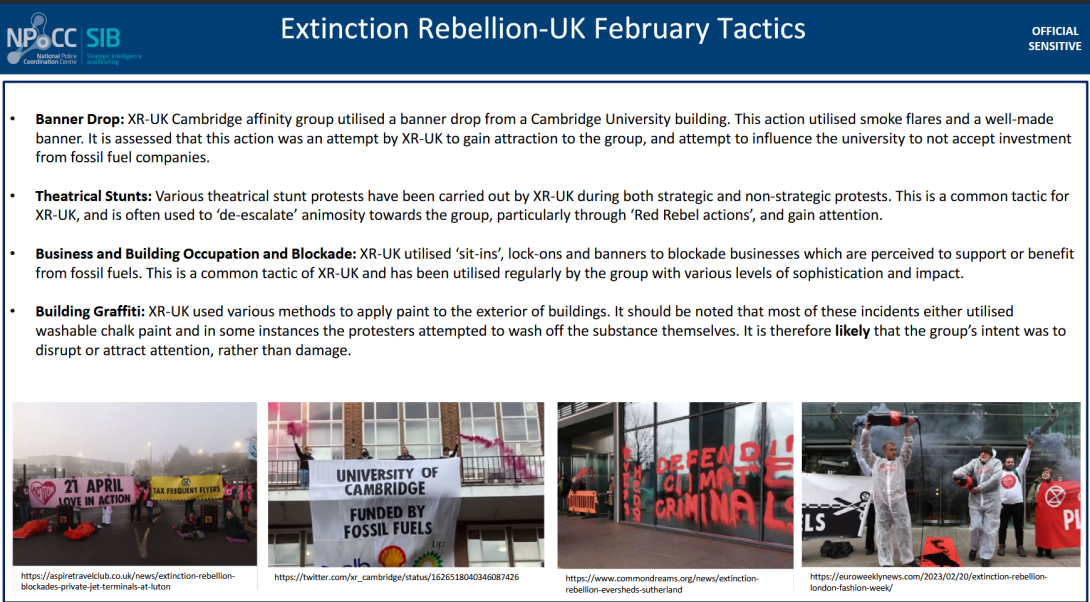
The SIB’s Extinction Rebellion (XR) assessment demonstrates how the unit assesses groups using a 'Cone of Plausibility' model to predict group behaviour, tactics, and likely protest escalation.
Some of the report’s assessment of XR contains questionable analysis. For instance, it describes XR’s capacity to organise ‘banner drops’ and ‘lock-ons’ as evidence of the group’s ‘sophistication’. However, these are two of the most basic, well-known and relatively easy types of action for any protest group to plan and execute.
SIB’s assessments provide intelligence for national and regional police units and are designed to inform decisions under the National Mobilisation Plan.
Another protest group that sprang from XR was 'Just Stop Oil' (JSO). In 2022, the Highways Agency took out controversial protest injunctions against the group and individual members. The NPoCC produced a report that assessed whether the injunction was an effective means of curbing JSO's disruptive protests. They concluded that it was.
SIB’s work also includes providing analysis to Counter Terrorism Policing (CTP) and the Home Office, and coordinating on ideological and single‑issue threats.