
The National Police Coordination Centre (NPoCC) coordinates the local, regional and national police response to a range of events, including public-order incidents. It was formed in April 2013 and is part of the National Police Chiefs’ Council (NPCC).
One part of the NPoCC is the Strategic Intelligence and Briefing (SIB) team, which operates under the NPCC. This sub-unit is an indirect successor to the National Public Order Intelligence Unit (NPOIU), although it is not believed to utilise undercover officers. A separate article details the SIB. This article summarises the NPoCC’s remaining functions, which include national public order planning and response.
The NPoCC works with all forces across England and Wales, as well as Police Scotland, Police Service of Northern Ireland (PSNI) and non-home office forces including Jersey, Guernsey, Isle of Man, the Civil Nuclear Constabulary and other national police units to undertake a rolling programme of capacity assessments for a wide range of specialist police skills.
Like the NPCC, the NPoCC is hosted by the Metropolitan Police Service, but reports to the NPCC itself. Specifically, its functions are:
- 6.1.1 To support the operational coordination of national operations including informing, monitoring and testing force contributions to the Strategic Policing Requirement working with the National Crime Agency where appropriate
- 6.1.2 To support the operational coordination of the national police response to national emergencies and the coordination of the mobilisation of resources across force borders and internationally
- 6.1.3 Coordinate the Police Service response and provide representation during COBR (Cabinet Office Briefing Room)
- 6.1.4 The coordination of the national police response to UK disaster victim identification
- 6.1.5 The continual assessment of national capacity and capability in relation to the Strategic and National Policing Requirements and maintaining information and data sets relating to policing specialist skills and assets for the benefit of the police service
- 6.1.6 To coordinate a continuous testing and exercising regime to ensure effective mobilisation of national assets in a crisis
- 6.1.7 Developing reporting mechanisms with the Home Office and central government crisis management.
In August 2011, widespread riots took place across England, triggered by the police killing of Tottenham resident Mark Duggan. The considerable property damage led to the police’s response to the disorder being widely criticised from a variety of standpoints.
A 2011 HM Inspectorate of Constabulary report into the policing response focused on the technical-response issues and found that the Police National Information Coordination Centre (PNICC) was not up to the job, being ‘reactive’ rather than ‘proactive’, and that its response was patchy due to under-utilisation of its information and resources.
Consequently, on 13 April 2013 the NPoCC replaced the PNICC, funded directly by the Home Office. A media release issued on the NPoCC’s first anniversary in April 2014 said:
Commissioned by the Home Office and led by the Association of Chief Police Officers (ACPO), NPoCC replaced the Police National Information Centre (PNICC) and was created with a wider remit to ensure policing is better prepared for large-scale disorder, such as the riots of 2011.
On NPoCC’s launch, it was stated:
NPoCC will be a lot more proactive than PNICC, which previously focused either on pre-planned events, or when activated in response to a spontaneous emergency.
NPoCC will carry out the same duties, but also focus on:
• Monitoring which specialisms are available nationally in each police force such as firearms, public-order officers, search officers, mounted officers, and dog handlers, among others.
• Establishing a test and exercise regime to ensure effective mobilisation of national assets in a crisis
• Dealing with significant-event planning
• Working closely with the National Domestic Extremism Unit (NDEU) to monitor intelligence and effectively prepare for potential threats.
The NPoCC reports to the NPCC and is monitored by an eponymously named governance board. However, although the NPoCC is the lead police agency for many major incidents, this does not include cases deemed connected to terrorism. These cases fall to the Counter Terrorism Policing Operations Centre (CTPOC) for operational purposes and to the UK National Counter Terrorism Policing Headquarters (NCTPHQ) for policy development. The NPoCC assists with asset management and audit for counter-terror and organised crime purposes.
There is also significant overlap between the NCTPHQ remit, as it included ‘domestic extremism’, and public-order incidents that still fall under the NPoCC’s remit.
In 2017, a budget was planned to employ five senior police officers holding the following ranks within the NPoCC: one assistant chief constable, one chief superintendent, one superintendent and two inspectors.
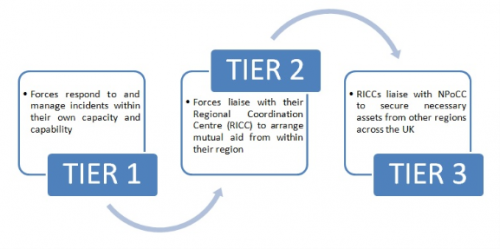
Depending on the scale and seriousness of ‘major incidents’, the role of the NPoCC will vary. It uses a three-stage schemata:
Tier 1 – Local: The local force will deal with the event itself and will make use of its own resources. ‘An assessment of whether resources will be needed from outside the force area – and whether assets are available regionally through the Regional Information and Coordination Centres (RICCs) or nationally through the NPoCC will be a matter for assessment by senior officers from all those police bodies’.
Tier 2 – Regional: ‘The coordinating organisation will be one of the nine RICCs’. The NPoCC’s role will be to assess whether the (‘mutual aid’) resources needed are available at regional level, or whether the request needs to be escalated to a national level.
Tier 3 – National: NPoCC is responsible for mobilisation at a national level. It ‘assesses national capacity and contribution in relation to the Strategic Policing Requirement and National Policing Requirement, establishes and coordinates continuous testing and exercising regimes to ensure effective capability and mobilisation of national assets when required facilitates mutual aid in and provides a coordination facility in times of crisis [that] ensures effective reporting mechanisms with the Home Office and central government crisis management structures’.
The NPoCC also takes the lead in cases where mass fatalities occur.
It works with other national coordination centres that have responsibility for mobilising specialist resources for example, the Counter Terrorism Coordination Centre (CTCC) and the Police National Chemical Biological Radiological and Nuclear (CBRN) Centre.
Mercury System
The Mercury Computer System is used by the NPoCC, local police forces and National Counter Terrorism Policing Headquarters (NCTPHQ). The system ‘assists in managing the mutual-aid deployment of police resources across force geographic boundaries’. It also identifies the number of ‘specialisms’ available within each force.
2013 G8 meeting, Fermanagh
The launch of the NPoCC mentioned that the meeting of the G8, hosted by the UK and taking place at Lough Erne golf resort in Fermanagh in Northern Ireland on 17 and 18 June 2013, would be:
the biggest police operation in Northern Ireland’s history, involving 8,000 officers, 4,400 of them local and 3,600 from England and Wales.
There was no counter-mobilisation on the scale that either the 'Dissent! Network' or 'G8 Alternatives' launched when the G8 visited Scotland in 2005. Counter-Terror Command and the Security Services would have been responsible for public-order or terrorist threats, which did not materialise during the conference. Nevertheless, the NPCC stated that in 2013 the ‘NPoCC supported the G8 summit in Northern Ireland [and] assisted PSNI in dealing with wide-scale riots during the marching season.’
Anti-fracking protests
Protests against high-pressure drilling for shale gas, or fracking, started in the UK in 2011. This controversial and environmentally damaging extractive industry had already drawn significant resistance in the US and Canada.
The 2011 anti-fracking protests were the first significant mobilisations by UK social and environmental movements after the news broke that undercover police officers had been tasked to spy on political activists, deployed for significant periods to infiltrate and report on protest groups.
Groups that undercover officers had targeted in the recent past were now part of the anti-fracking movement. Aggressive public-order po licing, a long-term feature of the police response to environmental protests, continued and even intensified during the anti-fracking protests.
A College of Policing public-order training exercise conducted in 2014 used a fictional anti-fracking protest as part of the exercise.
The NPoCC coordinated police ‘mutual aid’ requests to anti-fracking protests in 2013/2014 in Balcombe, Sussex and later, in 2017, at the Cuadrilla site in Lancashire. However, several official police documents have suggested that the lead agency would have been the NCTHQ, having classified the protests and protesters as ‘domestic extremist’, even referring some individuals to the UK government’s controversial PREVENT counter-terrorist programme.
President Trump’s visit to UK
The NPoCC was also involved in organising ‘mutual aid’ to police US President Donald Trump’s visit to London in July 2018.
Preparing for Brexit
A September 2018 article in The Sunday Times made a number of claims about police preparations for a ‘no-deal Brexit’, based on a secret report written by the NPoCC:
Police chiefs are drawing up contingency plans to deal with widespread civil disorder at the country’s borders and ports in the event of a no-deal Brexit, according to a leaked report.
The article warned that the main concern for the police was that food and goods shortages, including medical supplies, would trigger ‘widespread unrest’. It went on to report that the disruption and civil unrest could last for three months either side of March 29, rather than the six-week period of disruption that the government had planned for.
Extinction Rebellion and other ‘nationally significant protests’
One of the most heavily publicised uses of the NPoCC mutual aid function took place during the climate change protests organised by Extinction Rebellion (XR) in October 2019, for which all 44 British forces, including Police Scotland, gave ‘mutual aid’.
The National Police Chiefs’ Council said ‘500 officers [were] drafted in from across England and Wales, with police being sent from all 10 regional organised crime units that cover the two countries’. This included 100 officers from Scotland.
According to former Metropolitan Police Commissioner Cressida Dick, policing this protest cost £37 million. In November 2019, the High Court found that the Metropolitan Police's use of Section 14 of the 1986 Public Order Act to ban all XR protests was unlawful.
NPoCC also coordinated other ‘nationally significant protests’, including those involving Insulate Britain, Extinction Rebellion, Just Stop Oil, Animal Rebellion, and the G8 protests in Cornwall in 2021, as well as anti-lockdown and anti-vaccine protests.
Operation Navette response to 2024 racist riots
In early August 2024, far-right UK groups unleashed a wave of racist violence against asylum seekers, targeting hotel accommodation housing refugees. The NPoCC was in charge of resourcing police for ‘Operation Navette’, the largest mobilisation of public-order officers since 2011. This was the first time the national mobilisation plan was activated to create a national strategic reserve of public-order officers.
Afterwards, an HMICFRS report concluded that the deployment of ‘mutual aid’ support worked well, although the decision to deploy support could have been made earlier. On some occasions, refugee hotels had only counter-protesters to protect them.
The NPoCC works with NPCC committee leads and the College of Policing ‘to develop an ongoing exercising regime to test police mobilisation in response to a variety of scenarios including natural disasters and wide-scale disorder’.
Bermuda Protests
Chris Shead conducted a review of policing on behalf of the NPoCC of a protest at the House of Representatives in Bermuda, a British overseas territory, regarding the controversial development of the airport. Disruptions in parliament and scuffles between police and protesters escalated until the officers withdrew, and parliament was suspended for the day.
Operation Skep
Operation Skep was a Kent Police operation to control right-wing protests and pro-refugee/anti-fascist counter protests in Dover, Kent in February 2016. Physical clashes between the two groups of protesters prompted complaints from businesses and other local interests about disruption to the town. A review of policing undertaken by the NPoCC, also authored by Shead, vindicated’ the police tactics.
Senior officers
At time of writing, Assistant Chief Constable Mark Williams led the National Police Coordination Centre, overseeing national mobilisation, intelligence, and briefing. He chairs the NPCC Civil Contingencies portfolio, coordinating with government on emergency preparedness. Having served since 1993, Williams has held senior roles in Police Scotland and led major operations including EU Exit and COVID-19.
Chief Superintendent Matt Lawlor leads Operations and Strategic Intelligence, supporting national mobilisation, government liaison, and coordination across UK forces and territories. He has experience in operational policing, firearms, and public order command. Formerly Head of Specialist Operations for Devon, Cornwall, and Dorset, he joined NPoCC in 2022.
Superintendant Kris Barnard, is the current head of operations unit. He joined Norfolk Constabulary in 1997 and has served in various operational and command roles. He has worked in firearms, roads policing, and specialist operations across Norfolk and Suffolk. Since 2023, he has led joint specialist operations, overseeing officer deployment changes and a review of Taser training.
Former senior officers
Owen Weatherill
From July 2019, Assistant Chief Constable Owen Weatherill led the NPoCC. He had served 26 years with Hertfordshire Constabulary, much of it in detective and intelligence roles, including as senior investigating officer. A qualified gold commander for firearms, public order, and chemical, biological, radioactive and nuclear (CBRN), he managed major events including the 2012 Olympics and political conferences.
Nigel Goddard
Chief Superintendent Nigel Goddard succeeded Weatherill in 2020, after serving as NPoCC deputy head since 2018. With 25 years in the Royal Ulster Constabulary (RUC) and Police Service of Northern Ireland (PSNI), he specialised in operational policing and public order. As PSNI head of operations, he oversaw the public order, armed response, and roads policing units and contributed to policing the G8 summit in Northern Ireland.
Howard Hodges
Superintendent Howard Hodges became Deputy Head in 2020, following 25 years with Sussex Police. He previously oversaw operational dogs, public order, and CBRN teams, and managed protests, conferences, and football policing.
Earlier heads included Commander Chris Greany (2014-2017), Assistant Chief Constable Stuart Williams, and Assistant Chief Constable Chris Shead, all of whom held senior national public-order or intelligence roles before or after serving with NPoCC.