
This page sets out how the paper files in the Metropolitan Police Special Branch Registry, the Registry Files (RF), were organised and categorised. Pre-computerisaton, the Registry was a large number of paper records, organised into files and accessed through a number of indexes.
They were primarily organised into:
1) Personal files which contain information relating to a specific subject of counter terrorism or domestic extremism interest.
2) Bulk files which contain information relating to either a specific topic or a miscellaneous area of counter terrorism or domestic extremism.
3) Indicies used to navigate the system.
Often these were referred to as 'Pink' or 'Secret Pink' files from the colour of their covers. However, particularly sensitive files, those categorised as '588', were called 'Secret Green'.
Although computerisation with MPSB began in the 1980s, the process was slow and limited, and only the top 300 records of interest were computerised. Computerisation only began in earnest in the early 2000s.
Much of the public information regarding this comes from two statements from the Metropolitan Police Service in response to questions from the UCPI: those of Alistair Pocock and Steven Proctor. Pocock sets out the organisational system of the pre-computerisation of the Registry’s paper files. While Proctor goes into the numbering system of the files themselves.
Despite repeated requests by non-state core participant to receive their individual Registry Files, neither the Metropolitan Police nor the Inquiry have disclosed them. The only exception to this was Diane Langford, who used a Subject Access Request under the Data Protection Act to obtain part of hers. She subsequently added this as an exhibit to her second witness statement.
A limited number of Registry Files mainly dating from the first half of the 20th Century are available at the National Archives. Most Registry Files have been destroyed, and of those which have been kept for future publication, most of these have been retained by the Home Office with their release date uncertain. For instance, most of those relating to prominent members of the Communist Party of Great Britain, or from Irish Republican organisations in the 1920s are still deemed too sensitive to be published. Those which are retained, tend to be from the high echelons of political organisations or well-known figures such as Eric Blair, better known as George Orwell. The vast of majority on 'rank-and-file' or 'ordinary' people who were poltically active have been destroyed. This distorts the historical record.
Pre-computerisaton, the Registry was a large number of paper records, organised into files and accessed through a number of indexes.
Files were organised by three numbers:
Their RF or 'cut' number, which denoted the subject or topic of each file, was three digits long. Proctor's statement lists the topics corresponding to specific numbers (see below).
Two digits representing the year the file was opened; for a personal file, this remained unchanged, but for a group file, this could change as it moved to a new paper folder, the year indicating when this change happened. This is why groups have multiple Registry Files,
A numerical index starting at 1 for that year.
So, for instance, 348/72/121 would represent the 121st file created in 1972 relating to the topic 348 (Strikes and Disturbances).
Nominal index
According to Pocock, this:
consisted of binders containing white card slips that noted the biographical data of individuals (for example, their names and aliases) and a summary of their known activity. The slips were cross-referenced with relevant file numbers (known as 'mentions'). The slips were an aid to finding the files in which an individual was referred to.
Once a file was opened on an individual, the white slip was replaced by a pink one, 'containing the individual's biographical data and personal file number.'
Subject Index
This was a card index that contained dedicated sections for entities such as groups, policy, operations, and events, as well as a large miscellaneous section. It was made up of white cards that summarised the information contained in the reports and cross-referenced with the relevant file numbers.
Their main purpose was to assist in finding the original reports sorted in the Registry. When a bulk file (see below) was opened, the white card was replaced with a pink card detailing the bulk files created for that subject. When computerisation took place, the pink cards were added to the electronic database, but the white cards in the index were destroyed.
In 2004, it was described as:
The subject index contains details of organisations, firms, terrorist incidents, demonstrations and events to name just a few subject areas. Team members also record non-personal information relating to operations, policy and various enquiries on behalf of SO12, other police forces and government agencies. ... Over the last two years the section has run an intensive weeding, revision and destruction programme in preparation for conversion from a manual to a computerised system.
Locations Index
Pocock noted:
Each registered hard copy file had a corresponding location slip bearing the file number and title. This was used to book out files to sections or individuals and acted as an audit trail.
The Locations Index has not been computerised, and as of 2017, is located in the IMOS file store, where it is used to search for historical paper copies of Personal and Bulk files.
The list of known numbers corresponding to the topic was:
301 - Historical cut number — Discontinued pre-1970s; the subject area it refers to is not known.
335 - Bulk Files re Irish Republican Terrorism up to 1993, which then became Personal Files re Irish Republican Terrorism from 1994
346 - Meeting, Demonstrations and Conferences
347 - Literature
348 - Strikes and Disturbances
355 - Passports, including policy and visas
361 - Special Branch Policy, Legislation, Conferences, Training and Terrorism Act Counter Terrorism (TACT) reports
370 - Operations — Arms and Explosives
371 - Miscellaneous — includes bulk files related to port movements, etc.
399 - Loyalist Para-Militaries (personal)
400 - Organisations
401 - Extreme Right-wing
402 - Extreme Left-Wing — including Communist/Marxist-Leninist and Maoist groups
403 - Historical Irish — superseded by 405
404 - Historical Asian — superseded by 405
405 - Personal files — non-specific
406 - Historical only — Trade Disputes
407 - Personal files — UK Subjects born in Eastern Europe
408 - Personal files — Non UK Subjects, mainly born in the Middle East
588 - Especially sensitive files which cross over the above cut numbers ('secret green' files)
Former undercover, SDS manager and C Squad staffer, HN218 Barry Moss , was asked in his live evidence about the markings on the files Diane Langford obtained. He noted they came from the now-discontinued Government Protective Marking Scheme (GPMS). He stated C was for Confidential, S was for Secret, and SP meant Secret Pink, which covered meaning material accessible to anyone in Special Branch. Secret Green was for top secret material.
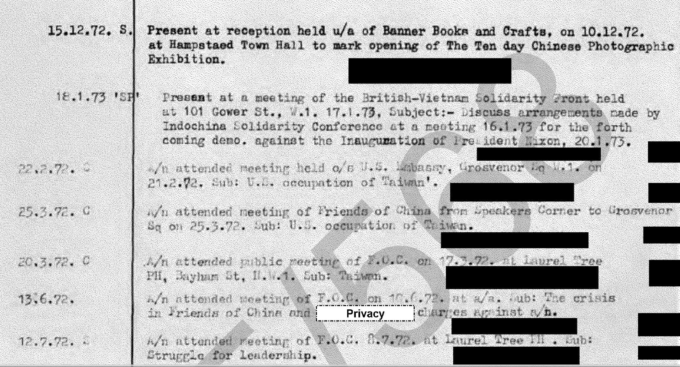
The GPMS used a five-level categorisation scheme where the following criteria for the top, more secure, three, with some level of security vetting needed to access them:
Criteria for assessing TOP SECRET assets:
- threaten directly the internal stability of the United Kingdom or friendly countries;
- lead directly to widespread loss of life;
- cause exceptionally grave damage to the effectiveness or security of United Kingdom or allied forces or to the continuing effectiveness of extremely valuable security or intelligence operations;
- cause exceptionally grave damage to relations with friendly governments;
- cause severe long-term damage to the United Kingdom economy.
Criteria for assessing SECRET assets:
- raise international tension;
- to damage seriously relations with friendly governments;
- threaten life directly, or seriously prejudice public order, or individual security or liberty;
- cause serious damage to the operational effectiveness or security of United Kingdom or allied forces or the continuing effectiveness of highly valuable security or intelligence operations;
- cause substantial material damage to national finances or economic and commercial interests.
Criteria for assessing CONFIDENTIAL assets:
- materially damage diplomatic relations (i.e. cause formal protest or other sanction);prejudice individual security or liberty;
- cause damage to the operational effectiveness or security of United Kingdom or allied forces or the effectiveness of valuable security or intelligence operations;
- work substantially against national finances or economic and commercial interests;
- substantially to undermine the financial viability of major organisations;
- impede the investigation or facilitate the commission of serious crime;
- impede seriously the development or operation of major government policies;
- shut down or otherwise substantially disrupt significant national operations.
The remaining ones were RESTRICTED, PROTECT and UNCLASSIFIED. In 2012, it was superseded by the Government Security Classifications Policy.