
Class War was a tabloid-style anarchist newspaper founded in 1983 by Ian Bone. In 1986, the movement that published it became the Class War Federation (CWF), a national anarchist federation.
Its roots lie in the punk scene and as a reaction to anarcho-punk bands such as Crass, whose political message appeared to shift towards pacifism.
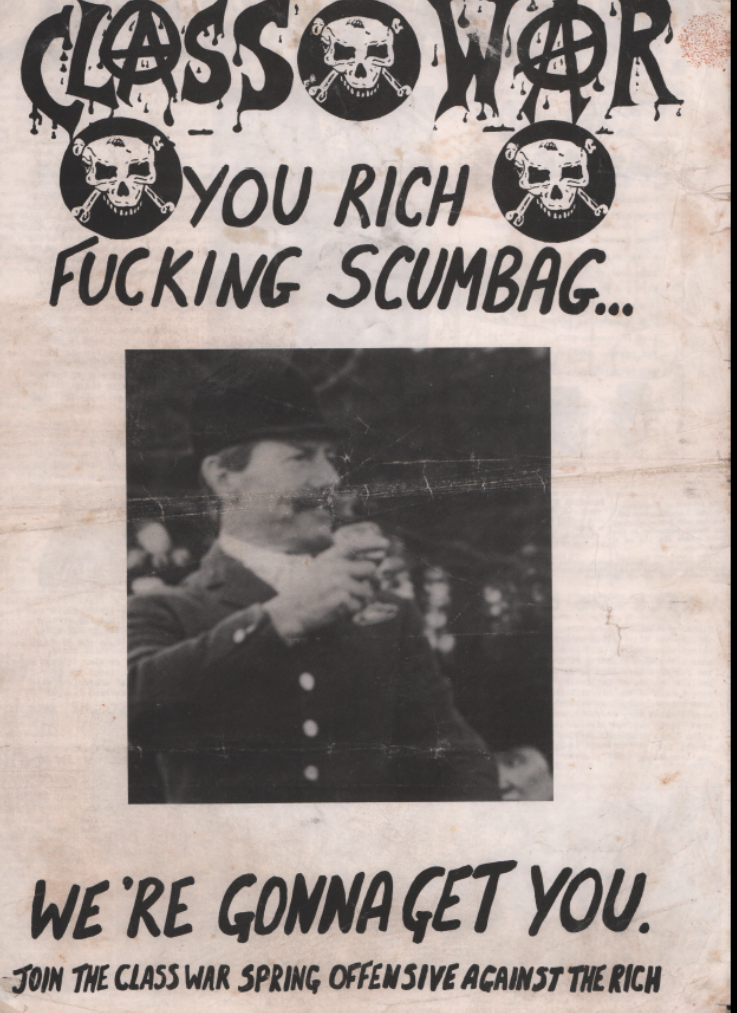
To Bone, this was symbolic of a broader problem on the left. Describing the aims of Class War over 30 years later in his book Bash the Rich, Bone described the need to put ‘class’ and ‘violence’ back on the anarchist agenda.
CWF was infiltrated by HN122 ‘Neil Richardson’ from April 1992 to September 1993. Richardson joined the east London ‘branch’ of CWF, but described spending a significant amount of time outside of London reporting on more active branches in Bristol and Leeds. Bristol CWF, in particular, gained prominence within the organisation because it was where the Class War newspaper was published in the 1990s.
Members of Class War were reported on by HN85 Roger Pearce (‘Roger Thorley’) through his infiltration of the Freedom Collective in 1983 and 1984. HN10 Robert Lambert ‘Bob Robinson’ and HN82 'Nicholas Green' also reported on members of Class War through their target groups.
Accusations that another SDS’ undercover infiltrated Class War were made in the opening statement on behalf of ‘Friends of Freedom Press’.
Described by Bone as ‘a punkoid fanzine mutated into a newspaper’, the Class War newspaper was written in a style that sent up the tabloid sensationalism of The Sun and inverted its right-wing politics.
Examples such as the 1990 front-page ‘Gotcha! – Poll Tax Flagship Sunk’ mimicked The Sun's cover after the sinking of the Argentine naval vessel General Belgrano, which started the Falklands War in 1982.
In 1984, British tabloid newspaper The Sunday People described Bone as ‘The most dangerous man in Britain.’ Class War was written to be accessible and funny, something that set it apart from other radical newspapers, while agitating its readers into action.
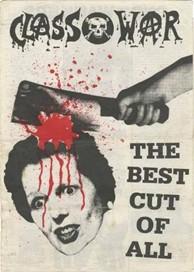
At its height, the paper was selling 10,000-20,000 copies on the streets. Its popular covers included The Best Cut of All, showing Thatcher’s bloody severed head, in response to public-sector austerity measures in 1985, Better Dead than Wed, marking the royal wedding of Andrew Mountbatten-Windsor (known as Prince Andrew at the time) in 1986 and The Working Class Strikes Back, showing a Black rioter holding a petrol bomb after the riots in Handsworth, Birmingham in 1985.
Early actions by supporters of Class War included staged disruptions of CND rallies and interventions in the 1983/1984 Stop the City (STC) protests alongside London Greenpeace and the London Workers Group against the financial sector, which aimed to bring the City of London to a halt.
The first STC event in September 1983 was largely peaceful, but ended with more than 200 arrests. This was derided in Class War (5) under the headline 'Wreck The City', in which Bone called for readers to ‘Join the Class War mob at Stop the City on 29 March. If you want peace, prepare for war.’ This second STC was far more destructive, and the next issue of Class War relished the overturned cars, attacks on the police and chaos in the financial district.
Another intervention by Class War, in 1984, sought to violently overwhelm the fences at Molesworth RAF base, where cruise missiles were stored. After this came the Bash the Rich (BTR) campaign, designed to disrupt wealthy areas and social events. Notable BTR events included mass interventions in Kensington in May 1984, in Hampstead in September 1984 and at the Henley Regatta in July 1985.
In June 1984, during the Miners’ Strike, supporters of Class War joined striking miners in Mansfield and on picket lines across the country, selling the paper to agitate miners into further action. One issue’s front cover showed the head of the National Coal Board being attacked by miners, statements inside predicting that the ‘battle of the picket lines will inevitably be transformed into a battle of the streets’.
In 1985, Metropolitan Police officers shot and seriously injured Brixton mother Cherry Groce in her own home. The shooting triggered protests and then rioting in Brixton and Class War supporters got involved in the disorder.
Far from having caused the riot, as the media described it, however, anarchist supporters had turned up late in the day. Ian Bone describes in Bash the Rich how Class War built barricades in Brixton’s streets and stood with locals against the police.
In London, Class War members had good relations with Red Action and the London group joined the first incarnation of Anti-Fascist Action (AFA) in 1985.
In 1986, the Class War Federation (CWF) formed, bringing together local Class War groups from around the country. These included class-struggle anarchists, council communists, situationists and autonomists.
CWF had an internal bulletin and a theoretical journal The Heavy Stuff, and branches produced broadsheet inserts with local news for Class War, along with stickers, posters and other material. Although its ‘official’ membership never exceeded a few hundred, CWF relied on the paper and its growing notoriety in the national media to spread its influence.
Efforts to agitate the union rank and file were repeated in 1986/1987 in the Wapping printers’ dispute, when CWF groups joined the strikers in mass pickets and took part in direct action against Rupert Murdoch’s News International.
This Class War cover story called for mass picketing, picketing of company distribution points, sabotage of plants and the distribution network and called on the rest of the Fleet Street media industry to start industrial action.
In 1988, CWF launched the Rock Against the Rich national tour featuring several bands and led by former Clash frontman Joe Strummer. It included a focus on ‘yuppies’: the CWF argued that the presence of wealthy people in working-class areas was driving rent increases, displacing local people and driving them into poverty.
In the late 1980s, Class War ran a campaign against gentrification in the Docklands area of east London and in several other cities, including Bristol and Southampton.
The CWF was prominent during the anti-Poll Tax campaign of 1989-1990. Press reports and some activist groups, notably Militant , claimed that CWF was among the main instigators of the Trafalgar Square anti-Poll Tax Riot on 31 March 1990. The defeat of the Poll Tax and Thatcher’s subsequent resignation represented the high-water mark for Class War.
During the early 1990s, CWF was involved in anti-election campaigns and, in 1994, protests against the Criminal Justice Bill, which aimed to curb raves and free parties.
The reorganised CWF was now a more conventional leftist political organisation, producing a journal called Smash Hits.
In 1997, the supposed final issue of Class War was published as a critical ‘letter to the revolutionary movement’ explaining why most of the CWF decided to dissolve.
Sources:
LibCom. Class War newspaper archive.
Ian Bone. Bash the Rich. True-life confessions of an anarchist in the UK.
Chris Bowkett. Unpublished conversation with a former Class War member.