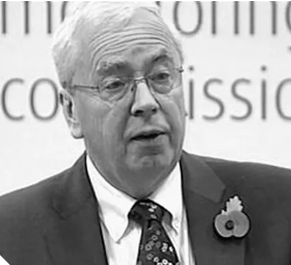
John Grieve CBE QPM is a retired Metropolitan Police officer whose career became closely associated with policing reform following the murder of Stephen Lawrence.
Although he played no part in the original 1993 murder investigation, he later became one of the Metropolitan Police's leading figures on race and intelligence. It is this role, rather than as the Metropolitan Police's first Director of Intelligence or Commander of the Anti-Terrorist Branch (SO13), that is relevant to the Inquiry. He was appointed Director of the Racial and Violent Crime Task Force on 3 August 1998, and kept that role until his retirement in April 2002.
His evidence to the Inquiry on 22 July 2026 was important, because it concerns the Metropolitan Police's handling of intelligence relating to the Lawrence family and campaign, the work of the Racial and Violent Crime Task Force, and the relationship between senior management and undercover policing.
As head of CID in the 1990s, he himself was embroiled in a different Covert Human Intelligence Source-related scandal, involving the use of violent criminals to provide information on drug-related crime. This included one 'source' committing rape whilst being paid as an informer.
Grieve's evidence to the Inquiry was overtly critical of all Special Demonstration Squad surveillance of Stephen Lawrence's family and justice groups.
Below is a summary profile. A full profile will follow later.
Grieve joined the Metropolitan Police in 1966, serving largely as a detective and intelligence officer. He later became the Metropolitan Police's first Director of Intelligence before being appointed Deputy Assistant Commissioner and head of the Racial and Violent Crime Task Force (C024) in 1998. The Task Force was established during the Macpherson Inquiry to improve the investigation of racist crime and rebuild confidence among Black communities following the failures exposed by the Stephen Lawrence case.
Grieve became known as one of the Metropolitan Police's more supposedly reform-minded senior officers. He publicly accepted many of the Macpherson Report's conclusions regarding institutional racism and argued that policing required significant cultural change. When he retired in 2002, Members of Parliament praised his contribution to tackling racist crime and improving police-community relations.
In 1973, as a police constable, he was involved in a racist police raid on an innocent Black couple's home. Despite finding no evidence of wrongdoing, the couple were held for 10 days without charge, only for a judge at the trial to direct the jury to find them not guilty. Grieve expressed regret for the raid in 2016 when confronted with the documents relating to it by a BBC journalist in 2016.
John Grieve's tenure as Commander of SO11 (Criminal Intelligence Division) coincided with two of the Metropolitan Police's most controversial criminal informant scandals.
These involved Eaton Green and Delroy 'Epsy' Denton. Although Grieve neither recruited nor personally handled either men, both cases exposed significant weaknesses in the management of high-risk covert human intelligence sources (CHIS) within the division for which he held overall responsibility.
Moreover, Grieve was an advocate of intelligence-led policing. Under his leadership, SO11 increasingly relied upon criminals as informants to penetrate London's organised firearms and drug networks, particularly the so-called 'Yardie' gangs. He argued that intelligence from serious offenders was often indispensable in combating organised crime. Critics, however, maintained that SO11 accepted excessive risks by permitting dangerous offenders to continue offending while supplying intelligence.
The first scandal concerned Eaton Green, a major cocaine trafficker who remained an SO11 informant while continuing to offend. In May 1993 he took part in an armed robbery at a Nottingham blues party attended by around 150 people, shooting one victim in the foot. The subsequent failure to disclose Green's informant status promptly to Nottinghamshire Police and prosecutors prompted allegations that the prosecution had been compromised. Grieve later defended Green's recruitment, controversially stating that he had been 'well worth the investment', despite acknowledging serious failings in the handling of the case.
The second involved Delroy 'Epsy' Denton, a violent gangster recruited as an SO11 informant in 1994 despite repeated warnings about his criminal background. While acting as a police source, he continued offending and, within a year, raped and murdered Marcia Lawes.
Following investigations by The Guardian and ITV's World in Action, Hampshire Chief Constable Sir John Hoddinott led a 20-month investigation on behalf of the Police Complaints Authority into the handling of both informants. His report concluded that many of the published criticisms were substantially correct, identifying serious weaknesses in the supervision of high-risk informants. Although neither Grieve nor other senior officers faced criminal proceedings, the investigation was highly critical of SO11's management arrangements and became one of the most significant reviews of police informant handling undertaken during the 1990s.
Despite this, Grieve defended the use of high-risk criminal informants despite acknowledging operational failures. While saying he 'deeply regretted' the handling of Eaton Green, he insisted that Green had been 'well worth the investment' and described the intelligence he supplied as 'mountains' of valuable information.
Grieve maintained that it was effectively impossible to combat serious organised crime without relying upon such informants, while later accepting only that SO11 had failed to provide Nottinghamshire Police with 'the right information in the right format at the right time.'
The subsequent reforms of informant-handling were reinforced by Part II of the Regulation of Investigatory Powers Act 2000 (RIPA), which for the first time placed the authorisation and management of covert human intelligence sources on a statutory footing through legislation and the accompanying Home Office Covert Human Intelligence Sources Code of Practice.
Although the violent nature of the crimes being investigated is obviously significantly different to those targeted by the SDS and NPOIU, the scandal surrounding the use of SO11 informants does have some commonalities with the spycops scandal, namely, the proportionality of using Covert Human Intelligence Sources as well as disclosure during legal proceedings.
Grieve's reputation was called into question by the publication of Mark Ellison QC's independent review in 2014. The review revealed that the Metropolitan Police had covertly recorded a meeting involving Duwayne Brooks, his legal representatives and detectives in 1999.
Grieve acknowledged authorising the recording, stating that it was intended to preserve an accurate record of Brooks' evidence because officers believed his account had altered over time. He later apologised for the distress caused.
The Ellison Review also raised wider questions about the Racial and Violent Crime Task Force's receipt and use of intelligence relating to the Lawrence campaign. Campaigners and researchers have argued that intelligence derived from undercover policing reached Grieve's command, blurring the distinction between investigating racist crime and monitoring a justice campaign.
Grieve's evidence to the Inquiry was overtly critical of all Special Demonstration Squad surveillance of Stephen Lawrence's family and justice groups.
This included those deemed legitimate targets by the Special Branch, such as the Movement for Justice (MfJ). He could not recall HN183 Richard Walton from the time, but thought his meeting with HN81 'Dave Hagan' regarding intelligence on MfJ - and by extension on the Lawrence family - was completely inappropriate and could not be justified.
He also spoke of the controversy and 'rage' from senior Metropolitan Police officers regarding the reality of 'institutional racism' he wrote with Julie French.
To be updated.