
Tariq Ali is a prominent socialist, anti-war campaigner, journalist, author, and broadcaster. Ali was a leading voice in the Vietnam Solidarity Campaign (VSC), which launched in 1966, and in the VSC Ad Hoc Committee, which planned and led massive UK anti-war protests in 1967 and 1968. He went on to become a leading figure in the International Marxist Group (IMG).
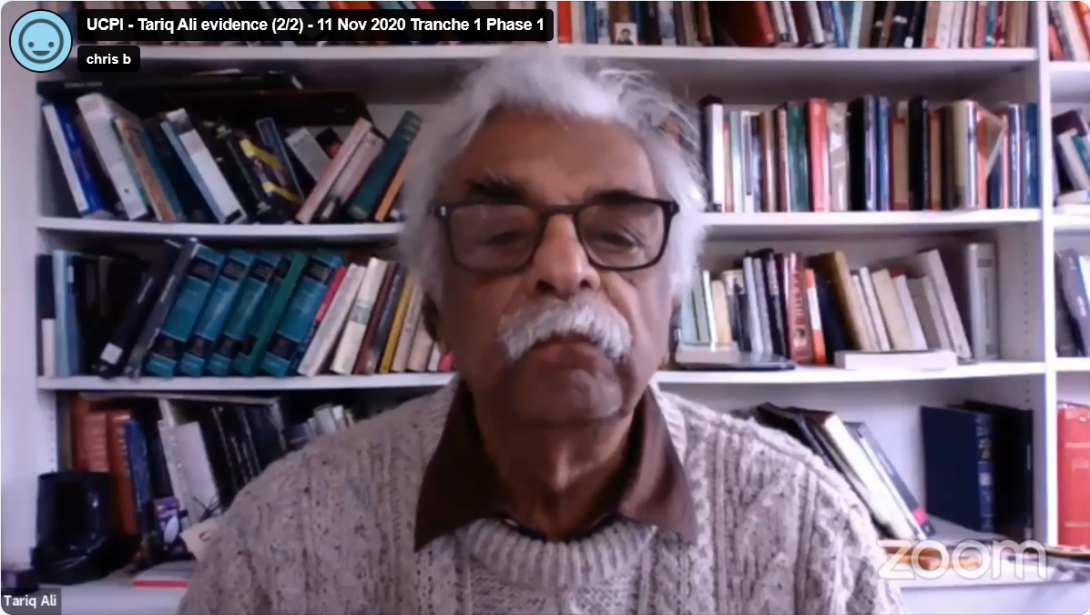
The Special Demonstration Squad was formed in July 1968 to gather intelligence on the VSC and other groups mobilising for the anti-Vietnam war demonstration in October 1968. As a prominent figure in these movements, Ali was among the earliest and most critical targets of the SDS.
That surveillance continued as Ali emerged in the 1970s as a prominent member of the International Marxist Group (IMG), through his career in the 1980s and 1990s as a writer and broadcaster, and into the early 2000s, when he co-founded the Stop the War coalition.
In his written statement, Ali noted that 14 undercover officers spied on him over five decades – he also said that the Inquiry had disclosed few of these officers’ real or cover names.
Tariq Ali was born in 1943 in Lahore, in colonial India, to a prominent Punjabi political family. A teenage anti-colonial activist, he moved to the UK to avoid arrest and to study politics, philosophy and economics at Oxford University.
Inquiry disclosure revealed that Special Branch opened a reference file on Ali in 1965, when he was president of Oxford Students’ Union, then active across many campaigns.
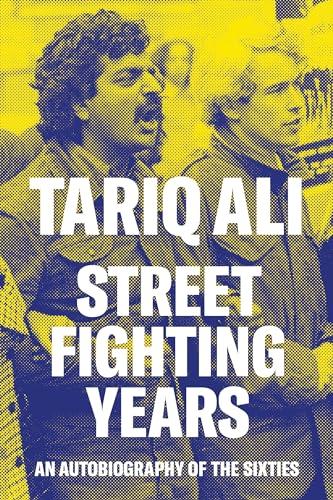
Ali came to see the Vietnam war as the most pressing issue of the time. In the mid-Sixties, he travelled to Vietnam, Prague, Laos, Bolivia and Palestine as a reporter and activist. In 1967, he returned to the UK and became a founding member of the Vietnam Solidarity Campaign (VSC).
By the early 1970s, Ali had joined the International Marxist Group (IMG) , an affiliate of the Trotskyist Fourth International. The IMG campaigned on national and anti-colonial issues, supporting left-wing and nationalist struggles in Ireland, Palestine and Chile. As editor of the New Left Review, Ali helped shape national and international debates about socialism and imperialism.
After Margaret Thatcher returned the Conservatives to power in 1979, Ali focused on writing and broadcasting, while pressing for nuclear disarmament, speaking out against Thatcherism, and campaigning against imperialism in the Global South.
In 2001, with the US/UK-led invasions of Afghanistan and Iraq, Ali became a founding member of the Stop the War coalition , speaking at large anti-war rallies. Ali, now in his eighties, remains a prominent speaker, writer and activist, a leading voice of the radical left.
All citations below are drawn from Ali's witness statement unless otherwise stated.
Ali has been spied on across five decades, from the 1960s through the early 2000s, by MI5, Special Branch, the SDS and, from 1999, the National Public Order Intelligence Unit (NPOIU). At least 14 SDS officers spied on Ali, personally and on the campaign groups he led. He assumes the security services continue to monitor him.
Special Branch opened a registry file on Ali in 1965, before he was organising protests. This suggests that it was Ali’s political views – not his threat to public order – that drew security services’ attention.
As a founder member of the Vietnam Solidarity Campaign (VSC) from 1966, Ali became a key target for police spies, undercover officers trailing him through private meetings and public events, noting his decisions and conduct, naming his friends and associates and quoting from his speeches.
That surveillance continued through the 1970s, 1980s, 1990s and into the 2000s.
HN329 ‘John Graham’ infiltrated the VSC, reporting on Ali and the people around him from public and private meetings. Graham reported on Ali everywhere, from public meetings to an intimate gathering of eight at the North London Red Circle. He made detailed notes on Ali’s comments, conduct and leadership style.
Disclosure to the Inquiry reveals that police reporting framed Ali as planning violent disorder – something Ali refutes. He told the Inquiry that his activism has always been public, political and non-violent.
Despite this, police targeting became physically intrusive. An unnamed undercover officer, trusted with keys to the VSC and International Marxist Group (IMG) offices, made copies for MI5 officers to let themselves in. MI5 searched the building, staging a ‘burglary’ to cover their tracks. Ali told the Inquiry:
That depth of intrusive state surveillance was something I had not expected.
Police spies gathered detailed personal information about Ali, his friends and associates. In 1980, Ali co-authored a guidebook, Trotsky for Beginners, with cartoonist Phil Evans, a member of the Socialist Worker Party. A police report noted Evans’ workplace and address, his girlfriend’s name, job and address, and the two owners of her home.
It included a photo of Evans and a list of file names and references. Ali told the Inquiry that he found the level of detail in this reporting ‘grotesque’.
Foundation of the SDS
The Special Demonstration Squad was formed in March 1968 to infiltrate the Vietnam Solidarity Campaign (VSC) and other groups associated with the mobilisation for the anti-Vietnam war demonstration in October 1968.
As a co-founder of the VSC in the 1960s, a leading player in the International Marxist Group (IMG) through the 1970s, and a left-wing writer and broadcaster through the early 2000s and beyond, Ali was an early target for the SDS and later for the National Public Order Intelligence Unit (NPOIU).
Ali called out multiple errors in police reports on him from the 1960s and 1970s, from inaccurate details to examples of SDS founder HN325 chief inspector Conrad Dixon overplaying the risk of disorder.
It was ‘entirely wrong’, Ali said, to conclude that:
the deployment of SDS officers into people’s private lives was justified based on occasionally lurid and inaccurate reports of threats of serious violence that never transpired.
Speaking of Dixon, Ali said:
He is the first head of SDS as I understand it, and had everything to gain by playing up the threat of violence. It gave him a new unit under his personal command and a budget of £500,000. His report is as dodgy a dossier as ever was.
In his written evidence, Ali noted that Dixon had:
a vested interest in over-estimating the threat of violence to give credence to the idea that his secret SB unit was valuable to the British State.
Catch-all surveillance and reporting
The sheer number of undercover officers who targeted Tariq Ali highlights the extent of SDS reporting on left-wing groups and how far it intruded on activists’ personal lives. Inquiry disclosures to Ali reveal that at least 14 undercover police officers spied and reported on him from 1967 to 2003 – but police disclosed none of these officers’ real names or even, in four cases, their cover names. The officers are listed in the details tab.
Southall Demo and the killing of Blair Peach
Left-wing groups and targeted communities mobilised against the far right. In April 1979, the NF called a public meeting at the town hall in Southall, a London neighbourhood with a large south Asian community. Anti-racists – local activists and the Anti-Nazi League (ANL) – organised a counter-protest.
On 24 April, approximately 5,000 ANL members and local people staged a counter-protest outside Southall Town Hall, where 25-40 NF members had gathered. Ali was at the counter-protest.
The Metropolitan Police had mobilised 2,500 officers, provoking violent clashes. One demonstrator, Blair Peach, was badly beaten by the Metropolitan Police’s Special Patrol Group and later died from his injuries. Ali challenged the Inquiry:
I would like to know why the Inquiry has not deemed it fit to disclose the full Special Branch report into the Southall demonstration [...] Was this made available to Commander Cass? Was it provided to the Coroner? Has it now been disclosed to [core participant and Blair Peach’s partner] Celia Stubbs and her legal team?
Ali was himself injured on the day, after police burst into a Southall home where he, Misty in Roots singer Clarence Baker and others had taken refuge from the violence. Police dragged them out onto the street and started ‘belting us with batons. It was like a baton charge. Hitting one on the head mainly’.
Ali was knocked unconscious. Baker spent several months in a coma due to his head injuries.
Impact of being targeted
Ali did not dwell on the personal, emotional costs of having had so many spycops monitor him for so many years. In fact, he could not recall any of the individual undercovers. Instead, he challenged the scale and breadth of SDS intrusion – and urged the Inquiry to press the police to disclose more evidence of this, to be held fully to account.
He wrote in his witness statement:
I am not at all surprised at the police having Special Branch officers in our meetings. But most of their reporting could have been done by routine SB officers. What I want to know about is these long-term deployments and the intrusive deployment into people’s private lives. As yet I have been given no detail of this. What did all these officers get up to after the meetings were over? Who did they befriend and sleep with? If there is a right to privacy, how far did they go in invading people’s private and family lives?
Tariq Ali put himself forward as a non-state core participant (NSCP – Inquiry parlance for spied-on person) – in 2018. He submitted his written statement to the Undercover Policing Inquiry in March 2020. He gave evidence at the hearings over two days in November that year, becoming the first non-state core participant to testify.
Counsel for Tariq Ali and fellow core participants, Piers Corbyn and Ernie Tate, submitted the joint opening statement of the three NSCPs in May 2022 and the closing statement in February 2023.