
‘Extremism’ is used within Special Branch to describe the activities of those it is targeting. It is often used alongside ‘militancy’, ‘subversion’ and ‘terrorism’, depending on context.
A precise definition is not given in the Special Branch Guidelines, and the word itself is somewhat circular - extremism is the politics of an extremist, whose activities or beliefs are considered extreme, i.e. what ‘most people’ would not think normal, reasonable or acceptable. This naturally creates a considerable latitude in how it is used within policing.
Within Special Demonstration Squad-related documents, it appears to be used to refer to anyone not relatively close to the centre of the political spectrum, usually those who had different perspectives on how democracy should be organised (or done away with). This covered a broad swathe of political beliefs and Special Branch applied it equally to them all, regardless of their propensity for or advocacy of violence: anyone seeking social change could find themselves characterised by it.
Initially, it was applied by Special Branch to the political left and right wings and Irish republicanism, often being used in the acronym XLW - Extreme Left Wing and XRW - Extreme Right Wing.
Extreme Left Wing covered a wide variety of political traditions, whether Trotskyist, Maoist, revolutionary Marxist/communist, socialist and/or anarchist. It also covered those groups willing to engage in civil disobedience or take direct action, such as the peace movement, anti-racist/ anti-Apartheid groups, or Black Power/liberation groups.
Later, animal rights activists were labelled as AREs - Animal Rights Extremists. This was further extended to cover environmentalists (though eco-terrorism is also used in this context).
Within the Metropolitan Police Special Branch, these groups were initially monitored by B Squad, changing to C Squad from 1969 onwards.
In the 2000s the term ‘Domestic Extremism’ was adopted, though without a clear definition, finding its way into the names of various units and positions.
Initially it was focused on animal rights, but was soon adopted to cover left and right wing and environmentalist activities alike.
In 2009, a working definition was reported to include individuals or groups:
that carry out criminal acts of direct action in furtherance of a campaign. These people and activities usually seek to prevent something from happening or to change legislation or domestic policy, but attempt to do so outside of the normal democratic process.
It came in for criticism because such a broad definition meant anyone in such a group could be considered an extremist even if they had no intention of committing any crime. It effectively treated many forms of lawful protest as criminal acts, thereby justifying surveillance of people and campaigns.
It has been replaced by 'Aggravated Activism'.
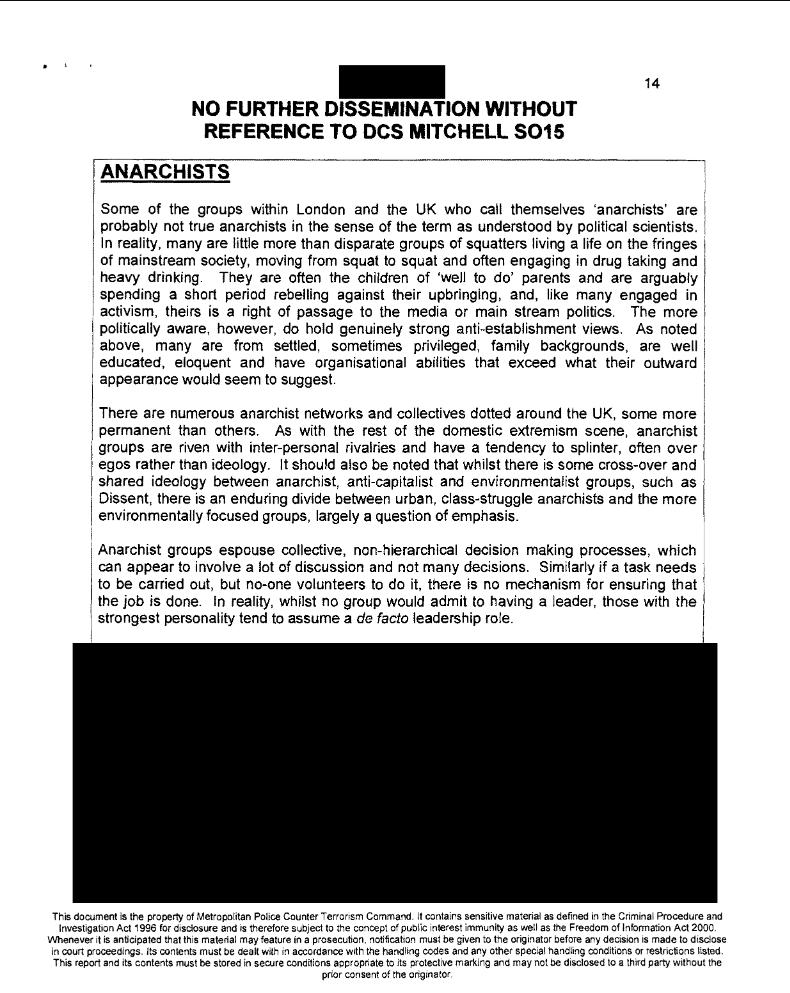
The principal body responsible for domestic extremism intelligence gathering was the National Public Order Intelligence Unit (NPOIU), established in 1999.
The NPOIU gathered intelligence on protest movements from police forces across the country and maintained databases on activists and campaigns. Intelligence was obtained through overt surveillance, police photography, informants, undercover officers and information supplied by regional police forces.
Alongside the NPOIU operated the:
- National Extremism Tactical Coordination Unit (NETCU)
- National Domestic Extremism Team (NDET)
- National Coordinator for Domestic Extremism
These organisations were coordinated through the Association of Chief Police Officers (ACPO), a private company that exercised significant influence over national policing policy despite lacking direct democratic accountability.
The NPOIU was responsible for gathering intelligence relating to 'public disorder connected to domestic extremism'.
One of the most visible manifestations of domestic extremism policing was the use of Forward Intelligence Teams (FIT teams).
FIT officers routinely attended demonstrations, photographing and filming activists, recording identities and gathering intelligence. Campaigners argued that the practice was intended not merely to collect information but also to discourage participation in protest.
Research found that protesters frequently experienced such surveillance as intrusive and stigmatising. Activists described being photographed at close range, monitored over long periods and treated as suspects despite engaging in lawful activity. Surveillance rendered protesters 'hyper-visible' and contributed to the construction of identities such as 'troublemaker' or 'extremist'.
In 2013, The Guardian revealed that police maintained records on almost 9,000 individuals on domestic extremism databases. The records included people who had never been arrested or convicted of any offence.
Aston notes that the database included activists 'seen on a regular basis' as well as people on the periphery of demonstrations and that inclusion did not depend upon criminal convictions.
The database also contained records relating to:
- Journalists covering protests.
- Elected politicians.
- Community campaigners.
- Environmental activists.
- Anti-racist campaigners.
One of the most prominent examples was Jenny Jones, later Baroness Jones of Moulsecoomb, who discovered she had been recorded as a domestic extremist after obtaining police records through a subject access request.
Activists and researchers have argued that domestic extremism should be understood as a policing construct rather than an objective category.
Aston argues that protest movements increasingly came to be viewed through frameworks of intelligence gathering, surveillance and risk management. She notes that activists frequently experienced surveillance practices as stigmatising and reported feeling that they were being categorised as 'extremists' despite engaging in lawful political activity.
The domestic extremism category attracted sustained criticism from campaign groups, lawyers, academics and civil liberties organisations.
Critics argued that:
* It had no legal definition.
* It blurred the distinction between protest and criminality.
* It enabled intelligence gathering against lawful political activity.
* It stigmatised campaigners by associating them with extremism.
* It lacked adequate transparency and accountability.
The Network for Police Monitoring (Netpol) conducted a long-running campaign challenging the use of the domestic extremism label.
In 2020, the National Police Chiefs' Council informed Netpol that police would cease using the term domestic extremism.